Ministry of Housing and Urban Affairs (MoHUA) launched operational guidelines of Urban Challenge Fund (UCF) | Current Affairs | Vision IAS

Upgrade to Premium Today

Start Now
MENU
Home
Quick Links

High-quality MCQs and Mains Answer Writing to sharpen skills and reinforce learning every day.

Watch explainer and thematic concept-building videos under initiatives like Deep Dive, Master Classes, etc., on important UPSC topics.

A short, intensive, and exam-focused programme, insights from the Economic Survey, Union Budget, and UPSC current affairs.

ESC

In Summary

  • Urban Challenge Fund (UCF): Centrally sponsored scheme with ₹1 lakh crore allocation to facilitate ₹4 lakh crore investment in urban infrastructure from FY 2025-26 to 2030-31.
  • UCF Funding & Focus: 25% project cost from fund, 50% from market, 25% from States/UTs/ULBs; focuses on city development, growth hubs, water, and sanitation.
  • Credit Repayment Guarantee Sub-Scheme (CRGSS): Provides central guarantee up to ₹7 crore or 70% of loan for Tier-II/III cities and NE/hilly regions to access market finance.

In Summary

Along with the guidelines for the UCF, the guidelines for the Credit Repayment Guarantee Sub-Scheme have also been launched.

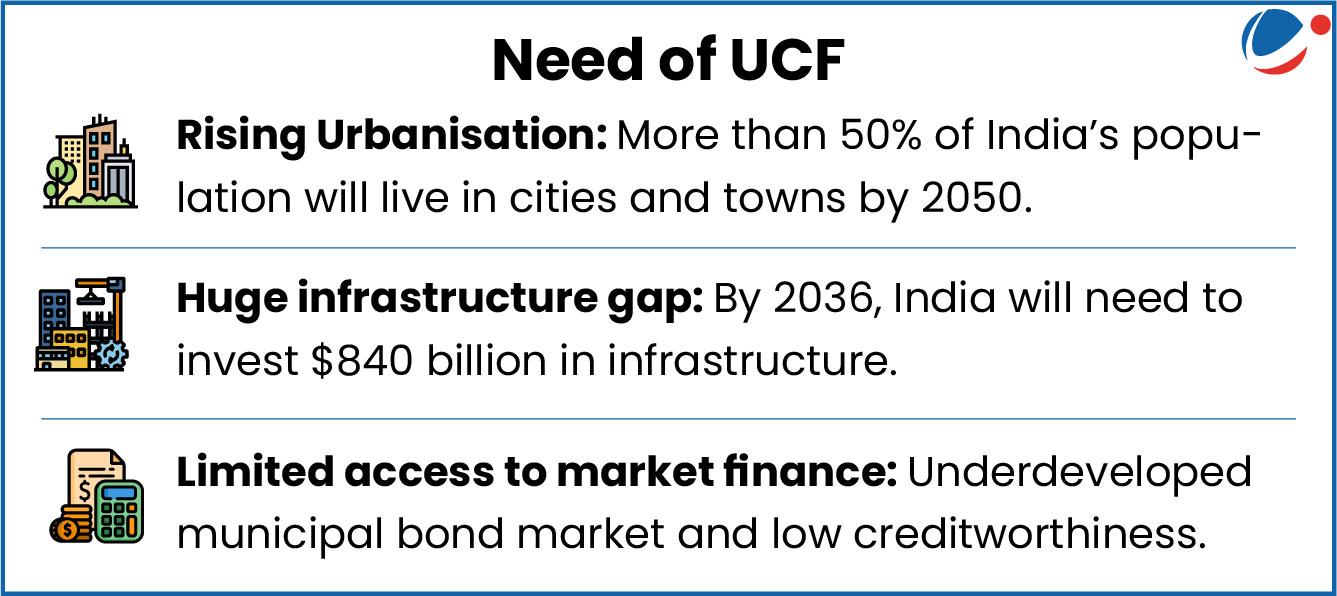
  • UCF will leverage market finance, private participation and citizen- centric reforms for delivery of high-quality urban infrastructure.

About Urban Challenge Fund 

  • Scheme Type: Centrally Sponsored Scheme 
  • Fund Allocation: 1 Lakh crore (this will facilitates a total investment of ₹4 lakh crore in next five years)
  • Funding pattern
    • 25% of the project cost will be provided through the fund.
    • At least 50% must be mobilised from market sources, ensuring private participation.
    • The remaining 25% can be contributed by States/UTs/ULBs or raised from the market.
  • Focus areas: Creative development of cities’, Cities as growth hubs’, and Water and sanitation’. 
  • Eligible Cities
    • All cities with a population of 10 lakh or more (2025 estimates); 
    • All State and Union Territory capitals not covered above; and
    • Major industrial cities with a population of 1 lakh or more.
  • Implementation period: FY 2025–26 to 2030–31 (with scope for extension)
  • Projects already funded under AMRUT 2.0/ SBM 2.0/ other CSS are not eligible under UCF.

Guiding Principles of UCF Implementation

  • Market-linked financing: Requires substantial funding from market sources, with limited central support to ensure fiscal discipline. 
  • Challenge-based selection: Projects chosen through a competitive process focusing on impact and reforms. 
  • Reform-linked disbursement: Funds released only when governance, financial and planning reforms are undertaken.  
  • Outcome-based approach: Funding tied to performance, milestones and measurable results. 

About Credit Repayment Guarantee Sub-Scheme(CRGSS)

  • It enables Urban Local Bodies (ULBs), especially smaller cities, to access market-based financing through credit guarantees
  • Target beneficiaries: Tier-II, Tier-III cities, and cities in North-Eastern and hilly regions
  • It will provide a Central guarantee of up to ₹7 crore or 70 per cent of the loan amount (whichever is lower) for first-time loans.
Watch Video News Today

Explore Related Content

Discover more articles, videos, and terms related to this topic

RELATED VIDEOS

1
Lateral Entry

Lateral Entry

YouTube HD

RELATED TERMS

3

Outcome-based approach

A project management philosophy where funding and support are directly tied to achieving measurable results and performance milestones, rather than simply allocating resources. This ensures accountability and focuses on impactful delivery.

Reform-linked disbursement

A funding mechanism where the release of funds is contingent upon the successful implementation of specified governance, financial, or planning reforms by the recipient entity. This incentivizes the adoption of better administrative practices.

Challenge-based selection

A project selection methodology where proposals are invited and then evaluated based on predefined criteria in a competitive process. Only the most promising or impactful projects, often those demonstrating innovation or significant reform, are chosen for funding.

Title is required. Maximum 500 characters.

Search Notes

Filter Notes

Loading your notes...
Searching your notes...
Loading more notes...
You've reached the end of your notes

No notes yet

Create your first note to get started.

No notes found

Try adjusting your search criteria or clear the search.

Saving...
Saved

Please select a subject.

Referenced Articles

linked

No references added yet