
AI Governance and Economic Group (AIGEG) constituted to Lead India’s National AI Governance Strategy | Current Affairs | Vision IAS

Upgrade to Premium Today

Start Now
MENU
Home
Quick Links

High-quality MCQs and Mains Answer Writing to sharpen skills and reinforce learning every day.

Watch explainer and thematic concept-building videos under initiatives like Deep Dive, Master Classes, etc., on important UPSC topics.

A short, intensive, and exam-focused programme, insights from the Economic Survey, Union Budget, and UPSC current affairs.

ESC

In Summary

  • The AIGEG, a 10-member inter-ministerial body chaired by the Minister of Electronics & IT, will coordinate India's AI governance policy.
  • It formalizes recommendations from AI Governance Guidelines and the Economic Survey, emphasizing a 'whole-of-government' approach.
  • India's AI strategy, guided by NITI Aayog's 'AI for All' vision, focuses on inclusive development and seven principles like trust and accountability.

In Summary

The AIGEG, constituted by the Ministry of Electronics and Information Technology (MeitY) formalizes recommendations from India’s AI Governance Guidelines and the Economic Survey. 

  • The Guidelines emphasized a "whole-of-government" approach to AI governance.
  • Economic Survey highlighted the need for a central authority to align AI deployment with India's unique labor market realities and social stability.
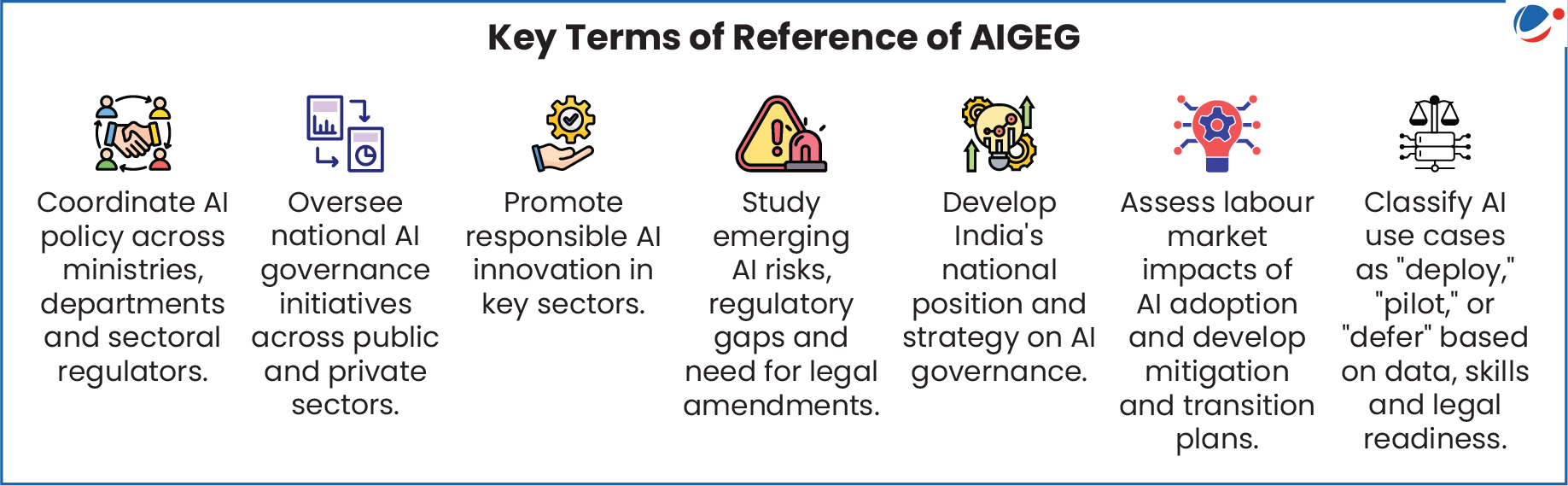
About AIGEG 

  • It is a high-level inter-ministerial body that will serve as India’s central institutional mechanism for AI governance policy development and coordination.
  • Composition (10-member body)
    • Chairperson: Minister of Electronics & IT
    • Vice-Chairperson: Minister of State for Electronics & IT
    • Other Members: Stakeholders across policy development, science and technology, security and economic affairs. E.g. Principal Scientific Advisor, Chief Economic Advisor (CEA), CEO (NITI Aayog) etc.
  • Expert Support: By a Technology and Policy Expert Committee (TPEC), which provides technical advice on global trends, emerging risks, and regulatory gaps.

India’s AI Governance Strategy

  • National Strategy for AI by NITI Aayog (2018):‘AI for All’ vision, focus on inclusive development and democratisation of the AI ecosystem through initiatives like IndiaAI Mission.
  • Seven Principles or Sutras:  Trust, people-centricity, responsible innovation, equity, accountability, understandability, and safety, resilience and sustainability.
  • Integration with Digital Public Infrastructure (DPI), building Institutional architecture like AI Governance Group etc.

Watch Video News Today

Explore Related Content

Discover more articles, videos, and terms related to this topic

RELATED VIDEOS

3
Harnessing the Power of Youth: Their Role in Nation Building and Driving Progress

Harnessing the Power of Youth: Their Role in Nation Building and Driving Progress

YouTube HD
Gender Equity in Public Service: Challenges and Institutional Reforms

Gender Equity in Public Service: Challenges and Institutional Reforms

YouTube HD
Freebies in India: Balancing Welfarism and Fiscal Prudence

Freebies in India: Balancing Welfarism and Fiscal Prudence

YouTube HD

RELATED TERMS

3

Technology and Policy Expert Committee (TPEC)

An expert body envisioned to consolidate knowledge and provide guidance on AI governance by bringing together professionals from law, policy, and AI safety disciplines.

Digital Public Infrastructure (DPI)

A set of shared digital systems, platforms, and standards that enable the delivery of essential services and foster innovation, often including digital identity, payments, and data exchange.

National Strategy for AI

Developed by NITI Aayog, this strategy outlines India's vision for AI, focusing on 'AI for All' to ensure inclusive development and democratization of AI. It emphasizes key principles and areas for AI adoption and research.

Title is required. Maximum 500 characters.

Search Notes

Filter Notes

Loading your notes...
Searching your notes...
Loading more notes...
You've reached the end of your notes

No notes yet

Create your first note to get started.

No notes found

Try adjusting your search criteria or clear the search.

Saving...
Saved

Please select a subject.

Referenced Articles

linked

No references added yet