
Unified Payments Interface (UPI) completes 10 Years | Current Affairs | Vision IAS

Upgrade to Premium Today

Start Now
MENU
Home
Quick Links

High-quality MCQs and Mains Answer Writing to sharpen skills and reinforce learning every day.

Watch explainer and thematic concept-building videos under initiatives like Deep Dive, Master Classes, etc., on important UPSC topics.

A short, intensive, and exam-focused programme, insights from the Economic Survey, Union Budget, and UPSC current affairs.

ESC

In Summary

  • UPI, launched in April 2016 by NPCI under RBI oversight, has become India's digital payments backbone.
  • UPI's annual transaction volume surged from 2 crore (FY17) to 24,162 crore (FY26), processing ~49% of global real-time payments in 2024.
  • NPCI, a "Not for Profit" entity under RBI and IBA, manages UPI and other key payment systems like RuPay and IMPS.

In Summary

Demonstrating extraordinary scale and momentum, UPI has emerged as backbone of India’s digital payments ecosystem. 

About UPI

  • Launched: April 2016 by National Payments Corporation of India (NPCI) under Regulatory Oversight of Reserve Bank of India (RBI). 
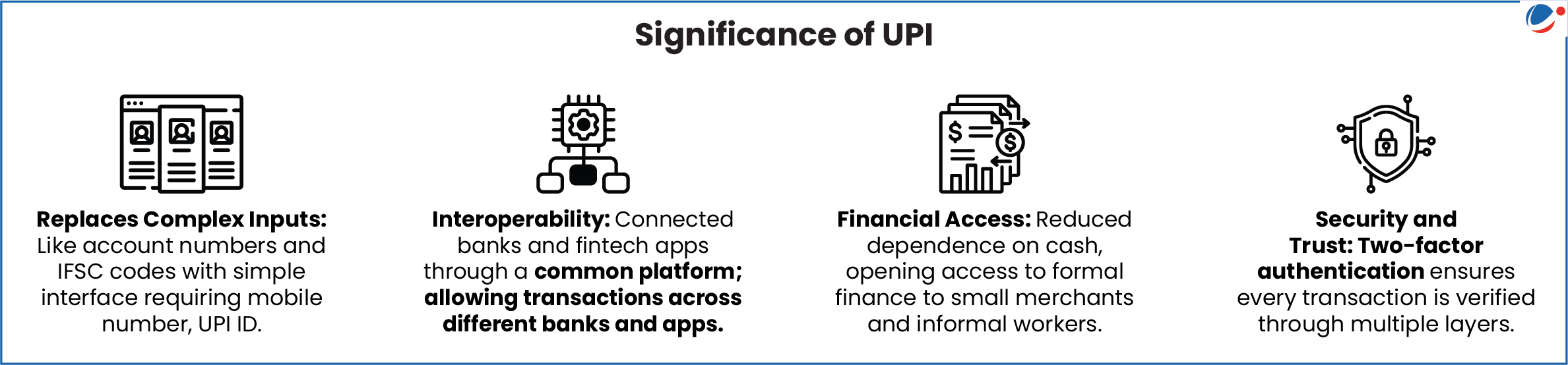
  • Meaning: System that powers multiple bank accounts into a single mobile application (of any participating bank), merging several banking features, seamless fund routing & merchant payments into one hood. 
Key Achievements of UPI

  • Annual Transaction Volume: From 2 crore in FY 2016-17 to 24,162 crore in FY 2025-26
    • In 2025, it processed approximately 22,000 crore transactions, with a daily average of about 60 crore transactions.
  • Banks Onboarded on UPI: Increased from 44 banks in FY 2016-17 to 703 banks by FY 2025-26 covering public sector, private, small finance, payments, cooperatives, etc. 
  • Global Reach: UPI accounts for nearly 49 % of world’s real-time payment transaction volume (2024), a feat recognized by IMF. 
    • Operationalised in Countries including UAE, Singapore, France, Bhutan, Nepal, Sri Lanka, Mauritius, Qatar. 

National Payments Corporation of India (NPCI)

  • About: Umbrella organisation for operating retail payments and settlement systems in India. 
  • Initiative of: Reserve Bank of India (RBI) and Indian Banks’ Association (IBA). 
  • Legal Framework: Payment and Settlement Systems Act, 2007. 
  • Nature: “Not for Profit” Company under Section 8 of Companies Act 2013. 
  • Key Products offered by NPCI: Immediate Payment Service (IMPS); National Automated Clearing House (NACH); Unified Payments Interface (UPI); RuPay; Aadhaar enabled Payment System (AePS); etc.
Watch Video News Today

Explore Related Content

Discover more articles, videos, and terms related to this topic

RELATED VIDEOS

3
Simplified: Unified Payments Interface (UPI): Transforming the Way Indians Transact

Simplified: Unified Payments Interface (UPI): Transforming the Way Indians Transact

YouTube HD
News Today (Aug 18-19-20, 2024)

News Today (Aug 18-19-20, 2024)

YouTube HD
News Today (May 30, 2025)

News Today (May 30, 2025)

YouTube HD

RELATED TERMS

3

Aadhaar enabled Payment System (AePS)

A payment system developed by NPCI that uses Aadhaar as a financial identity to enable bank account holders to use Aadhaar authentication for Aadhaar-enabled transactions.

RuPay

India's own card network, developed by the National Payments Corporation of India (NPCI). It provides a platform for domestic card transactions and is often used for government-sponsored financial inclusion schemes.

National Automated Clearing House (NACH)

A system developed by NPCI that facilitates bulk transactions like salaries, pensions, and interest credits, and also enables bill payments through ECS (Electronic Clearing Service).

Title is required. Maximum 500 characters.

Search Notes

Filter Notes

Loading your notes...
Searching your notes...
Loading more notes...
You've reached the end of your notes

No notes yet

Create your first note to get started.

No notes found

Try adjusting your search criteria or clear the search.

Saving...
Saved

Please select a subject.

Referenced Articles

linked

No references added yet
