
Approved List of Models and Manufacturers (ALMM) List II for Solar Cells Comes into Force | Current Affairs | Vision IAS

Upgrade to Premium Today

Start Now
MENU
Home
Quick Links

High-quality MCQs and Mains Answer Writing to sharpen skills and reinforce learning every day.

Watch explainer and thematic concept-building videos under initiatives like Deep Dive, Master Classes, etc., on important UPSC topics.

A short, intensive, and exam-focused programme, insights from the Economic Survey, Union Budget, and UPSC current affairs.

ESC

In Summary

  • MNRE will not extend ALMM List-II implementation beyond June 1, 2026, impacting solar module/cell sourcing.
  • ALMM aims to ensure quality, boost domestic manufacturing, and enhance self-reliance in solar energy.
  • Concerns include capacity mismatch, pressure on small manufacturers, market consolidation, and potentially higher project costs.

In Summary

The Ministry of New and Renewable Energy (MNRE) has decided not to grant a blanket extension to ALMM List-II implementation beyond 1 June 2026.
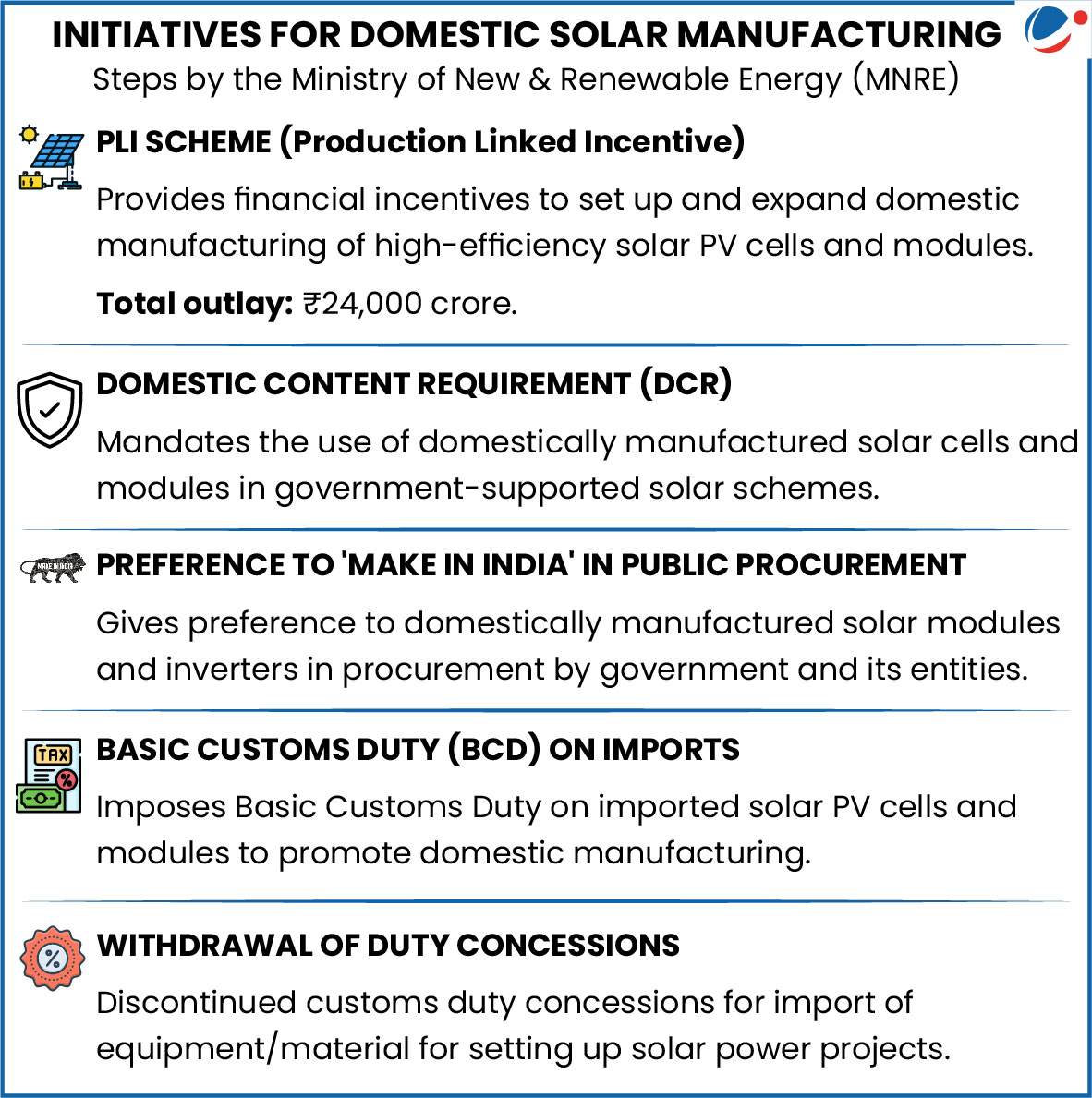
About ALMM

  • It is a list of models and manufacturers of solar photovoltaic (PV) modules approved by MNRE.
  • Introduced by the MNRE in 2019 to ensure quality, reliability, and domestic sourcing of solar PV modules.
  • Lists: Solar PV modules (List-I) and Solar PV cells (List-II).
  • Mandate: Only solar PV modules/cells included in the ALMM can be used in notified projects such as government projects, government-assisted projects, open access and net-metering projects.

Rationale and Significance

  • Policy Certainty: Provides a stable regulatory framework.
  • Domestic Manufacturing Boost: Supports development of an indigenous solar manufacturing ecosystem.
  • Supply Chain Self-Reliance: Enhances self-reliance and reduces import dependence in renewable energy supply chains.

Concerns

  • Capacity Mismatch: Significant gap between India's solar module capacity (~200 GW) and solar cell capacity (~30 GW).
  • Pressure on Small Manufacturers: Smaller, non-integrated manufacturers may face supply constraints and higher input costs.
  • Market Consolidation Risk: Increased dependence on large integrated players could reduce competition.
  • Higher Project Costs: Costlier domestic cells may raise overall solar project costs in the short term.

Watch Video News Today

Explore Related Content

Discover more articles, videos, and terms related to this topic

RELATED TERMS

3

Indigenous Solar Manufacturing Ecosystem

Refers to the domestic industrial infrastructure, supply chains, and capabilities developed within India for the production of solar energy components and systems.

Net-Metering Projects

A billing mechanism that allows consumers who generate their own electricity (e.g., from rooftop solar) to be credited for any electricity they export to the grid.

Open Access Projects

In the context of electricity, open access refers to the ability of consumers to purchase electricity from any generator or supplier, rather than being restricted to the local distribution utility. Open access projects allow for greater flexibility and choice in electricity procurement.

Title is required. Maximum 500 characters.

Search Notes

Filter Notes

Loading your notes...
Searching your notes...
Loading more notes...
You've reached the end of your notes

No notes yet

Create your first note to get started.

No notes found

Try adjusting your search criteria or clear the search.

Saving...
Saved

Please select a subject.

Referenced Articles

linked

No references added yet