


The Central Government has decided to constitute a High Level Committee to resolve water sharing problems between the three southern States- Telangana, Andhra Pradesh and Karnataka. E.g. Rajolibanda Diversion Scheme (RDS) across Tungabhadra River (tributary of Krishna river).
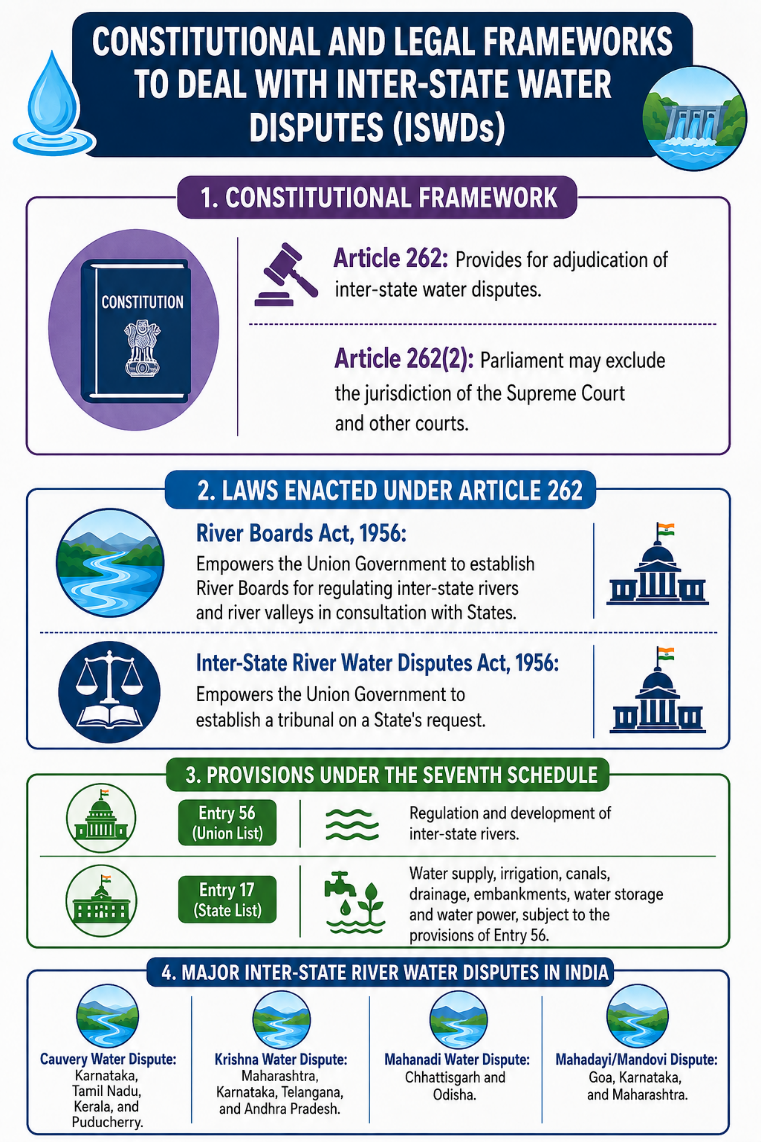
Factors responsible for the disputes
- Geographical: Upper riparian states enjoy greater access and control of river water.
- State Reorganisation: Post-independence state boundaries overlooked river basin-based distribution.
- Constitutional Ambiguity: Entry 56 (Union List) and Entry 17 (State List) create a regulatory overlap, impacting accountability for interstate river water.
- Rising Demand & Changing Water Use: Population growth, climate change, unsustainable agriculture, rapid urbanisation, industrial use.
- Others: Delays and lack of expertise in Tribunals; Lack of Reliable Data, Identity politicsetc.
Way Forward
- Cooperative Federalism: Promote regular inter-state dialogue, with the Union Government acting as a facilitator; establish a Forum for Dialogue on ISWDs under NITI Aayog.
- Policy Interventions: Bring ISWDs under the Inter-State Council (Article 263); amend the Inter-State River Water Disputes Act, 1956 to strengthen tribunal functioning.
- Integrated River Basin Management: Use technology like AI for river basin data, flow and water-use planning.
- Sustainable Water Use: Promote natural farming, precision agriculture, rainwater harvesting through initiatives like Catch the Rain.
- Stakeholder Engagement: Community participation and traditional water conservation practices. E.g. Taanka (Rajasthan).


