


The Union Minister highlighted that the future of national security will be shaped by the convergence of Artificial Intelligence (AI), Quantum Technologies, Biotechnology and Space capabilities.
Role of Technology in National Security
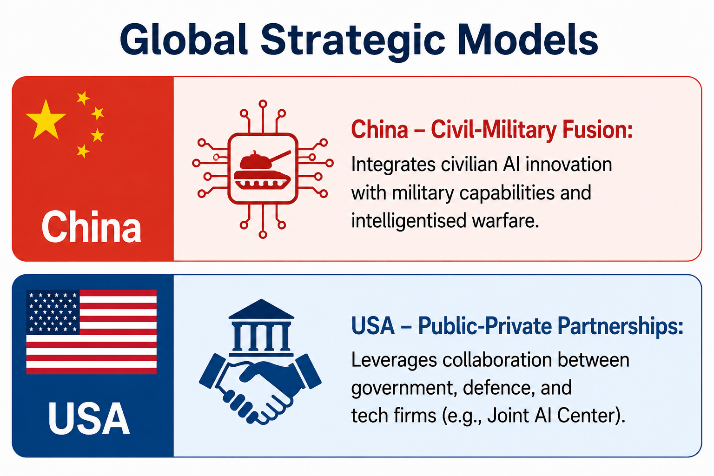
- Artificial Intelligence (AI): Enables faster decision-making, intelligent surveillance, predictive policing, autonomous weapons, and multi-sensor data integration; example-
- South Korea: Uses AI-powered patrol vehicles with voice recognition and real-time analytics.
- Cyber Technology: Strengthens secure military communications and network-centric warfare.
- For example, Indian Navy uses indigenous Software Defined Radios (SDRs) and the Naval Unified Domain (NUD) and Indian Air Force operates Air Force Network (AFNET).
- Quantum Technology: Provides quantum-secure communication, post-quantum cryptography, and advanced sensing (e.g., Indian Navy developing quantum sensors for deep-sea submarine detection).
- Biotechnology & Space: Enhances preparedness against biological threats, while space assets support surveillance, satellite communications, and precision operations.
Government Initiatives
- Institutional Framework: Established Defence AI Council (DAIC), Defence AI Project Agency (DAIPA), and Defence Cyber Agency (DCyA).
- R&D & Innovation: iDEX (Innovations for Defence Excellence), Technology Development Fund, and National Quantum Mission (2023).
- Internal Security: Crime and Criminal Tracking Network and Systems (CCTNS) and National Intelligence Grid (NATGRID).
- Service-Specific Tech Hubs: Army's AI Centre of Excellence & Quantum Lab (MCTE); Navy's AI & Big Data Lab (INS Valsura) and WESEE.




