


Instances of cloudbursts have been quite prominent in the mountainous region with past incidents witnessed in Kedar Nath (2013); Himachal Pradesh (2020); etc.
About Cloudbursts
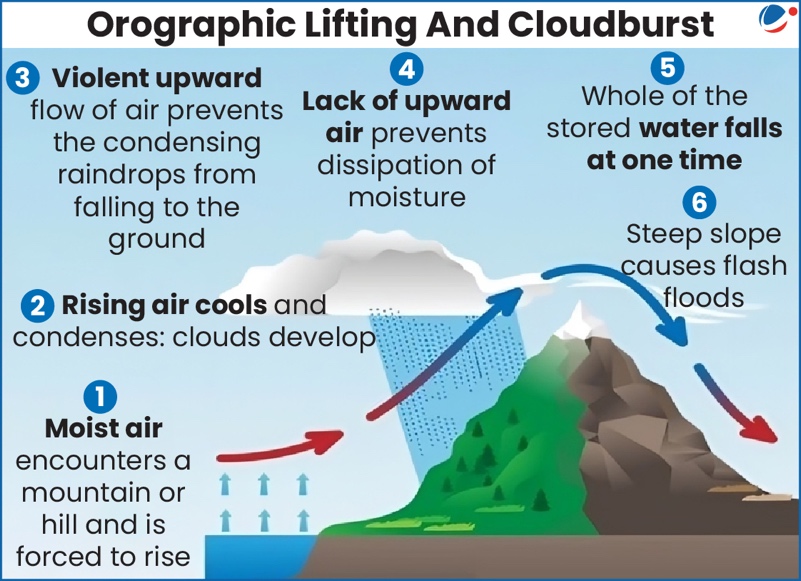
- Meaning: Extreme amount of precipitation in a short period of time, sometimes accompanied by hail and thunder, capable of creating flood conditions.
- IMD classifies an event as cloudbursts if rainfall of about 100 mm or above per hour is recorded over a place roughly less than 100 sq.km area.
- Occurrence: Result of highly localized convective precipitation, often triggered by orographic lifting.
- Occurs when moist air masses are forced upward by steep Himalayan terrain, cooling and condensing rapidly.
- Impact of Cloudbursts: Flash flood, inundation of low lying areas and landslides causing damages to life and property
- Flash floods are characterised by very fast rise and recession of flow of small volume and high discharge.
Way Forward: Cloudburst Disaster Risk Reduction (DRR) Strategy – National Disaster Management Plan (2019)
- Understanding Risk: Landslide Hazard Zonation (LHZ) using different kinds of spatial data (aerial photographs, satellite imagery) employing technological improvements in remote sensing.
- Inter-Agency Coordination: Among central and state agencies to ensure quick, clear, effective dissemination of warnings, information and data.
- Structural Measures: Integrated approach to slope stabilization combining bioengineering (plants, trees) and mechanical structures.
- Capacity Development: Provide guidance and technical support to SDRF, community, and volunteers.



