


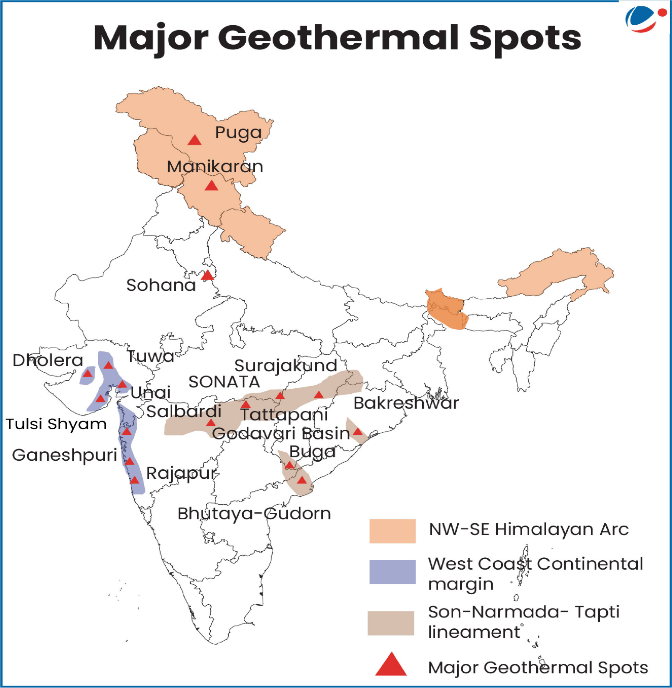
Lieutenant Governor of Ladakh commissioned the country's first and deepest (1,000 m) geothermal wells (Executed by ONGC) at Puga Valley.
- These two wells are critical to implementation of the 1 MW geothermal power project at Puga, which will be India’s first demonstration-scale geothermal power project.
About Geothermal Energy
- It harnesses heat stored within Earth's crust.
- The system consists of multiple components including production and reinjection (wells, pumps), transport (pipelines), distribution (heat exchangers) and end-use application.
- Sources
- High-enthalpy resources: Volcanic regions, geysers and hot springs primarily for electricity generation.
- Low- to medium-enthalpy resources: Like hot rocks and shallow ground layers, better suited for direct-use applications (e.g. heating and cooling, agri-food, aquaculture), etc.
- Potential In India
- 381 hot springs (identified by Geological Survey of India) with surface temperatures ranging from 35°C to 89°C.
- 10 geothermal provinces (identified) in India including Himalayan Geothermal Province; Cambay Graben; Aravalli etc.
- Benefits: Reliable and uninterrupted electricity generation, low carbon emissions, reducing dependence on fossil fuels, ideal for remote areas etc.
- Challenges: High initial investment, exploration risks, limited to certain regions, requires advanced technology, etc.
- Policy: MNRE formulated National Policy on Geothermal Energy 2025 for exploration and development of geothermal resources in India.

