
Cabinet approves BHAVYA Rasayan Scheme | Current Affairs | Vision IAS

Upgrade to Premium Today

Start Now
MENU
Home
Quick Links

High-quality MCQs and Mains Answer Writing to sharpen skills and reinforce learning every day.

Watch explainer and thematic concept-building videos under initiatives like Deep Dive, Master Classes, etc., on important UPSC topics.

A short, intensive, and exam-focused programme, insights from the Economic Survey, Union Budget, and UPSC current affairs.

ESC

In Summary

  • Union Cabinet approved BHAVYA Rasayan scheme to establish 3 dedicated Chemical Parks with Rs 3,030 crore outlay.
  • Scheme aims to enhance chemical industry competitiveness via world-class common infrastructure over FY 2026-27 to 2030-31.
  • India ranks 6th globally and 3rd in Asia in chemical production, contributing ~7% to GDP.

In Summary

The Union Cabinet approved the Bharat Audyogik Vikas Yojana Rasayan (BHAVYA Rasayan) scheme to establish three dedicated Chemical Parks across India.

  • It was announced in the Union Budget 2026–27.

About BHAVYA Rasayan Scheme 
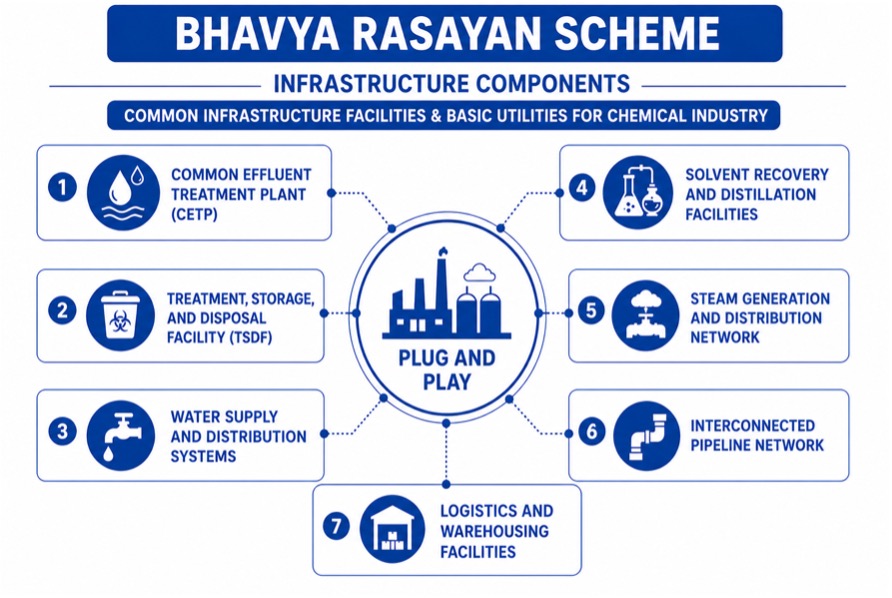
  •  Ministry: Ministry of Chemicals & Fertilizers 
  • Implementation Period: FY 2026–27 to FY 2030–31 (5 years). 
  • Objective: Develop three dedicated Chemical Parks with world-class common infrastructure to enhance the competitiveness of India's chemical industry. 
  • Financial Outlay: Rs 3,030 crore
    • Rs 3,000 crore for common infrastructure.
    • Rs 30 crore for administrative expenditure.
  • Central Assistance: Up to Rs 1,000 crore per Chemical Park, subject to a minimum Rs 500 crore contribution by the concerned State Government.
  • Selection Process: Challenge-based.
  • Land Requirement: Minimum 2,000 acres (8 sq. km.) of contiguous, encumbrance-free land per park.
  • Significance: Promote the development of the chemical industry across the entire value chain, including upstream, downstream and ancillary industries.
    • Improving resource efficiency
    • Reducing logistics costs.

Chemical Industry: At a Glance 

  • Contribution to GDP: ~7%
  • Share in Manufacturing GVA (FY24): 8.1% (Economic Survey 2025–26)
  • Global Rank: 6th largest chemical producer
  • Asia Rank: 3rd largest
  • Product Range: 80,000+ chemical products
  • Major Segments: Bulk chemicals, Specialty chemicals, Petrochemicals, Agrochemicals, Polymers, Fertilisers.
  • Key Consumer Industries: Agriculture, Pharmaceuticals, Textiles, Automobiles, Construction


Watch Video News Today

Explore Related Content

Discover more articles, videos, and terms related to this topic

RELATED VIDEOS

3
News Today (Mar 19, 2026)

News Today (Mar 19, 2026)

YouTube HD
News Today (Apr 19, 2026)

News Today (Apr 19, 2026)

YouTube HD
News Today (Apr 18, 2026)

News Today (Apr 18, 2026)

YouTube HD

RELATED TERMS

3

Upstream, Downstream, and Ancillary Industries

These terms describe the different stages of a value chain. 'Upstream industries' produce raw materials or intermediate goods used by other industries. 'Downstream industries' use intermediate goods to produce final products. 'Ancillary industries' provide supporting services or components to the main industries. The BHAVYA Rasayan scheme aims to promote development across all these segments within the chemical sector.

GVA

Gross Value Added. It is a measure of the value added to a product or service by the process of production. GVA at basic prices in a sector provides an indication of the performance of that sector.

Common Infrastructure

In the context of the BHAVYA Rasayan scheme, 'common infrastructure' refers to shared facilities and services provided within the dedicated Chemical Parks. This typically includes utilities, waste management systems, logistics support, safety infrastructure, and R&D facilities, which are crucial for enhancing the operational efficiency and competitiveness of chemical industries located within these parks.

Title is required. Maximum 500 characters.

Search Notes

Filter Notes

Loading your notes...
Searching your notes...
Loading more notes...
You've reached the end of your notes

No notes yet

Create your first note to get started.

No notes found

Try adjusting your search criteria or clear the search.

Saving...
Saved

Please select a subject.

Referenced Articles

linked

No references added yet