Parts of Assam and Gujarat hit by Flash Floods | Current Affairs | Vision IAS

Upgrade to Premium Today

Start Now
MENU
Home
Quick Links

High-quality MCQs and Mains Answer Writing to sharpen skills and reinforce learning every day.

Watch explainer and thematic concept-building videos under initiatives like Deep Dive, Master Classes, etc., on important UPSC topics.

A short, intensive, and exam-focused programme, insights from the Economic Survey, Union Budget, and UPSC current affairs.

ESC

In Summary

  • Flash floods are sudden floods with rapid water level changes, often occurring within six hours of intense rainfall.
  • Key drivers include meteorological events, hydrological factors, geomorphological characteristics, cryospheric changes, and anthropogenic activities like urbanization and deforestation.

In Summary

About Flash Floods

  • They are sudden floods characterized by a rapid rise and recession of water levels, usually developing within six hours of intense rainfall or other triggering events
  • Status in India
    • Occurrence: 75% of events occur during the Southwest Monsoon (June–September). 
    • Increased frequency: From 132 events (2020) to 184 events (2022). (Union Ministry of Jal Shakti)
    • Major flash flood hotspots: In the Himalayas, West Coast and Central India. 
      • Among river basins, the Brahmaputra records the highest number of events, followed by the Ganga and Krishna basins.

Major Drivers of Flash Floods 

  • Meteorological Drivers: Extreme rainfall, cloudbursts, monsoon depressions, cyclones and thunderstorms, sometimes driven by climate change.
  • Hydrological Drivers: Saturated soil, prolonged rainfall, high basin flashiness and impervious urban surfaces reduce infiltration and accelerate runoff. 
  • Geomorphological Drivers: Steep slopes, high relief, dense drainage networks and basin shape accelerate runoff. 
  • Cryospheric Drivers: Glacial Lake Outburst Floods (GLOFs), glacier melt and landslide dam failures trigger sudden floods in Himalayan river basins.
  • Anthropogenic Drivers: Floodplain encroachment, urbanisation, poor drainage, deforestation, reservoir releases and embankment breaches amplify flood risk.

Way Forward to Reduce Flash Flood Risk

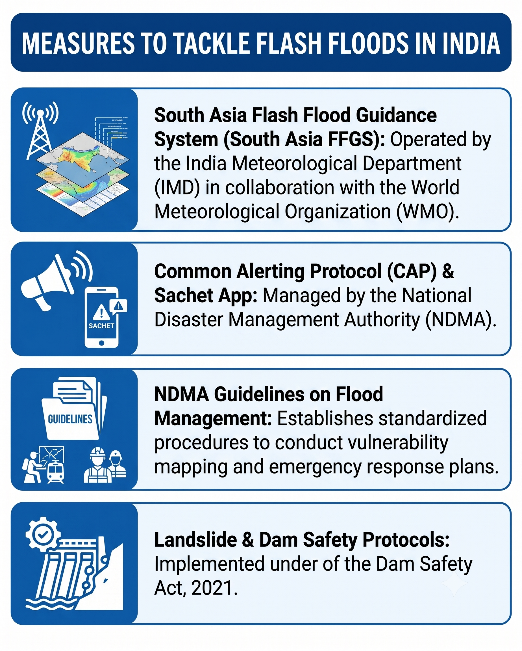
  • Strengthen early warning systems (Automatic Weather Stations (AWS), Doppler radars, satellite monitoring and real-time forecasting).
  • Prepare scientific hazard maps and identify vulnerable sub-basins.
  • Promote nature-based solutions such as wetland, forest and mangrove restoration.
  • Enforce floodplain zoning and climate-sensitive land-use planning.
  • Develop climate-resilient infrastructure and improve reservoir management.

Watch Video News Today

Explore Related Content

Discover more articles, videos, and terms related to this topic

RELATED TERMS

3

Climate-resilient infrastructure

Infrastructure designed and built to withstand the impacts of climate change, including extreme weather events like flash floods, ensuring continued functionality and safety.

Floodplain Zoning

A land-use planning and regulatory measure that restricts or prohibits development in areas prone to flooding to reduce risks and protect lives and property from flash floods.

Nature-based Solutions

Approaches that use natural ecosystems and processes to address societal challenges, such as using wetlands or forests for flood control or coastal protection, contributing to disaster resilience.

Title is required. Maximum 500 characters.

Search Notes

Filter Notes

Loading your notes...
Searching your notes...
Loading more notes...
You've reached the end of your notes

No notes yet

Create your first note to get started.

No notes found

Try adjusting your search criteria or clear the search.

Saving...
Saved

Please select a subject.

Referenced Articles

linked

No references added yet