


Why in the News?
Recently, the Ministry of Labour and Employment has joined the PM Gati Shakti portal to identify and bridge gaps in social security coverage which is in line with PM Gati Shakti's plan to cover social infrastructure.
More on News
The data available at the portal will be leveraged to cover workers engaged in industrial clusters and special economic zones (SEZs) so as to improve the social infrastructure in India.
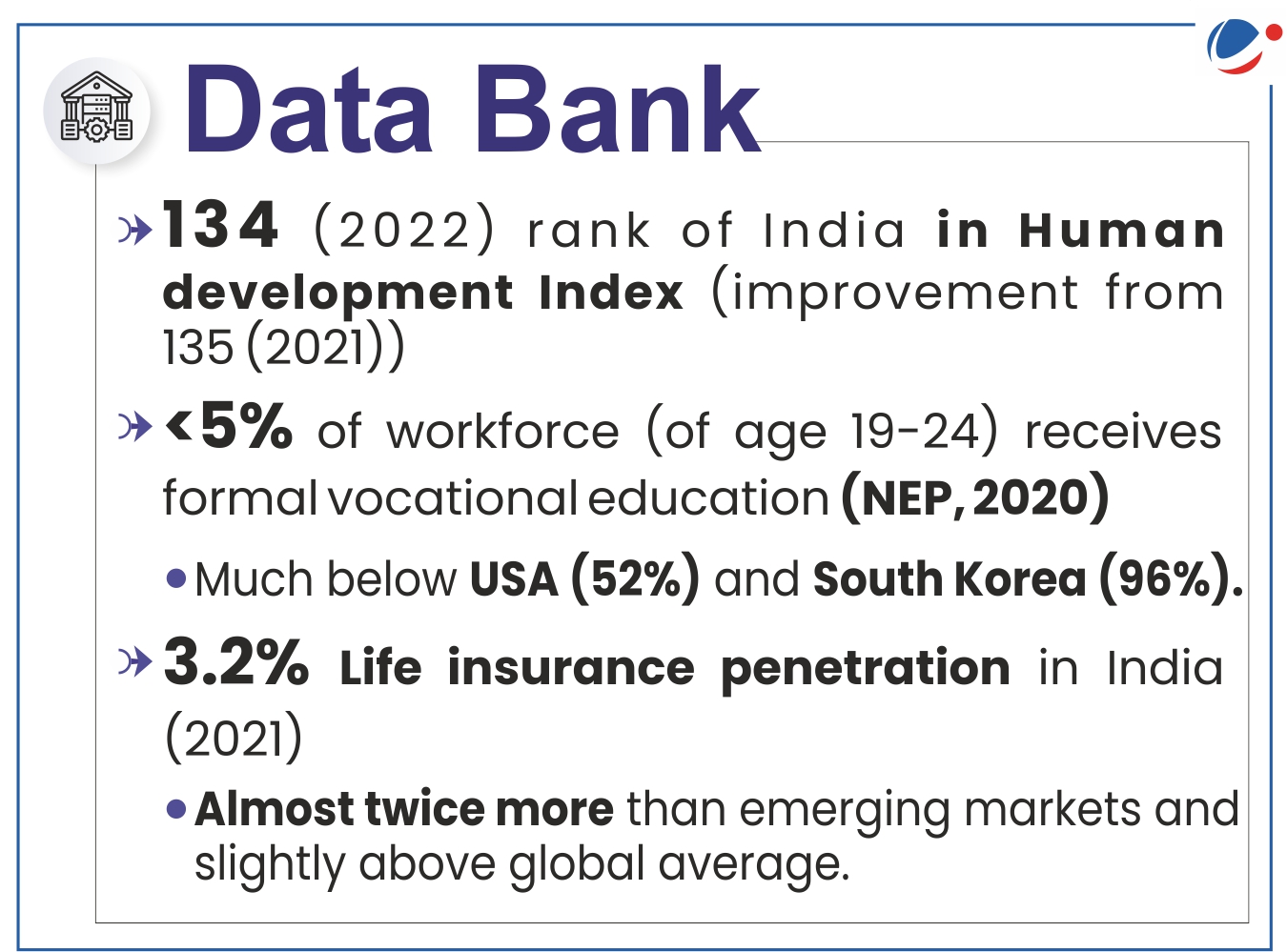
What is meant by Social Infrastructure?
- Social infrastructure includes assets which provides for social services such as education, health, washing and sanitation facilities, housing, etc.
- It is different from economic Infrastructure which helps in improving the productive capacity of the nation. E.g. energy, transportation and communication etc.
Significance of Social Infrastructure in India
- Promotes inclusive growth by reducing incidents of poverty and cases of inequality.
- Enhances human resource productivity by improving education and skill levels, thereby maximizing the chances of utilizing India's demographic dividend.
- Social security and labour welfare improves mobility, productivity and efficiency of labour.
- Encourages upward social mobility and enhances social well-being.
- Social mobility refers to change in a person's socio-economic situation, either in relation to their parents (inter-generational mobility) or throughout their lifetime (intra-generational mobility). (OECD)
- Improves quality of life of individuals by increasing their incomes and employment opportunities.
- Access to clean water and sanitation has direct benefits in reducing mortality and morbidity that increases the productive capacity of the poor.
- Helps in achievement of Sustainable Development Goals by adoption of eco-friendly practices such as reducing carbon footprints, promoting resilience to climate change.
- Reduces sense of alienation among citizens by creation of liveable and inclusive settlements where social and economic benefits also accrue to the marginalised groups such as poor, women, children, persons with disability etc.
Constitutional Provisions for Social Infrastructure in India
|
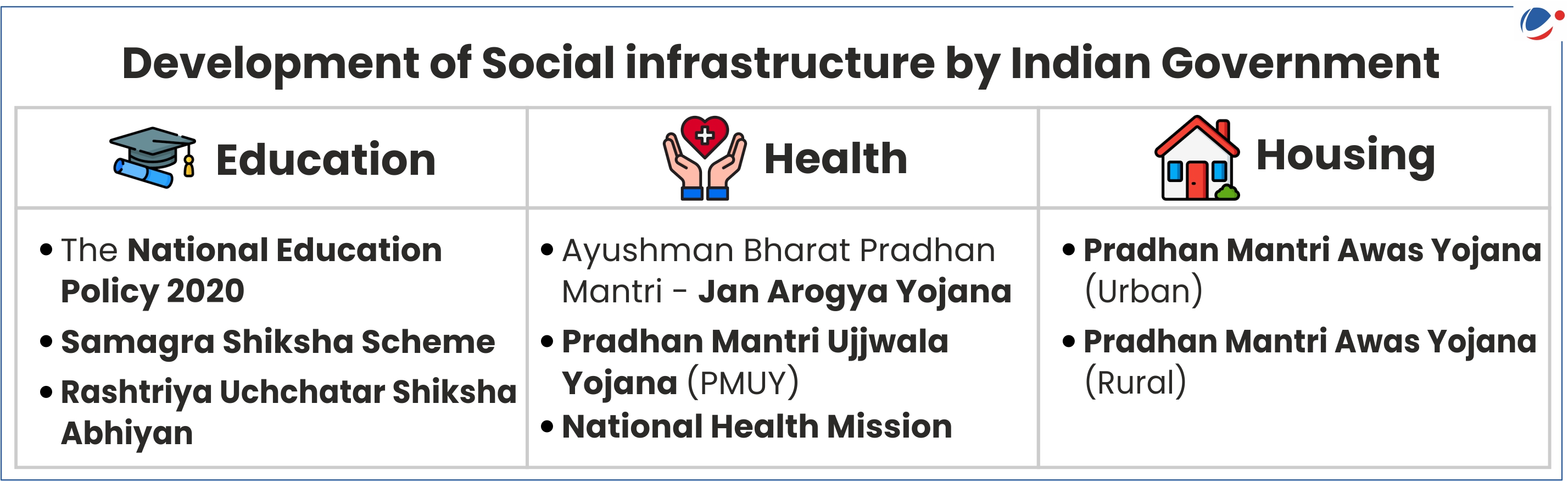
Challenges related to developing Social Infrastructure in India
- Inadequate public funding on key social sectors such as education and health leading to low learning outcomes.
- Low private sector participation due to low return on investments further complicates the problem.
- Lack of Human Resources: Such as absence of trained teachers, lack of high skilled health professionals, planning etc.
- Inequality in access: Due to affordability issues in marginalized communities, especially in lower-income groups.
- Low awareness among citizens about the importance of social infrastructure: E.g., the perception of the high costs of having a household toilet and the perceived convenience of open defecation keep the sanitation status low.
- Uneven distribution and regional disparities: E.g., the rural-urban disparity in the distribution of higher educational institutions and hospitals.
Way Forward
- Supplement public resources with Public-private partnerships (PPPs) to address financial gaps in social infrastructure by leveraging private sector technical expertise, experience and efficiency.
- Use of innovative initiatives such as Development Impact Bonds to finance development programs by attracting private investors.
- Securing the unsecured by ensuring universal coverage of life, accident, and pension insurance, will help in increased social security coverage.
- Increase public expenditure on healthcare and education to 2.5% and 6% of GDP in line with National Health Policy 2017 and National Education Policy 2020 respectively.
- Direct Benefit Transfer can be used as a tool to achieve desired outcomes related to the standard of living.



