Proportional Representation | Current Affairs | Vision IAS
MENU
Home

Periodically curated articles and updates on national and international developments relevant for UPSC Civil Services Examination.

Quick Links

High-quality MCQs and Mains Answer Writing to sharpen skills and reinforce learning every day.

Watch explainer and thematic concept-building videos under initiatives like Deep Dive, Master Classes, etc., on important UPSC topics.

ESC

Proportional Representation

27 Jul 2024
3 min

Why in the news?

Recently, experts in India have called to consider Proportional Representation (PR) for Lok Sabha and State Assembly elections instead First-Past-The-Post (FPTP) electoral system.

Difference between First-Past-The-Post (FPTP) and Proportional Representation


First-Past-The-Post (Simple majority system)

Proportional Representation

Geographical unit

  • Country is divided into small geographical units called constituencies or districts.
  • Large geographical areas are demarcated as constituencies; the entire country may be a single constituency.

Representation

  • Every constituency elects one representative.
  • More than one representative may be elected from one constituency

Voting Process

  • Voter votes for a candidate.
  • Voter votes for the party 

Seat Distribution

  • A party may get more seats than votes in the legislature.
  • The winning candidate may not secure the majority (50%+1) of votes.
  • Every party gets seats in the legislature in proportion to the percentage of votes it receives.

Examples

  • U.S., U.K., Canada, India (Lok Sabha and State Legislative Assemblies).
  • Israel, Netherlands.

Benefits

  • Simple to understand for common voters.
  • Facilitates the formation of a stable government.
  • Encourages voters from different social groups to come together to win an election in a locality.
  • Ensures representation of all parties based on their vote share.
  • Fairer treatment of minority parties and independent candidates.
  • Fewer votes are wasted as more people's preferences are taken into account.

Concerns

  • Over or under-representation of political parties compared to their vote share.
  • Does not ensure due representation for minorities (small groups).
  • Can lead to fragmented legislatures with multiple small parties.
  • May result in coalition governments which can be less stable in parliamentary democracy.
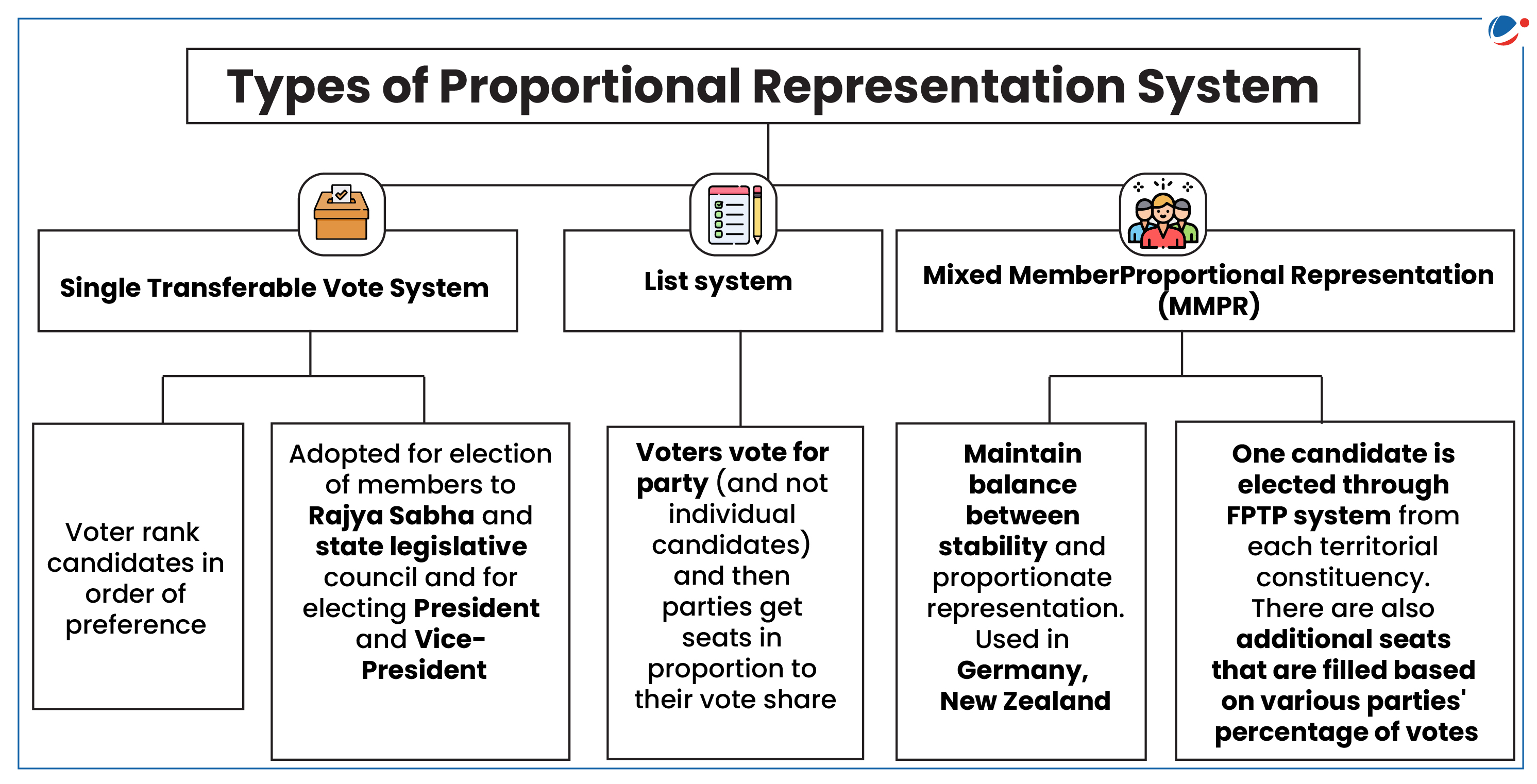
A flowchart titled

Reasons for not adopting PR system by Constitution

  • Difficulty for voters to understand the PR system due to its complexity.
  • Unsuitability to parliamentary government due to tendency of system to multiply political parties leading to instability in government.
  • Highly Expensive and does not give any scope for organising by-elections.
  • Eliminates intimate contacts between voters and representatives.
  • Increases the significance of party system and decreases that of voter.

Way ahead

  • Law commission Recommendation (170th report): Introduction of MMPR system on an experimental basis.  It had suggested that 25% of seats may be filled through a PR system by increasing strength of Lok Sabha.
    • Incorporating MMPR system for incremental seats or allocating at least 25% from each State/UT could alleviate apprehensions of smaller states (like Meghalaya) about FPTP system dominance by larger States.
  • Increasing number of seats based on 2026 Delimitation Exercise: Over past five decades, uneven population growth across regions complicates allocating Lok Sabha seats solely by population, potentially undermining federal principles and causing state disenchantment.

Explore Related Content

Discover more articles, videos, and terms related to this topic

RELATED VIDEOS

2
Simplified: One Nation One Election (Simultaneous Elections)

Simplified: One Nation One Election (Simultaneous Elections)

YouTube HD
Lateral Entry

Lateral Entry

YouTube HD
Title is required. Maximum 500 characters.

Search Notes

Filter Notes

Loading your notes...
Searching your notes...
Loading more notes...
You've reached the end of your notes

No notes yet

Create your first note to get started.

No notes found

Try adjusting your search criteria or clear the search.

Saving...
Saved

Please select a subject.

Referenced Articles

linked

No references added yet

Subscribe for Premium Features