


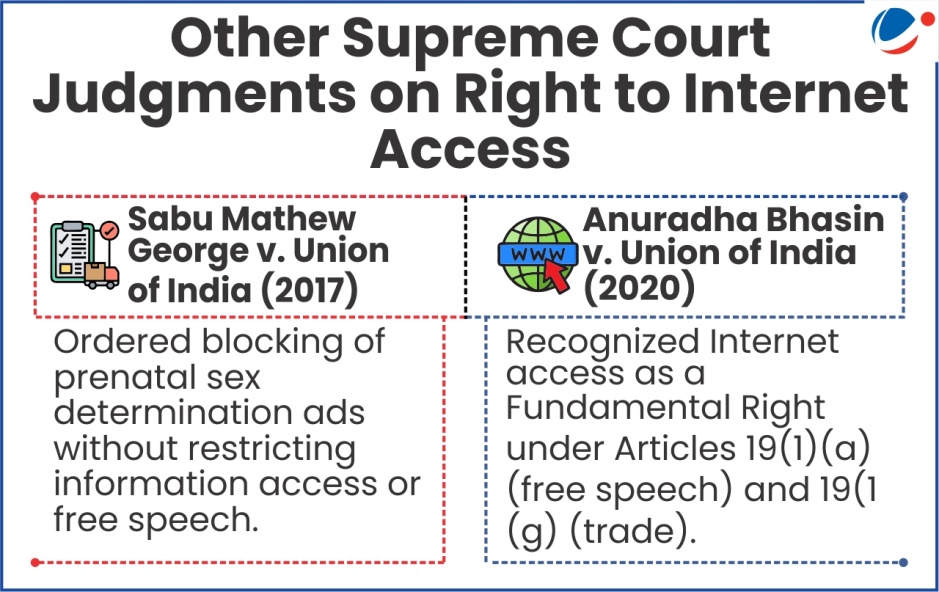
Recently, Supreme Court in Amar Jain V Union of India and Ors. judgment held that inclusive and meaningful digital access to e-governance and welfare delivery systems is a part of the fundamental right to life and liberty.
Key Highlights of Judgment
- Directed to revise the digital Know-Your-Customer (KYC) norms: To enable persons with facial disfiguration due to acid attacks or visual impairment to access banking and e-governance services.
- Under the Rights of Persons with Disabilities Act, 2016, the Court issued twenty directions to make the eKYC process accessible to them.
- Invoking the ‘principle of substantive equality’: Digital transformation must be both inclusive and equitable.
- Part of Article 21: Right to digital access emerges as an instinctive component of the right to life and liberty.
- State's obligation: Under Articles 21 [Right to a dignified life], 14 [Right to Equality], 15 [Right against discrimination], and 38 [directs the State to promote Social Justice] of the Constitution, state is obliged to ensure digital infrastructure to all vulnerable marginalized populations.
Significance of inclusive digital access: Access essential governmental schemes, reducing rural-urban divide, access to online learning platforms, and financial technologies, inclusion of marginalised in development process, etc.
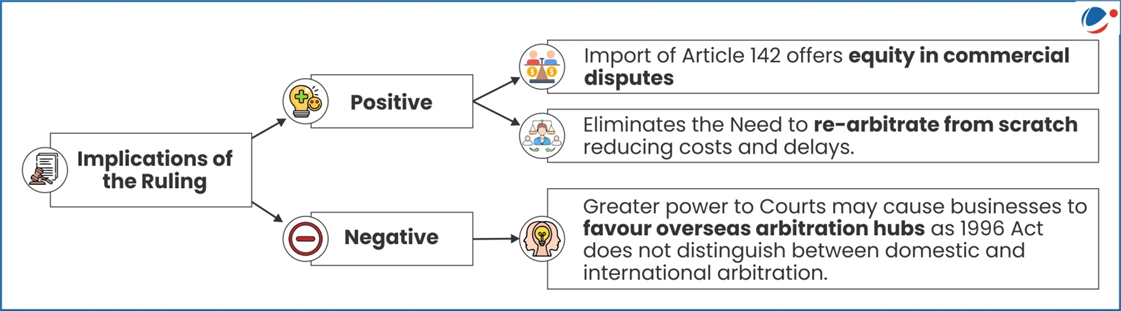
Supreme Court recently held that courts have limited powers to modify arbitral awards.
SC in the Gayatri Balasamy v. ISG Novasoft Technologies Limited, held that the power to modify awards can be exercised under Section 34 or 37 of the Arbitration and Conciliation Act, 1996 under the following circumstances:
- When the award is severable by separating the invalid portion from the valid portion.
- SC cited the doctrine of omne majus continet in se minus (the greater power includes the lesser), i.e. the power to set aside an arbitral award necessarily includes the power to set it aside in part.
- Correct any clerical, computation or typographical errors.
- Modify post-award interest in some circumstances.
- Under Article 142 (enabling Courts to do complete justice) of the Constitution provided this power should be in consonance with the fundamental principles of the 1996 Act.
Arbitration in India
- Meaning: It is a form of Alternative Dispute Resolution mechanisms (others being conciliation and mediation) involving consensual method of resolving disputes outside of a national judicial system through a private system of adjudication.
- Significance: Less adversarial, Flexible, Quicker, etc.
- Legal Framework: The Arbitration and Conciliation Act, 1996 modelled as per the United Nations Commission on International Trade Law (UNCITRAL) Model Law on International Commercial Arbitration, 1985.
- Section 34(1) of the Act stipulates ‘recourse’ to a court only by an application for setting aside the award.
- Section 37 states instances where an appeal may lie against orders.
Article Sources
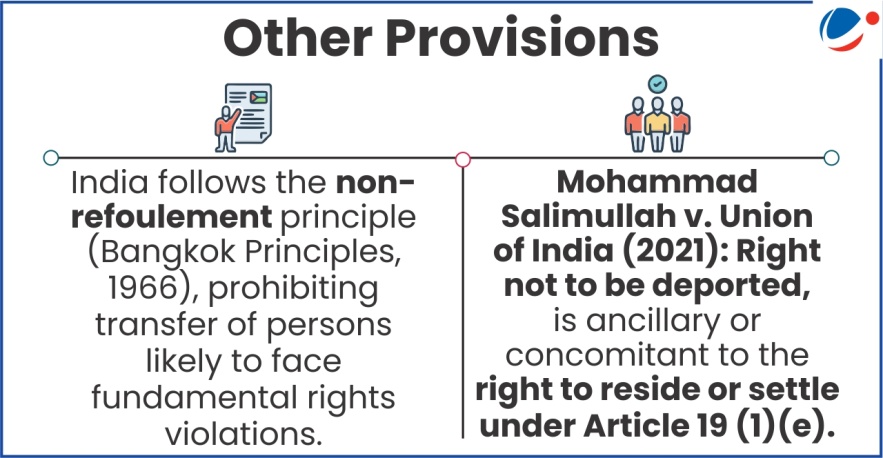
1 sourceThe Supreme Court (SC), while hearing petitions related to deportation and living conditions of Rohingya refugees, highlighted that they cannot claim reliefs based on the UNHCR cards.
- UNHCR (UN High Commissioner for Refugees) is a global organization to protect refugees, forcibly displaced communities, and stateless people.
- India is not a signatory to the 1951 Convention on Refugees and its 1967 Protocol.
Statutory Provisions in India related to Refugees and Deportation
- India does not have a separate law to deal with ‘refugees’. Thus, case for refugee ‘status’ are considered on a case-by-case basis based on the policy of bilateralism.
- Refugees come under the definition of ‘alien’ and ‘foreigners’.
- Foreigners Act, 1946: Section 3 of the Foreigners Act vest the Central Government with powers to detain and deport foreign nationals staying illegally in the country.
- Passport (Entry into India) Act, 1920: Centre may direct the removal of any foreigner from India who enters India without passport & visa.
- According to Articles 258(1) and 239(1) of the Constitution, States/UTs are also entrusted with these powers.
The Supreme Court (SC) passed an order affirming the constitutional rights of pedestrians.
About the SC Order
- SC stated that the Right to have unobstructed and disabled-friendly footpaths is guaranteed under Article 21.
- Article 21 (Protection of life and personal liberty) states that no person shall be deprived of their life except according to the procedure established by law.
- The SC issued directions:
- All public roads must have footpaths and must be accessible and usable by persons with disabilities.
- Removal of encroachments from footpaths is mandatory.
- States/UTs must evolve policies to ensure the availability and maintenance of footpaths and footways.
About Sikkim Statehood
- Sikkim was made a full-fledged State of the Union of India under the Constitution (36th Amendment) Act, 1975.
- Earlier, Constitution (35th Amendment) Act, 1974 granted Sikkim the status of an "Associate State" of the Union of India under Article 2A.
- Article 2A was repealed by the Constitution (36th Amendment) Act, 1975.
- Earlier, Constitution (35th Amendment) Act, 1974 granted Sikkim the status of an "Associate State" of the Union of India under Article 2A.
- It became 22nd State of India.
- Article 371F grants certain special provisions to the state of Sikkim.




