


At the Tech Leaders Roundtable in Mexico, Minister while emphasizing on need for responsible capitalism said that for large economies, the challenge is not just to grow but also to reduce inequality and create opportunities for everyone.
What is meant by Responsible Capitalism?
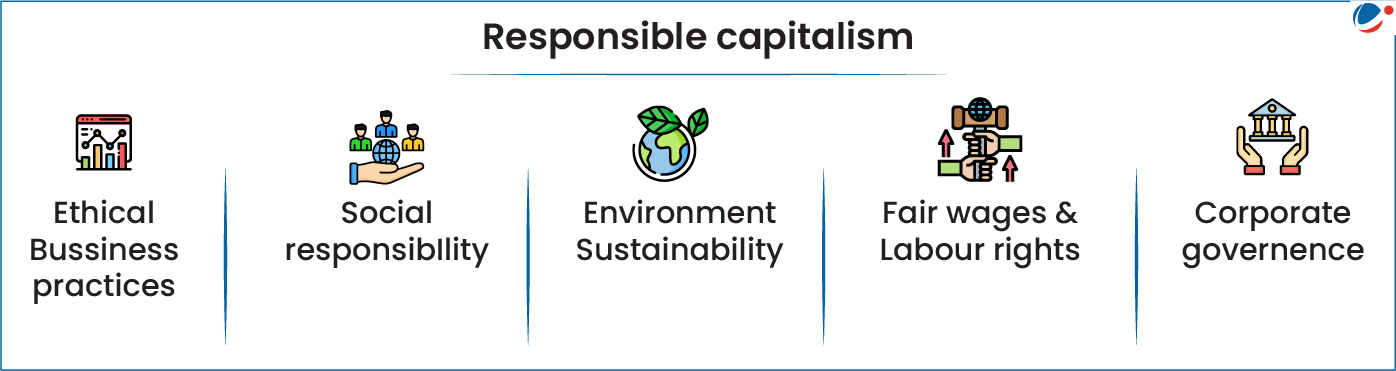
- It can be understood as an economic approach that integrates ethical values into business practices.
- It emphasizes balancing profit with social responsibility, ensuring businesses contribute to societal well-being, fairness, and environmental sustainability, rather than focusing solely on shareholder returns.
What’s the need for Responsible Capitalism?
- Addressing global challenges: It can help companies and governments respond to challenges like sustainability, inequality, and exclusion.
- Long-term business sustainability: Purely profit-driven models may not be viable in long-term; responsible capitalism can also help in better adaptation to tech-disruptions like AI, etc.
- Ethical Governance and Stakeholder Capitalism: Promotes fairness in decision-making, ensuring stakeholders are treated justly and business operations comply with legal and moral standards.
Measures taken to promote Responsible Capitalism in India
- Corporate Social Responsibility (CSR): Mandated under section 135 of Companies Act, 2013.
- Environmental regulations: Plastic Waste Management Rules, stricter emission norms for vehicles under BS-VI, etc.
- Labor reforms: Code on Wages, Occupational Safety; Health and Working Conditions Code, 2020, etc.
- Financial sector initiative: RBI’s Priority Sector Lending norms, SEBI’s Green Bond guidelines, etc.


