
Madras High Court, becomes first to recognise Cryptocurrency as Property | Current Affairs | Vision IAS
MENU
Home

Periodically curated articles and updates on national and international developments relevant for UPSC Civil Services Examination.

Quick Links

High-quality MCQs and Mains Answer Writing to sharpen skills and reinforce learning every day.

Watch explainer and thematic concept-building videos under initiatives like Deep Dive, Master Classes, etc., on important UPSC topics.

ESC

In Summary

Madras High Court uniquely recognizes cryptocurrency as property, affirms its legal status, and protects investors, marking a landmark step in India's digital asset legal framework.

In Summary

In Rhutikumari v. Zanmai Labs Pvt. Ltd, the Court granted protection to an investor whose digital assets were frozen on a crypto exchange after a massive cyberattack. 

  • In 2020, New Zealand High Court too held crypto currencies, as digital assets and a form of property capable of being held on trust. 

Key Highlights of the Ruling

What is Cryptocurrency?

  • It is a medium of exchange, created and stored electronically on the blockchain, using cryptographic techniques and algorithms. E.g., Bitcoin. 
  • It has no intrinsic value or physical form and is not regulated by the Central Banks. 
  • Nature of Cryptocurrency: The court held that it is not a tangible property nor is it a currency. Rather, it is a property, which is capable of being enjoyed, possessed and being held in trust.
    • The Court reaffirmed previous SC rulings on the principles of property and held them to apply equally to cryptocurrencies.
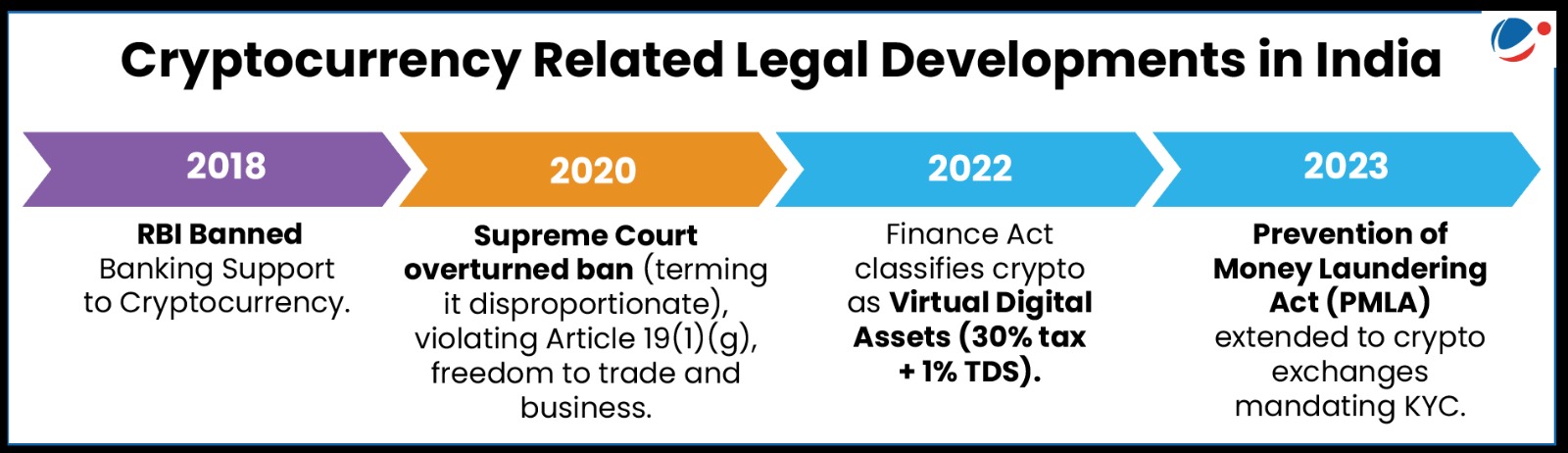
  • Legal Clarification: The court held that under Indian law, cryptocurrency is classified as a Virtual Digital Asset (VDA) and it is not treated as a speculative transaction under Income Tax Act, 1961.
  • Clarification on the RBI Ban (2018): The Court held that RBI had not banned virtual currencies as such; it had only prohibited banks from facilitating their trade. 

Significance of the Ruling

  • Addresses the Regulatory Grey Zone: The ruling marks a landmark judicial acknowledgment of digital assets as legally ownable property. 
  • Protects Investors: It could allow investors to seek traditional property remedies like bank guarantees rather than relying on exchange-driven loss-sharing schemes. 
Watch Video News Today

Explore Related Content

Discover more articles, videos, and terms related to this topic

RELATED VIDEOS

1
Lateral Entry

Lateral Entry

YouTube HD
Title is required. Maximum 500 characters.

Search Notes

Filter Notes

Loading your notes...
Searching your notes...
Loading more notes...
You've reached the end of your notes

No notes yet

Create your first note to get started.

No notes found

Try adjusting your search criteria or clear the search.

Saving...
Saved

Please select a subject.

Referenced Articles

linked

No references added yet
