
Swami Vivekananda's Visionary Legacy remembered on his Birth Anniversary | Current Affairs | Vision IAS
MENU
Home

Periodically curated articles and updates on national and international developments relevant for UPSC Civil Services Examination.

Quick Links

High-quality MCQs and Mains Answer Writing to sharpen skills and reinforce learning every day.

Watch explainer and thematic concept-building videos under initiatives like Deep Dive, Master Classes, etc., on important UPSC topics.

ESC

In Summary

  • Swami Vivekananda, disciple of Ramakrishna Paramhans, introduced Hinduism to the West at the 1893 Chicago Parliament and founded the Ramkrishna Mission in 1897.
  • His key philosophical ideas include Neo-Vedanta's oneness, universalism, knowledge as the primary goal, and religion's role in uplifting humanity.
  • Vivekananda's ideas promote inclusivity, societal transformation beyond caste, emotional intelligence, and peaceful coexistence through spiritual advancement and modernization.

In Summary

Born in Calcutta on 12 January, 1863, he was a disciple of Ramakrishna Paramhans.

  • In 1893, he addressed the Parliament of World's Religions in Chicago, introducing Hinduism to the western world and founded the Ramkrishna Mission in 1897. 
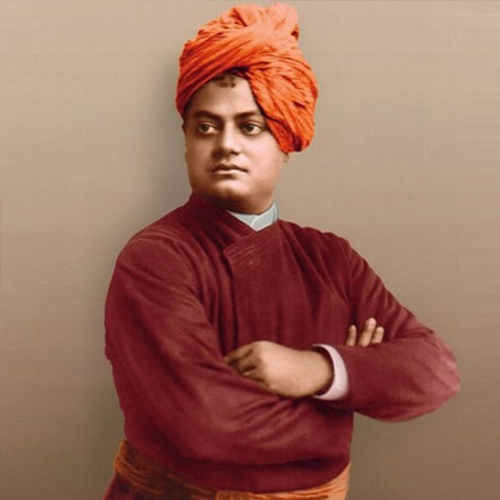
Key Philosophical Ideas of Swami Vivekananda

Description: A person in a red turban

Description automatically generated
  • Neo-Vedanta Philosophy: He emphasised the oneness of all, asserting that each person is interconnected and equal, with no inherent superiority of one over another. 
  • Universalism: It transcends sectarian divides, aiming to foster a sense of unity. 
  • Knowledge: He held knowledge to be the primary goal of humanity and held pleasure as impermanent while knowledge as enduring
  • Religion: He asserts that a religion's true worth lies in its ability to uplift humanity in all circumstances
  • Education: Swami Vivekananda advocated for a holistic approach to education that addresses physical, mental, and spiritual dimensions of an individual.

Relevance of his ideas in present times

  • Inclusivity and Universal Brotherhood: In globalized world, his ideas foster a sense of empathy and understanding among persons with diverse backgrounds. 
  • Societal transformation: His message broke through shackles of caste and creed. 
  • Emotional Intelligence: Integrating mindfulness practices and emotional intelligence can enhance a person’s well-being and ability to manage emotions effectively.
  • Peaceful Coexistence: He called the Western world to blend India’s spiritual advances into ideas of modernity and advised Indians to pursue modernisation while cutting through social hierarchies and meaningless rituals. 
Watch Video News Today

Explore Related Content

Discover more articles, videos, and terms related to this topic

RELATED TERMS

3

Emotional Intelligence

The ability to understand and manage one's own emotions, as well as those of others. Swami Vivekananda's emphasis on well-being and effective emotional management aligns with this concept.

Parliament of World's Religions

An interfaith dialogue forum that convenes religious and spiritual leaders from around the world to promote understanding and cooperation, notably addressed by Swami Vivekananda in 1893.

Ramakrishna Mission

A socio-spiritual organization founded by Swami Vivekananda in 1897, dedicated to service and the spiritual upliftment of humanity, inspired by the teachings of Ramakrishna Paramahamsa.

Title is required. Maximum 500 characters.

Search Notes

Filter Notes

Loading your notes...
Searching your notes...
Loading more notes...
You've reached the end of your notes

No notes yet

Create your first note to get started.

No notes found

Try adjusting your search criteria or clear the search.

Saving...
Saved

Please select a subject.

Referenced Articles

linked

No references added yet