
Third Path Framework for a Reformed, Inclusive and Networked Multilateralism | Current Affairs | Vision IAS
MENU
Home
Quick Links

High-quality MCQs and Mains Answer Writing to sharpen skills and reinforce learning every day.

Watch explainer and thematic concept-building videos under initiatives like Deep Dive, Master Classes, etc., on important UPSC topics.

ESC

In Summary

  • Canadian PM proposed a "Third Path" agenda based on "Value-Based Realism" and "co-operation of middle powers" amid global shifts.
  • "Value-Based Realism" balances core principles with diverging interests, while "variable geometry" forms issue-specific coalitions.
  • Middle powers, influential but not dominant, include nations like India, Canada, Australia, and Japan, distinct from UNSC permanent members.

In Summary

Canadian PM in his speech at World Economic Forum in 2026 outlined a new agenda for the world i.e. -“Third Path” amid US-China rivalry and fading Rule based world order.

About Third path or Carney doctrine:
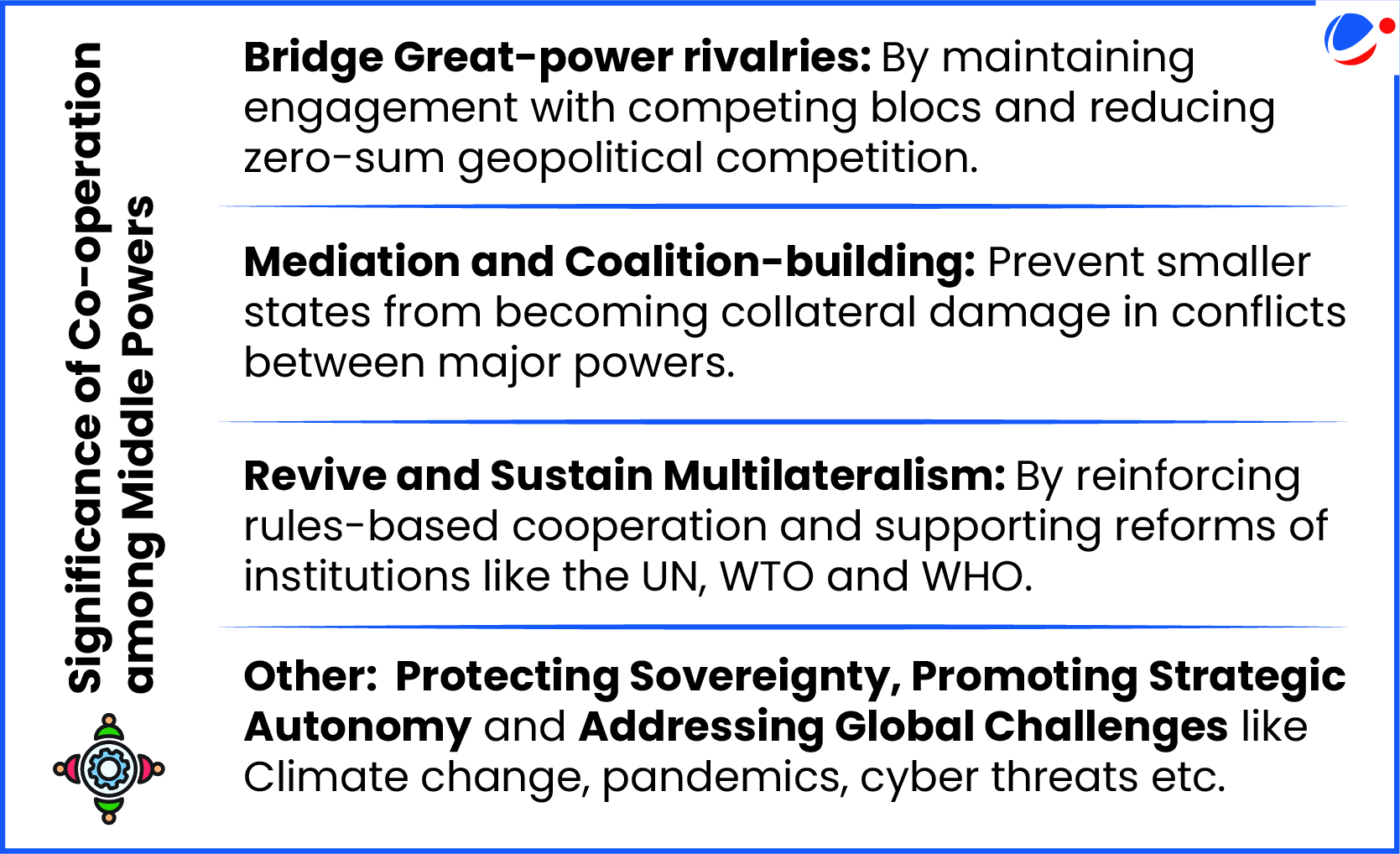
  • The third path or Carney doctrine is based upon “Value-Based Realism”, “co-operation of middle powers” against hegemons and a policy of “variable geometry”.
    • Value-Based Realism defends core principles such as sovereignty, territorial integrity, and human rights while recognizing incremental progress,  diverging national interests, and partners having value differentials.
      • Crucially, values-based realism rests on building domestic strength.
  • Policy of “variable geometry” involves forming different coalitions for different issues, based on values and interests.
    • E.g. Schengen Area, G7 Grouping, Quad Formation etc.
  • This third path framework is relevant for other middle powers, including and particularly India.

What are middle powers? 

  • Great powers are often defined as countries with a permanent seat on UNSC (i.e.China, France, Russia, United Kingdom and United States). These countries exert economic, political and military dominance over the world.
  • Middle powers are states below great powers that do not dominate the international system but possess significant diplomatic, economic, technological or normative influence. 
    • Examples include India, Canada, Australia, Japan, South Korea, Indonesia, Brazil, and several EU 
Watch Video News Today

Explore Related Content

Discover more articles, videos, and terms related to this topic

RELATED VIDEOS

2
News Today (Jan 22, 2026)

News Today (Jan 22, 2026)

YouTube HD
Role of Indian Diaspora in Making India Self-Reliant

Role of Indian Diaspora in Making India Self-Reliant

YouTube HD

RELATED TERMS

3

Great Powers

Countries possessing substantial economic, political, and military dominance globally, often characterized by permanent membership on the UN Security Council (e.g., China, France, Russia, UK, US).

Middle powers

Countries that are not major global powers but possess significant economic, diplomatic, or military influence, often playing a crucial role in regional and international affairs by mediating, forming coalitions, or contributing to global governance.

Variable Geometry

A foreign policy strategy involving the formation of flexible coalitions for specific issues, based on shared values and interests, allowing for diverse groupings like the Schengen Area, G7, or Quad.

Title is required. Maximum 500 characters.

Search Notes

Filter Notes

Loading your notes...
Searching your notes...
Loading more notes...
You've reached the end of your notes

No notes yet

Create your first note to get started.

No notes found

Try adjusting your search criteria or clear the search.

Saving...
Saved

Please select a subject.

Referenced Articles

linked

No references added yet
