
Empowering Women in Agriculture | Current Affairs | Vision IAS

Upgrade to Premium Today

Start Now
MENU
Home
Quick Links

High-quality MCQs and Mains Answer Writing to sharpen skills and reinforce learning every day.

Watch explainer and thematic concept-building videos under initiatives like Deep Dive, Master Classes, etc., on important UPSC topics.

A short, intensive, and exam-focused programme, insights from the Economic Survey, Union Budget, and UPSC current affairs.

ESC

In Summary

  • Women operate 11.72% of India's agricultural land, facing issues like lack of ownership and limited access to institutional support.
  • The feminization of agriculture increases women's responsibilities without proportional resources or decision-making power.
  • Empowerment requires recognizing women as farmers, strengthening land rights, and improving access to technology and services.

In Summary

International Women’s Day 2026, themed “Rights. Justice. Action.”, coincides with the International Year of the Woman Farmer, highlighting the significance of empowerment of women farmers.
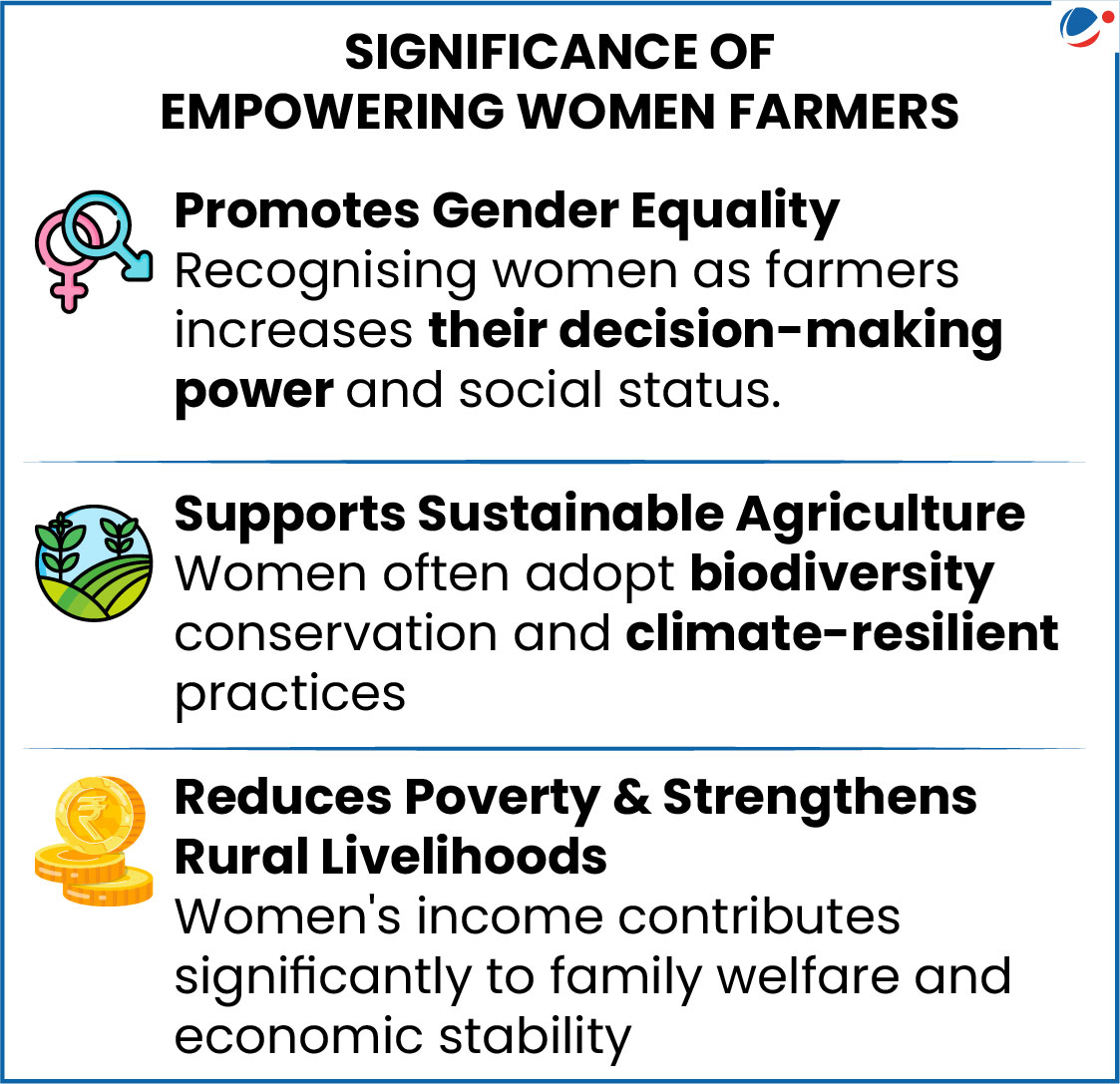
  • 11.72% of total operated area in India was operated by female operational holders. (Agriculture Census 2015-16)

Key issues faced by Women in Agriculture 

  • Lack of Land Ownership: Despite legal inheritance, women own only 11% of agricultural land (World Bank).
  • Limited Access to Institutional Support: Lack of land titles restricts women’s access to credit, crop insurance, irrigation schemes, extension services, and government agricultural programmes.
  • Feminisation of Agriculture: Male migration has increased women’s agricultural responsibilities without a corresponding rise in resources, decision-making power, or benefits.

Way forward for Women Empowerment

  • Recognise women as farmers: By defining farmers based on agricultural activities (not land ownership) and collecting gender-disaggregated data.
  • Strengthen land and resource rights: Through equal inheritance laws, joint land titles, incentives for property in women’s names, and gender-sensitive land administration.
  • Improve access to technology and services: By providing labour-saving tools, inclusive extension services, market information, and climate-resilient farming knowledge.
Watch Video News Today

Explore Related Content

Discover more articles, videos, and terms related to this topic

RELATED VIDEOS

3
Circularity in Textile Structure

Circularity in Textile Structure

YouTube HD
The Contribution of Indian Cinema to the Creative Economy

The Contribution of Indian Cinema to the Creative Economy

YouTube HD
Impact Investments

Impact Investments

YouTube HD

RELATED TERMS

3

Joint Land Titles

A legal arrangement where ownership of a piece of land is shared by two or more individuals, typically spouses. This promotes equitable access and control over land resources for both men and women.

Land Ownership

The legal right to possess and control land. In the context of agriculture, land ownership is a critical factor for accessing credit, insurance, and other resources, and its disproportionately low share among women farmers highlights a significant gender gap.

Institutional Support

Refers to the formal support systems and services provided by government agencies, financial institutions, and other organizations to farmers. For women farmers, limited access to this support, often due to lack of land ownership, hinders their progress.

Title is required. Maximum 500 characters.

Search Notes

Filter Notes

Loading your notes...
Searching your notes...
Loading more notes...
You've reached the end of your notes

No notes yet

Create your first note to get started.

No notes found

Try adjusting your search criteria or clear the search.

Saving...
Saved

Please select a subject.

Referenced Articles

linked

No references added yet