
Reserve Bank of India (RBI) cancels Banking Licence of Paytm Payments Bank | Current Affairs | Vision IAS

Upgrade to Premium Today

Start Now
MENU
Home
Quick Links

High-quality MCQs and Mains Answer Writing to sharpen skills and reinforce learning every day.

Watch explainer and thematic concept-building videos under initiatives like Deep Dive, Master Classes, etc., on important UPSC topics.

A short, intensive, and exam-focused programme, insights from the Economic Survey, Union Budget, and UPSC current affairs.

ESC

In Summary

  • Paytm Payments Bank violated RBI's Guidelines for Licensing of Payments Banks under the Banking Regulation Act, 1949.
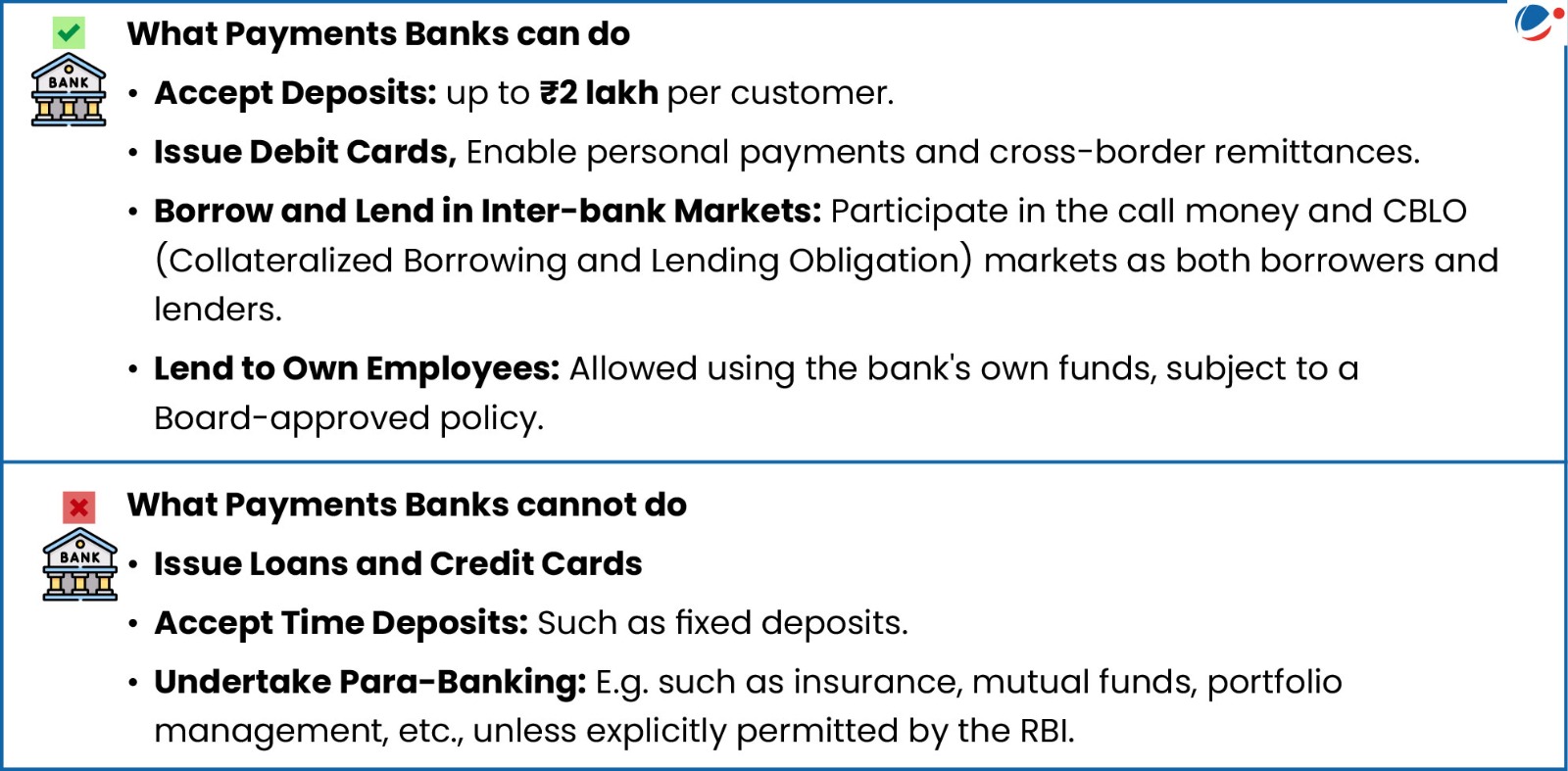
  • Payments Banks, recommended by Nachiket Mor Committee, promote financial inclusion by accepting deposits up to ₹2 lakh and issuing debit cards.
  • They cannot issue loans, credit cards, or accept time deposits, but can participate in inter-bank markets.

In Summary

According to the RBI, Paytm Payments Bank failed to adhere to the Guidelines for Licensing of Payments Banks under the Banking Regulation Act, 1949.

About Payment Banks 

  • Recommended by the Nachiket Mor Committee in 2014.
  • Definition: A Payment Bank is a financial institution set up to operate on a smaller scale with minimal credit risk under Differentiated banking licenses (DBL)
    • DBL are specialized licenses designed to serve specific customer segments.
      • Other Financial Institution under DBL: Small Finance Banks.
  • Objectives:  To promote financial inclusion through serving unbanked and underbanked populations (E.g. Migrant workers, low-income households).
    • Advantages: Boost digital payments, offer a safe alternative for small transactions, and reduce cash dependency.
  • Regulatory Framework:
    • Registration: Companies Act, 2013.
    • Governance: Banking Regulation Act, 1949; RBI Act, 1934; Foreign Exchange Management Act, 1999; Payment and Settlement Systems Act, 2007.
  • Capital Requirement: They must have a minimum paid-up capital of ₹100 crore (promoters’ share to be ≥40% for the first five years).
    • 75% funds in SLR securities, 25% with banks.
Watch Video News Today

Explore Related Content

Discover more articles, videos, and terms related to this topic

RELATED VIDEOS

3
Circularity in Textile Structure

Circularity in Textile Structure

YouTube HD
The Contribution of Indian Cinema to the Creative Economy

The Contribution of Indian Cinema to the Creative Economy

YouTube HD
Impact Investments

Impact Investments

YouTube HD

RELATED TERMS

3

SLR securities

Statutory Liquidity Ratio (SLR) securities are government or other approved securities that banks are mandated to hold as a portion of their Net Demand and Time Liabilities (NDTL). These are part of the monetary policy tools used by the RBI to manage liquidity in the banking system.

Banking Regulation Act, 1949

This is a principal legislation that governs the banking sector in India. It grants the Reserve Bank of India (RBI) powers to regulate and supervise banks, including licensing, capital requirements, and prudential norms. Amendments to this act have strengthened the RBI's regulatory framework.

Financial Inclusion

Financial inclusion means that individuals and businesses have access to useful and affordable financial products and services that meet their needs. UCBs are identified as key institutions contributing to this goal, particularly in remote and small towns.

Title is required. Maximum 500 characters.

Search Notes

Filter Notes

Loading your notes...
Searching your notes...
Loading more notes...
You've reached the end of your notes

No notes yet

Create your first note to get started.

No notes found

Try adjusting your search criteria or clear the search.

Saving...
Saved

Please select a subject.

Referenced Articles

linked

No references added yet