


Ministry of Power notifies Electricity (Amendment) Rules, 2026 amending Electricity Rules, 2005 for ease of doing business.
- The amendments provide a clear ownership definition to include subsidiaries that own the Captive Generating Plant.
About Captive Generating Plant
- Definition: Power Plant established by companies mainly for their own consumption. They are considered captive if:
- More than 51% of the electricity is used for own consumption
- Aggregate ownership of plant is more than 26%
- Origin: Electricity Act, 2003 and is also recognised by National Electricity Policy, 2005.
- Significance: Supports industrial growth by mitigating supply constraints and electricity cost volatility.
Ministry of Communications inaugurated Samriddhi Kendra under Samriddh Gram Phygital Services Initiative.
About Samriddh Gram Phygital Services Initiative
- Under: Department of Telecommunications (DoT).
- The initiative is in pilot phase which will be implemented in 3 villages.
- It leverages the high-speed broadband under BharatNet to transform digital connectivity into an integrated platform for delivery of services in rural areas.
- Under it, Samriddhi Kendra has been conceptualised as a single-window rural service hub bringing together healthcare, education, etc and e-governance support at one location.
Article Sources
1 sourceNor’wester induced strong winds and heavy rain wreaks havoc in Odisha.
About Nor’wester
- Nor’westers are severe thunderstorms that originate over Eastern and north Eastern parts of India during pre-monsoon season (March to May).
- The Nor’westers produce heavy showers, lightning, thunder, hailstorms, dust storms, squalls, down bursts and sometimes even tornadoes.
- In Bengal, it is also called ‘Kalbaisakhi’, a calamity of the month of Baisakh, while in Assam, it is known as Bordoisila or Bardoli Chheerha.
- These showers are useful for tea, jute, and rice cultivation.
Navratna NMDC has become the first mining company in India to produce 50 million tonnes of iron ore in a single financial year.
About NMDC
- Incorporated in 1958 as a CPSE (Central Public Sector Enterprise).
- NMDC is India’s largest producer of iron ore.
- Apart from iron ore it also explores various minerals e.g. copper, limestone etc.
- Ministry: Ministry of steel
- Also, NMDC is the only organised producer of diamond in India from its Majhgawan mine at Panna, Madhya Pradesh.
- HQ: Hyderabad
UAE’s Fujairah port was attacked in the recent Iran- US-Israel war.
About Fujairah port
- A key shipping hub for the Gulf and wider regions, the Port of Fujairah is the only multi-purpose maritime facility on the east coast of the United Arab Emirates.
- Strategically located just 70 nautical miles outside the Strait of Hormuz, the Port provides an essential economic link between Europe and Asia, opening the markets of the Indian subcontinent and North East Africa to greater local and international trade.
Other ports in news: Jebel Ali Port (UAE), Haifa Port (Israel), Al‑Faw Port (Iraq), etc.
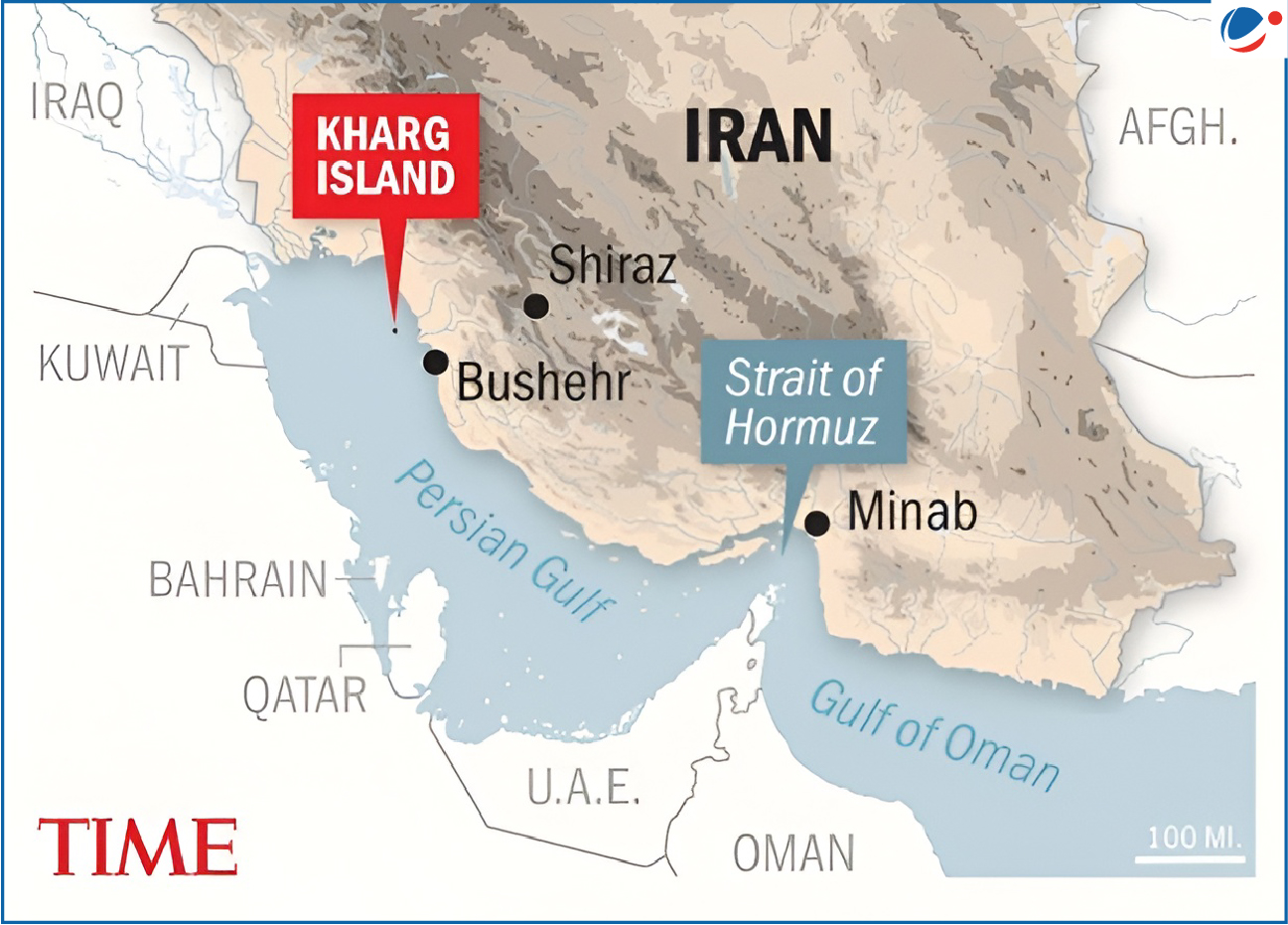
The US struck Kharg island considered as Iran’s economic lifeline.
About Kharg Island
- Location: Lies in Persian Gulf, north west of Strait of Hormuz off Iran coast.
- Iran’s Oil Hub: Approximately 90% of Iran’s oil is exported from the island.
Assam government signed memorandums of settlement with Kuki and Hmar militant groups.
- It includes groups such as the United Kukigam Defence Army and the Kuki Revolutionary Army, among others.
About Kukis
- The Kukis belong to the Tibeto-Burman ethnic group.
- Spread: Mainly resides in the Lushai Hills of Manipur but also found in all north eastern states (except Arunachal Pradesh), Myanmar, and Bangladesh.
- Traditional Kuki society is centred around the village hereditary chief, known as the 'Haosa'.
About Hmar tribe
- Hmar (meaning north) are a specific ethnic group within the larger Kuki-Zo umbrella.
- Spread: They live mostly in the hills of south Manipur, Mizoram, Assam, Meghalaya, Tripura and also found in Myanmar and Bangladesh.
Article Sources
1 sourceRecently, a Carnatic musician is named for Sangita Kalanidhi award 2026.
- Sangita Kalanidhi award conferred by the Music Academy, Chennai, is considered the highest accolade in the field of Carnatic music.
About Carnatic music
- It is the classical music tradition of South India and one of the two main systems of Indian classical music, the other being Hindustani music.
- It is primarily devotional in nature.
- Instruments: Veena, violin, flute, nadaswaram, mridangam, ghatam, kanjira and morsing.
- Compositions: kriti, keertanam, varnam, padam, jaavali etc.
- kriti is the most important of the melodic group of compositions.
- Tyagaraja, Muthuswami Dikshitar and Shyama Shastri are known as the trinity of carnatic music


