
Reserve Bank of India (RBI) announces the 'Payments Vision 2028' | Current Affairs | Vision IAS

Upgrade to Premium Today

Start Now
MENU
Home
Quick Links

High-quality MCQs and Mains Answer Writing to sharpen skills and reinforce learning every day.

Watch explainer and thematic concept-building videos under initiatives like Deep Dive, Master Classes, etc., on important UPSC topics.

A short, intensive, and exam-focused programme, insights from the Economic Survey, Union Budget, and UPSC current affairs.

ESC

In Summary

  • Payments Vision 2028 aims to strengthen India's digital payments ecosystem with cross-border reforms and TReDS interoperability.
  • India leads global real-time digital payments, supported by RTGS, NEFT, UPI, BBPS, and AePS.
  • Key initiatives include the PSS Act 2007, DPSS within RBI, NPCI establishment, and expansion of PPIs and TReDS.

In Summary

The vision outlines a roadmap to strengthen and expand India’s digital payments ecosystem.
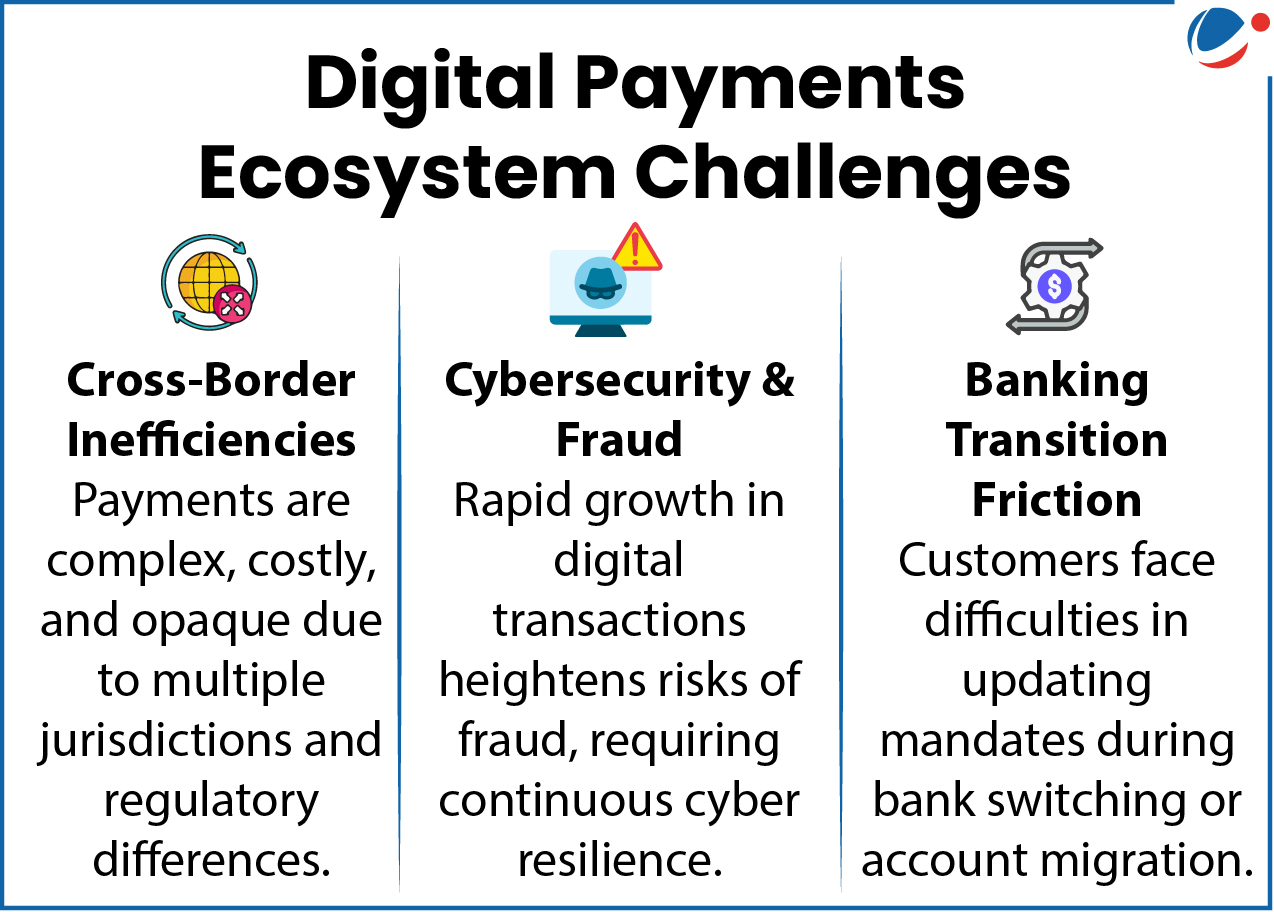
Key Focus Areas of Payments Vision 2028

  • Cross-Border Reforms: Exploring a single-window authorization process under PSS Act and FEMA to ease international payments.
  • Trade Receivables Discounting System (TReDS) Interoperability: Integration across platforms to boost MSMEs financing efficiency.
  • Proposed initiatives like "Switch On/Off" Facility, Payments Switching Service (PaSS), Uniform Domestic Legal Entity Identifier (DLEI), etc.

India’s Digital Payments Ecosystem

  • Global Leadership: India processes nearly 50% of global real-time digital payments.
  • Key Initiatives 
    • Core Infrastructure: Introduced Real-Time Gross Settlement (RTGS) in 2004, National Electronic Funds Transfer (NEFT), Electronic Clearing Services (ECS), and Cheque Truncation System (CTS).
    • Institutional Framework: Creation of Department of Payment and Settlement Systems (DPSS) within RBI in 2005, and the establishment of National Payments Corporation of India (NPCI) in 2008.
    • Regulatory Backing: Enactment of Payment and Settlement Systems (PSS) Act, 2007, giving RBI statutory authority to regulate payment systems.
    • Transformative Platforms: Unified Payments Interface (UPI), Bharat Bill Payment System (BBPS), and acceleration of Aadhaar Enabled Payment Systems (AePS).
    • Market Expansion: Licensing and expansion of Prepaid Payment Instruments (PPIs), Trade Receivables Discounting System (TReDS) for MSME payments, and Master Direction on Payment Aggregators.
Watch Video News Today

Explore Related Content

Discover more articles, videos, and terms related to this topic

RELATED VIDEOS

3
Circularity in Textile Structure

Circularity in Textile Structure

YouTube HD
The Contribution of Indian Cinema to the Creative Economy

The Contribution of Indian Cinema to the Creative Economy

YouTube HD
Impact Investments

Impact Investments

YouTube HD

RELATED TERMS

3

Payment Aggregators

Entities that facilitate e-commerce sites and merchants to accept various payment instruments from customers for completion of their purchase transactions. RBI has issued specific directions for their regulation.

PPIs

Prepaid Payment Instruments. These include instruments like mobile wallets, gift cards, and smart cards that facilitate the purchase of goods and services against the value stored on the instrument.

AePS

Aadhaar Enabled Payment System. A bank-led model that allows a bank customer to use Aadhaar as their identity to access their bank account and perform basic banking transactions like cash withdrawal, deposit, and balance inquiry.

Title is required. Maximum 500 characters.

Search Notes

Filter Notes

Loading your notes...
Searching your notes...
Loading more notes...
You've reached the end of your notes

No notes yet

Create your first note to get started.

No notes found

Try adjusting your search criteria or clear the search.

Saving...
Saved

Please select a subject.

Referenced Articles

linked

No references added yet