
India is almost free from Left-Wing Extremism (LWE) | Current Affairs | Vision IAS

Upgrade to Premium Today

Start Now
MENU
Home
Quick Links

High-quality MCQs and Mains Answer Writing to sharpen skills and reinforce learning every day.

Watch explainer and thematic concept-building videos under initiatives like Deep Dive, Master Classes, etc., on important UPSC topics.

A short, intensive, and exam-focused programme, insights from the Economic Survey, Union Budget, and UPSC current affairs.

ESC

In Summary

  • Union Home Minister stated Maoist leadership is largely eliminated, aiming for Naxal-free districts by March 2026 via integrated approach.
  • SAMADHAN strategy combines security operations, development interventions (SCA, Aspirational Districts), surrender policies, and technology.
  • Naxalism, originating from 1967 Naxalbari movement, targets Indian state via armed rebellion, fueled by socio-economic and governance issues in Red Corridor states.

In Summary

In Lok Sabha, Union Home Minister said that barring one, the entire leadership of Maoists had been wiped out in the past two years.

  • The central government aimed to make all affected districts Naxal-free by March 2026 through an integrated approach of Dialogue, Security, and Coordination.

How has a multi-pronged approach helped India tackle LWE?
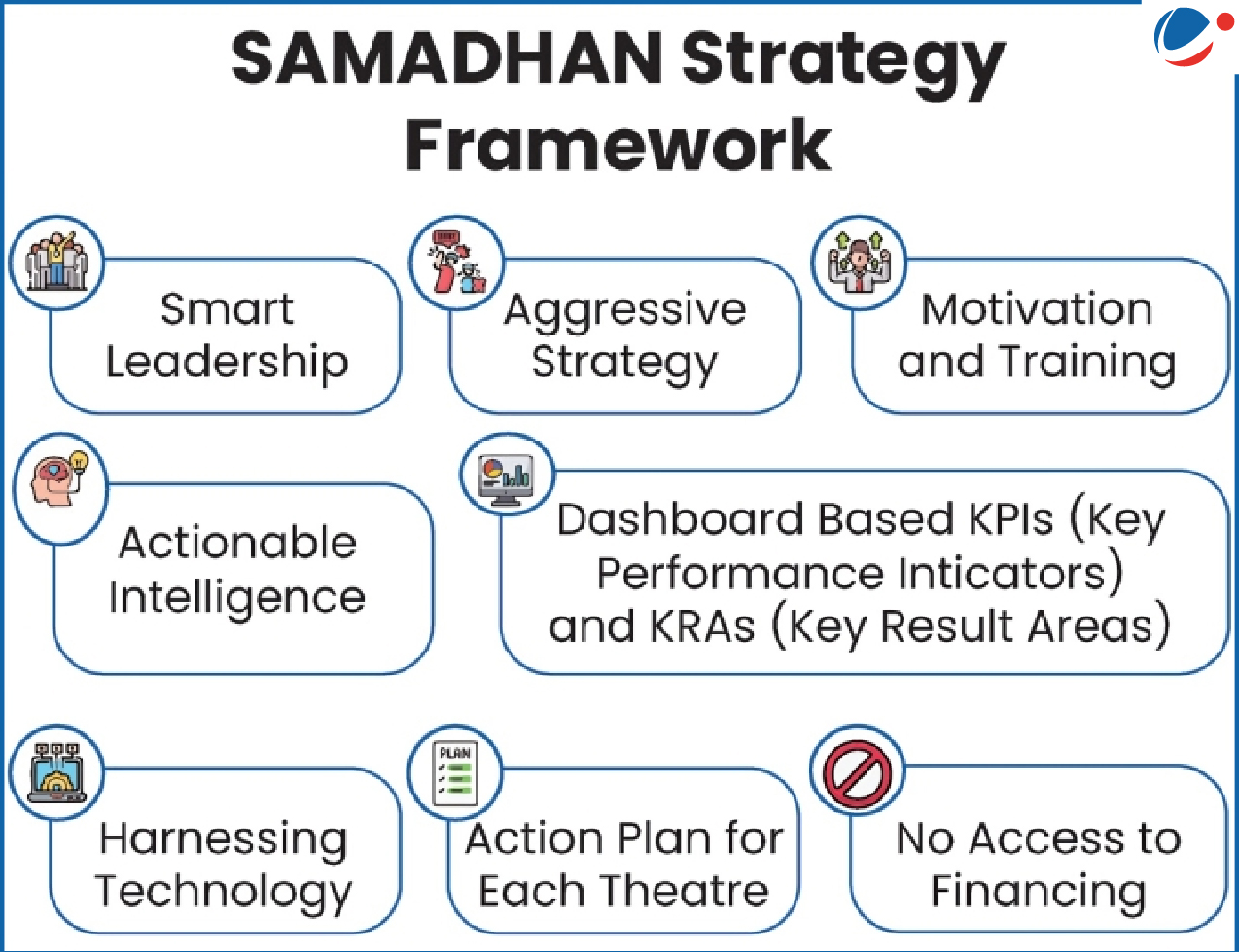
  • SAMADHAN Strategy: It encompasses the entire strategy for security operations, ranging from short-term policy to long-term policy formulated at different levels.
  • Development Interventions: E.g. Special Central Assistance (SCA) for most LWE affected districts to fill the critical gaps in Public Infrastructure and Services.
    • It also includes measures like Dharti Aaba Janjatiya Gram Utkarsh Abhiyan, Aspirational District Programme, etc.
  • Surrender and Rehabilitation Policy: Rehabilitated cadres receive financial assistance and a monthly stipend for vocational training.
  • Strengthened Security Infrastructure & Technology: E.g., Use of cutting-edge technologies, including location tracking, drone surveillance, satellite imaging, AI-based data analytics, and mobile data analysis, are being heavily utilized. 
  • Financial Crackdown: Target funding sources through the Prevention of Money Laundering Act enforcement and fund seizures. 

About Naxalism 

  • Background: Naxalism or Left Wing Extremism (LWE) originated from the Naxalbari movement of 1967 in West Bengal.
  • Aim: The movement aims to undermine the Indian state through armed rebellion and parallel governance structures, particularly targeting security forces, public infrastructure, and democratic institutions.
  • It spread primarily across the "Red Corridor," affecting states like Chhattisgarh, Jharkhand, Odisha, Maharashtra, Kerala, West Bengal, Madhya Pradesh, and parts of Andhra Pradesh and Telangana.
  • Key Reasons for Growth: Socio-economic (E.g., social alienation, sub-optimal access to education), Governance issues (E.g., Ineffective implementation of Forest Rights Act and PESA Act), etc. 
Watch Video News Today

Explore Related Content

Discover more articles, videos, and terms related to this topic

RELATED TERMS

3

PESA Act

The Provisions of the Panchayats (Extension to Scheduled Areas) Act, 1996, which extends the provisions of Part IX of the Constitution relating to the Panchayats to the Scheduled Areas, empowering tribal communities with self-governance rights.

Forest Rights Act

Officially the Scheduled Tribes and Other Traditional Forest Dwellers (Recognition of Forest Rights) Act, 2006. It grants forest-dwelling tribal communities and other forest dwellers their rights to forest land and the resources within. It aims to correct historical injustices against these communities.

Red Corridor

The 'Red Corridor' refers to the geographical area in India, primarily across central and eastern states, that has been significantly affected by Left Wing Extremism (LWE). These states often face challenges related to development, governance, and security.

Title is required. Maximum 500 characters.

Search Notes

Filter Notes

Loading your notes...
Searching your notes...
Loading more notes...
You've reached the end of your notes

No notes yet

Create your first note to get started.

No notes found

Try adjusting your search criteria or clear the search.

Saving...
Saved

Please select a subject.

Referenced Articles

linked

No references added yet
