
River Basin Management (RBM) Scheme extended for 5 more years | Current Affairs | Vision IAS

Upgrade to Premium Today

Start Now
MENU
Home
Quick Links

High-quality MCQs and Mains Answer Writing to sharpen skills and reinforce learning every day.

Watch explainer and thematic concept-building videos under initiatives like Deep Dive, Master Classes, etc., on important UPSC topics.

A short, intensive, and exam-focused programme, insights from the Economic Survey, Union Budget, and UPSC current affairs.

ESC

In Summary

  • The RBM Scheme will continue from 2026-27 to 2030-31 with an estimated cost of ₹2183 crore, fully funded by the government.
  • Launched in 2014, it focuses on strategically important, underdeveloped regions like the North Eastern Region and Indus Basin for water security and flood control.
  • Key actions include basin planning, flood/erosion management, drainage development, and community-based interventions, involving CWC and NWDA.

In Summary

The scheme will continue during the 16th Finance Commission period (2026–27 to 2030–31) with an estimated cost of ₹2183 crore, fully funded by the government. 
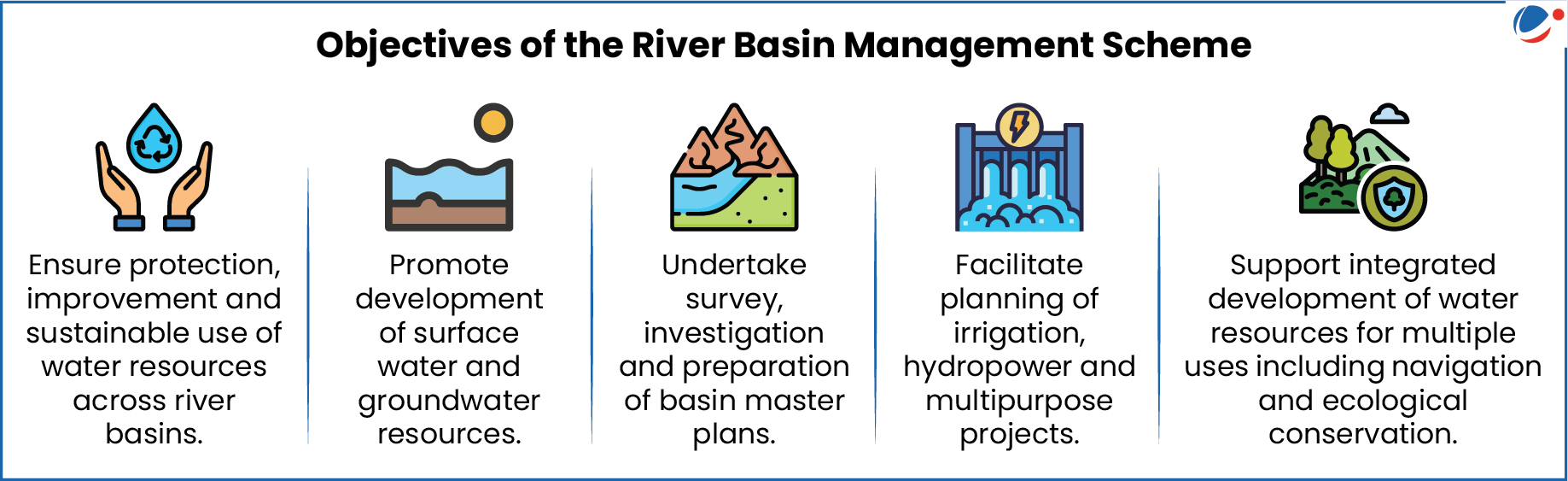
About RBM Scheme: 

  • Launched: In 2014 as a Central Sector Scheme.
  • Objectives: (Refer infographic).
  • Administered by: Department of Water Resources, River Development, and Ganga Rejuvenation under the Ministry of Jal Shakti.
  • Geographical Scope and Priority Areas: strategically important and water-rich but underdeveloped regions, particularly North Eastern Region and Indus Basin in Jammu & Kashmir / Ladakh.
    • These basins are prioritised due to their importance in National water security, Cross-border water management, Flood control and erosion management and Ecological stability.
  •  Institutional Structure: two broad components-
  • The Brahmaputra Board: for basin-level planning and flood management in the North Eastern Region.
  • Investigation of Water Resources Development Scheme (IWRDS): implemented through
    • Central Water Commission (CWC): undertakes surveys, investigations, and preparation of Detailed Project Reports (DPRs) for water resource projects such as Indus, Brahmaputra basins.
    • National Water Development Agency (NWDA): focuses on water resource planning at the national level, particularly under the Interlinking of Rivers (ILR) programme.

Key Areas of Action under RBM Scheme:

  • Basin Planning: Creating and updating long-term master plans to guide the conservation and use of water resources.
  • Flood and Erosion Management: Implementing structural and bio-engineering measures to protect land, communities, and infrastructure.
  • Drainage Development: Improving water flow in waterlogged areas to boost land productivity in both rural and urban regions.
  • Community-Based Interventions: Blending scientific and indigenous methods to improve local water practices, ecosystem development, and spring shed management.
Watch Video News Today

Explore Related Content

Discover more articles, videos, and terms related to this topic

RELATED VIDEOS

1
Lateral Entry

Lateral Entry

YouTube HD

RELATED TERMS

3

Spring shed management

A conservation approach focused on protecting and rejuvenating springs, which are natural sources of groundwater. It involves understanding the hydrological processes related to springs and implementing measures to ensure their sustained flow and water quality.

Bio-engineering measures

A type of flood and erosion management technique that uses biological elements, such as vegetation, along with engineering principles to stabilize slopes, prevent soil erosion, and manage water flow.

Interlinking of Rivers (ILR) programme

A proposed plan by the Indian government to create canals and dams to connect major rivers, aiming to transfer water from water-surplus basins to water-deficit basins, thereby addressing regional water scarcity and flood issues.

Title is required. Maximum 500 characters.

Search Notes

Filter Notes

Loading your notes...
Searching your notes...
Loading more notes...
You've reached the end of your notes

No notes yet

Create your first note to get started.

No notes found

Try adjusting your search criteria or clear the search.

Saving...
Saved

Please select a subject.

Referenced Articles

linked

No references added yet