
Relevance of ASEAN’s Partnership Model for Global Cooperation | Current Affairs | Vision IAS

Upgrade to Premium Today

Start Now
MENU
Home
Quick Links

High-quality MCQs and Mains Answer Writing to sharpen skills and reinforce learning every day.

Watch explainer and thematic concept-building videos under initiatives like Deep Dive, Master Classes, etc., on important UPSC topics.

A short, intensive, and exam-focused programme, insights from the Economic Survey, Union Budget, and UPSC current affairs.

ESC

In Summary

  • ASEAN exemplifies regional cooperation, maintaining cohesion despite diverse members for nearly 60 years.
  • Key achievements include mutual support (Timor Leste's accession) and wider integration via frameworks like DEFA.
  • Regional integration offers benefits like financial stability (CMIM), expanded markets, reduced inequality, and collective bargaining power.

In Summary

Mounting volatility of global system has underscored the growing importance of regional cooperation and integration, with ASEAN leading as an example. 

ASEAN’s Key Achievements Re-enforcing Regional Cooperation

  • Commitment to Core Beliefs: Despite significant differences in culture, political models and socio-economic indicators, ASEAN functioned as cohesive, viable economic and political bloc for almost 60 years. 
  • Mutual Support and Trust: Accession of Timor Leste to ASEAN in 2025 is an example how members (in this case Indonesia) can put aside years of enmity for mutual support and growth for entire bloc. 
  • Wider Integration: E.g., Digital Economy Framework Agreement (DEFA) represents an example of “coalitions of smaller economies”, to accelerate digital transformation throughout the region. 
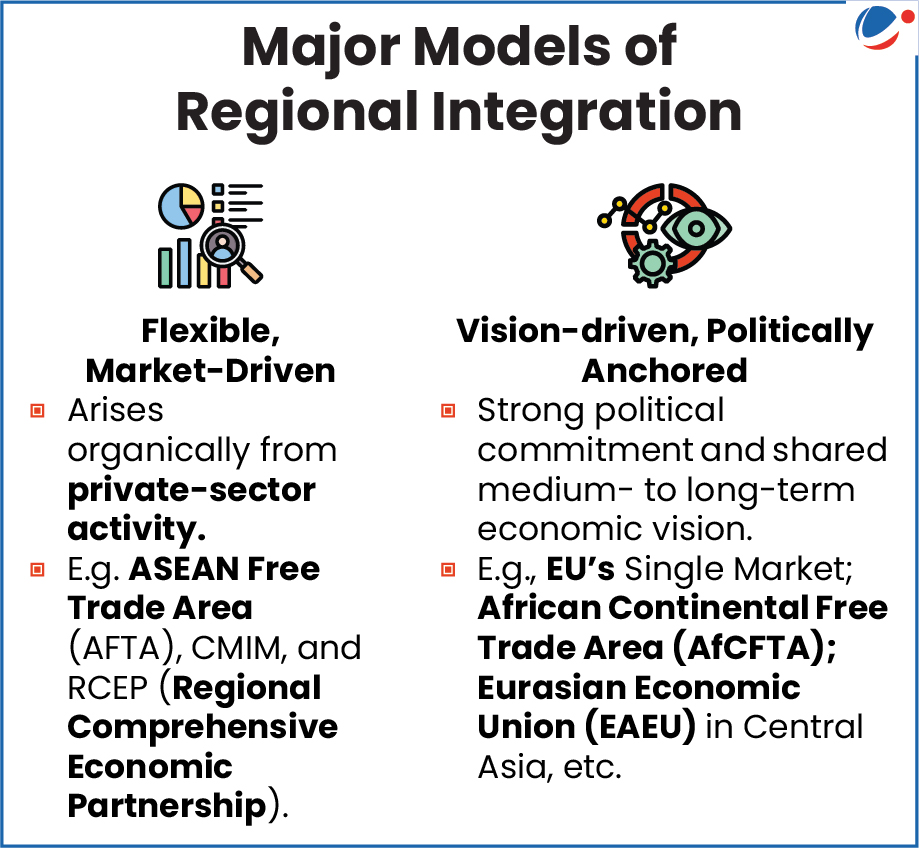
Other Key Benefits of Regional Integration

  • Regional Financial Stability: E.g., Chiang Mai Initiative Multilateralisation (CMIM), established due to Asian Financial Crisis, provided ASEAN+3 (China, Japan, and Republic of Korea (ROK)) economies with a crucial safety net. 
  • Expands Markets and Input Sources: Ensuring better allocation of resources and accelerating economic growth. 
  • Reduce Inequality between countries: Freer trade and factor mobility from integration allow less-developed members to grow faster. 
  • Political Stability and Collective Bargaining: Strengthens diplomatic relationships and Increases the influence of member states in global trade negotiations.
Tags:
Watch Video News Today

Explore Related Content

Discover more articles, videos, and terms related to this topic

RELATED VIDEOS

1
Role of Indian Diaspora in Making India Self-Reliant

Role of Indian Diaspora in Making India Self-Reliant

YouTube HD

RELATED TERMS

3

Factor Mobility

In economics, this refers to the ease with which factors of production (land, labor, capital, and entrepreneurship) can move between different industries or geographical locations. Regional integration often facilitates factor mobility, leading to more efficient resource allocation and economic growth.

Asian Financial Crisis

A period of severe financial turmoil that hit many Asian economies in 1997 and 1998, originating in Thailand and spreading rapidly to other countries, leading to significant economic downturns and prompting the establishment of regional financial cooperation mechanisms like CMIM.

Chiang Mai Initiative Multilateralisation (CMIM)

A multilateral foreign exchange reserve arrangement among the ten ASEAN member states plus China, Japan, and South Korea (ASEAN+3). It was established to provide a regional safety net for financial stability, particularly in response to financial crises.

Title is required. Maximum 500 characters.

Search Notes

Filter Notes

Loading your notes...
Searching your notes...
Loading more notes...
You've reached the end of your notes

No notes yet

Create your first note to get started.

No notes found

Try adjusting your search criteria or clear the search.

Saving...
Saved

Please select a subject.

Referenced Articles

linked

No references added yet
