
Recent Explosion at Fireworks Unit in Tamil Nadu Claimed Many Lives | Current Affairs | Vision IAS

Upgrade to Premium Today

Start Now
MENU
Home
Quick Links

High-quality MCQs and Mains Answer Writing to sharpen skills and reinforce learning every day.

Watch explainer and thematic concept-building videos under initiatives like Deep Dive, Master Classes, etc., on important UPSC topics.

A short, intensive, and exam-focused programme, insights from the Economic Survey, Union Budget, and UPSC current affairs.

ESC

In Summary

  • Industrial accidents in India, like the Bhopal Gas Tragedy and Vizag gas leak, stem from systemic, operational, and hazardous material factors.
  • Mitigation involves legislative measures (Environment Protection Act, 1986), institutional bodies (NDMA), emergency response forces (NDRF), and technological advancements.
  • Community involvement and healthcare preparedness are crucial for effective crisis management and information dissemination during industrial accidents.

In Summary

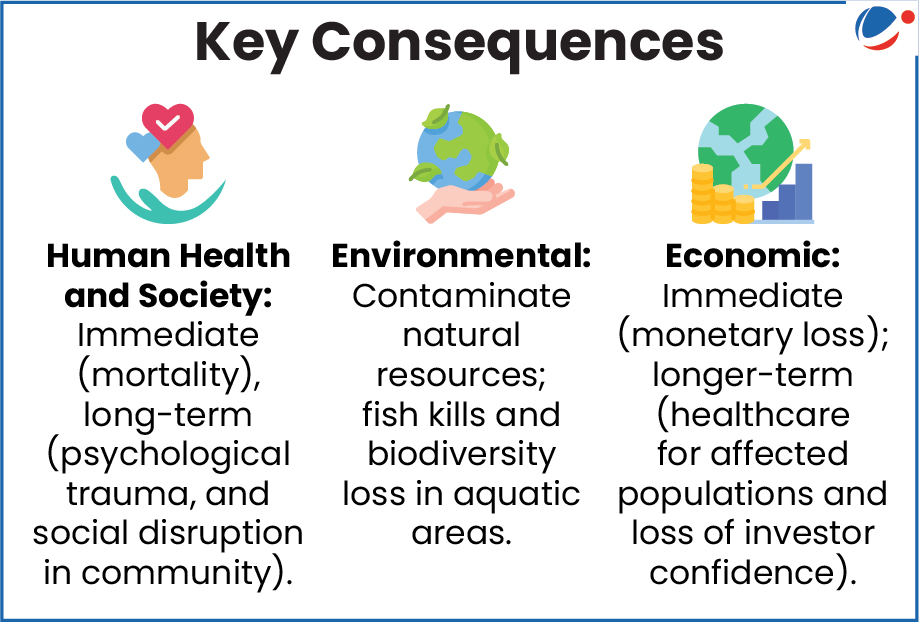
Large-scale chemical manufacturing have amplified the nature and scale of Industrial Accidents in India as evident in: 

  • 1984 Bhopal Gas Tragedy (leakage of methyl isocyanate); 1985 Oleum gas leak in Delhi; 2017 NTPC Unchahar (Uttar Pradesh) power plant boiler explosion; Vizag gas leak (2020); etc. 

Key Causes of Industrial Accidents

  • Systemic and Regulatory: Despite presence of framework of laws in India, effective implementation is often lacking.
    • Certain safety and environmental regulations are “diluted” through executive orders to promote ease of doing business. 
  • Operational and Technical Causes: Human errors, Engineering design flaws, Poor maintenance, or Protocol violations on factory floor.  E.g. 2017 NTPC Unchahar boiler blast
  • Hazardous Materials and Process-Related: Industries dealing with toxic gases (chlorine, ammonia, etc.) often operate on narrow margins of safety.
  • Environmental Factors: E.g., Earthquakes can damage industrial installations (e.g. 2001 Gujarat earthquake caused spills in some chemical warehouses). 
  • Economic and Managerial Factors: Cost-cutting on safety measures, inadequate investment in modern safety systems, etc. 
Key Mitigation Measures

  • Legislative: Environment (Protection) Act, 1986, enacted in direct response to Bhopal (1984), Public Liability Insurance Act, 1991; Disaster Management Act, 2005, etc. 
  • Institutional: National Disaster Management Authority (NDMA) including State and District Level institutions. 
  • Emergency Response Forces: Dedicated hazardous materials (HAZMAT) response units; National Disaster Response Force (NDRF) with units trained in Chemical, Biological, Radiological and Nuclear (CBRN) emergency response.
  • Technological: Advanced Process Safety Management (PSM) systems, etc. 
  • Community and Healthcare Preparedness: Involvement of local public; Local crisis groups for information dissemination, etc. 
Watch Video News Today

Explore Related Content

Discover more articles, videos, and terms related to this topic

RELATED TERMS

3

HAZMAT

Abbreviation for Hazardous Materials. These are substances that pose a threat to health, safety, property, or the environment, requiring specialized handling and response in case of an accident.

Process Safety Management (PSM)

A set of regulations and management practices designed to prevent accidental releases of highly hazardous chemicals. It involves a comprehensive approach to identifying, evaluating, and controlling process hazards.

National Disaster Response Force (NDRF)

A specialized force constituted under the Disaster Management Act, 2005, to respond to natural and man-made disasters. It comprises trained personnel equipped for rescue and relief operations.

Title is required. Maximum 500 characters.

Search Notes

Filter Notes

Loading your notes...
Searching your notes...
Loading more notes...
You've reached the end of your notes

No notes yet

Create your first note to get started.

No notes found

Try adjusting your search criteria or clear the search.

Saving...
Saved

Please select a subject.

Referenced Articles

linked

No references added yet