


National Crime Records Bureau (NCRB) for first time, has compiled national-level statistical data specifically tracking crimes under the Prevention of Cruelty to Animals Act, 1960.
- Highest number of cases: Maharashtra, Madhya Pradesh, Uttar Pradesh, Gujarat, and Tamil Nadu.
Prevention of Cruelty to Animals Act, 1960
- Objective: To prevent infliction of unnecessary pain or suffering on animals.
- Act defines "animal" as any living creature other than a human being.
- Animal Welfare Board of India (AWBI): Statutory body as established by Central Government under Section 4, to advise on making rules to prevent animal suffering and promotes animal welfare education.
India conducted the 2nd successful flight-trial of ‘Divyastra’ Missile from Dr. APJ Abdul Kalam Island, Odisha.
About ‘Divyastra’ Missile
- It is an advanced Agni Missile equipped with Multiple Independently Targeted Re-Entry Vehicle system (MIRV) system.
- MIRV system: Originally developed in the early 1960s, it allows a single missile to carry multiple nuclear warheads, each capable of striking different targets independently.
- TheUnited States of America (first country to develop MIRV technology), Russia, the United Kingdom, France, and China also have MIRV Technology.
DRDO successfully conducted a test of its Actively Cooled Full Scale Scramjet Combustor, achieving a run-time of over 1,200 seconds (earlier 700 seconds).
Scramjet Propulsion System
- Concept: Scramjet stands for Supersonic Combustion Ramjet.
- It is an advanced air-breathing jet engine designed to operate efficiently at hypersonic speeds by allowing the combustion of fuel to occur supersonically.
- Operating Mechanism: Vehicle's forward motion to "ram" and compress external air into the combustor.
- It uses atmospheric oxygen as its oxidizer as it flies through the air.
- Fuel Types:Hydrogen or advanced liquid hydrocarbon endothermic fuels.
- Advantages: Reduce total weight of vehicle, making it a highly efficient propulsion system for low-cost, reusable access to space and an ideal foundation for hypersonic cruise missile development.
Article Sources
1 sourceThe Government has appointed Lieutenant General NS Raja Subramani (Retd) as the next Chief of Defence Staff (CDS).
About CDS
- Genesis: The post of CDS was created in 2019 on the recommendations of a Group of Ministers (GoM) in 2001, based on the 1999 K. Subrahmanyam Committee (or Kargil Review Committee) Report.
- Roles and Responsibilities of CDS:
- Principal Military Adviser to the Raksha Mantri on all tri-service matters.
- Head of Department of Military Affairs (DMA): As the ex-officio Secretary, the CDS oversees Armed Forces Affairs, Procurement (excluding capital acquisitions), and Integration (promoting "jointness" in training, logistics, etc.).
- Permanent Chairman of Chiefs of Staff Committee: acting as "first among equals" to coordinate between the three Service Chiefs.
- Strategic Mandates:Theatre Commands, Nuclear Authority (Military Adviser to the Nuclear Command Authority) and Policy & Planning.
Article Sources
1 source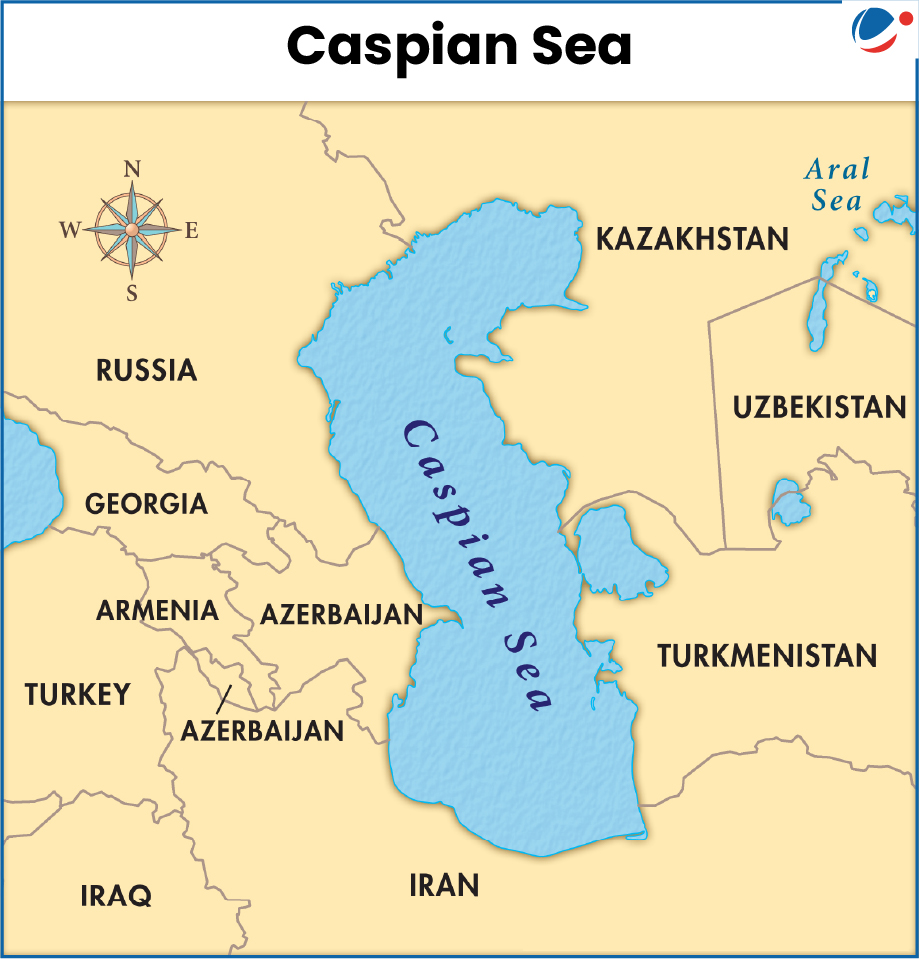
The Caspian Sea has emerged as a backdoor for military and commercial logistics between Russia and Iran amidst the ongoing West Asian conflict.
About Caspian Sea
- It is the world’s largest inland water body (or largest lake), located at the intersection of Eastern Europe and Western Asia.
- Borders five countries: Russia (northwest), Kazakhstan (northeast), Turkmenistan (southeast), Iran (south), and Azerbaijan (West).
- Inflow & Outflow: The Volga River is its primary source, providing approximately 80% of its water inflow.
- Since there is no outlet, water is lost only through evaporation, which results in its brackish (salty) nature.
- Current Status: Rich in oil and natural gas, the Caspian Sea has shrunk by 46% between 2001 and 2024, largely due to high evaporation rate and construction of dams on Volga River.
Ministry of Panchayati Raj has announced National Panchayat Awards 2025 with Mizoram’s Kawrthah North Village receiving top rank in ‘Clean and Green Panchayat’ category of DDUPSVP.
About National Panchayat Awards
- Core Purpose: Awarded annually to recognize best-performing Panchayats and promote inclusive, participatory, and sustainable development in rural India.
- Assessment Framework: Align with nine themes of the Localization of Sustainable Development Goals (LSDGs).
- Two award categories:
- Deen Dayal Upadhyay Panchayat Satat Vikas Puraskar (DDUPSVP): Recognizes outstanding Gram Panchayats based on their performance in nine thematic areas.
- Nanaji Deshmukh Sarvottam Panchayat Satat Vikas Puraskar (NDSPSVP): Honors the overall best-performing Panchayats at the District, Block, and Gram Panchayat levels.
Gharial was recently spotted in Assam's Kaziranga National Park after a long time and a recent survey recorded 143 Odonata species across Western Ghats, highlighting 35% shortfall in known diversity.
About Gharial
- Features: Massive crocodilian, with males 3 to 6 meters in length and females 2.5 to 4 meters, weighing between 150 and 250 kg, with bulbous knob on the end of the snout.
- Habitat and Distribution: Now only survive in India and Nepal (population ~800), they are primarily in the Ganges tributaries and Mahanadi.
- However, this recent sighting confirms their presence in the Brahmaputra river system as well.
- Conservation Status:
- Critically Endangered under the IUCN Red List.
- Protected under Schedule I of India's Wildlife (Protection) Act, 1972.
About Odonata
- Classification: Comprised of dragonflies (suborder Anisoptera) and damselflies (suborder Zygoptera).
- Habitat: Around 6,000 known living species globally distributed in every region except Antarctica (highest in the tropics).
- Characteristics: Adult odonates are recognizable by their two pairs of transparent wings, an elongated abdomen, and a sloping thorax.
Indian Biogas Association (IBA) has called for 10% mandatory blending of fermented organic manure (FOM) with chemical fertilizers by 2030.
About FOM
- FOM is a type of organic fertilizer produced through a controlled fermentation process of organic materials like manure, crop residues, and compost.
- It is a byproduct of operational biogas or compressed biogas (CBG) plants used as a fertilizer.
- Uses: FOM supplies essential plant nutrients, rejuvenates soil health, enhances beneficial microbial activity, and strengthens climate resilience in agricultural systems.

