
⁠Unseasonal Thunderstorms Claim Multiple Lives in Uttar Pradesh | Current Affairs | Vision IAS

Upgrade to Premium Today

Start Now
MENU
Home
Quick Links

High-quality MCQs and Mains Answer Writing to sharpen skills and reinforce learning every day.

Watch explainer and thematic concept-building videos under initiatives like Deep Dive, Master Classes, etc., on important UPSC topics.

A short, intensive, and exam-focused programme, insights from the Economic Survey, Union Budget, and UPSC current affairs.

ESC

In Summary

  • Thunderstorms are severe, localized storms from cumulonimbus clouds, characterized by thunder and lightning, with spatial extent of 2-20 km and temporal scale of hours.
  • In India, thunderstorms are categorized as moderate (wind speed 29-74 kmph) or severe (wind speed >74 kmph), with maximum occurrence during summer months (March-June).
  • The life cycle includes developing, mature (heavy rain, lightning, strong winds, tornadoes), and dissipating stages, with NDMA providing management guidelines since 2018.

In Summary

Thunderstorms are severe local storms of short duration, occurring over small area but violent causing significant harm to lives and infrastructure. 

About Thunderstorms

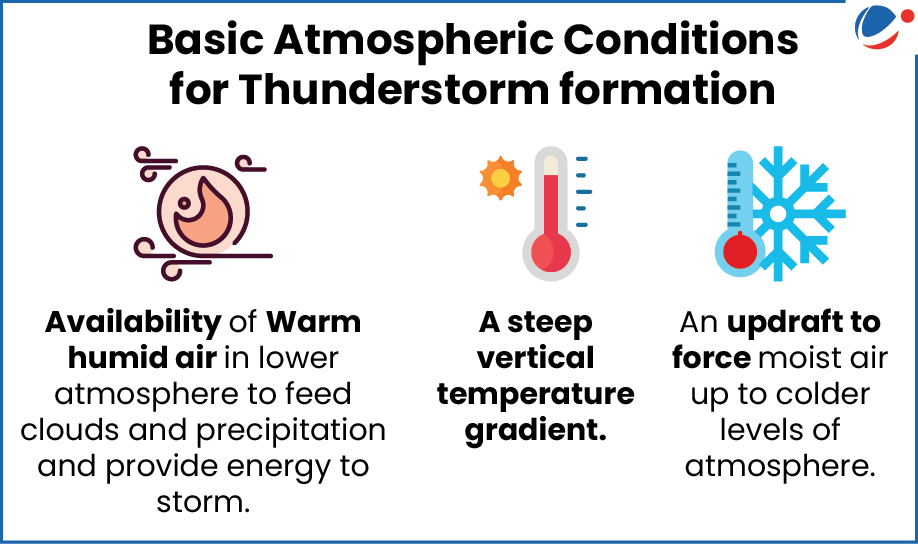
  • They are well grown cumulonimbus clouds producing thunder and lightning, caused by intense convection on moist hot days. 
    • They fall in category of Meso-gamma weather systems with spatial extent of around 2~20 km and temporal scale of few hours.
  • Types: Considering their intensity, the thunderstorms in India are categorised as
    • Moderate: Loud peals of thunder with associated lightning flashes, moderate to heavy rain and maximum wind speed of 29 to 74 kmph. 
    • Severe: Continuous thunder and occasional hailstorm, and maximum wind speed exceeding 74 kmph.
  • Occurrence: Frequency and intensity are maximum during summer months (March to June) due to intense heating up of atmosphere at surface level.
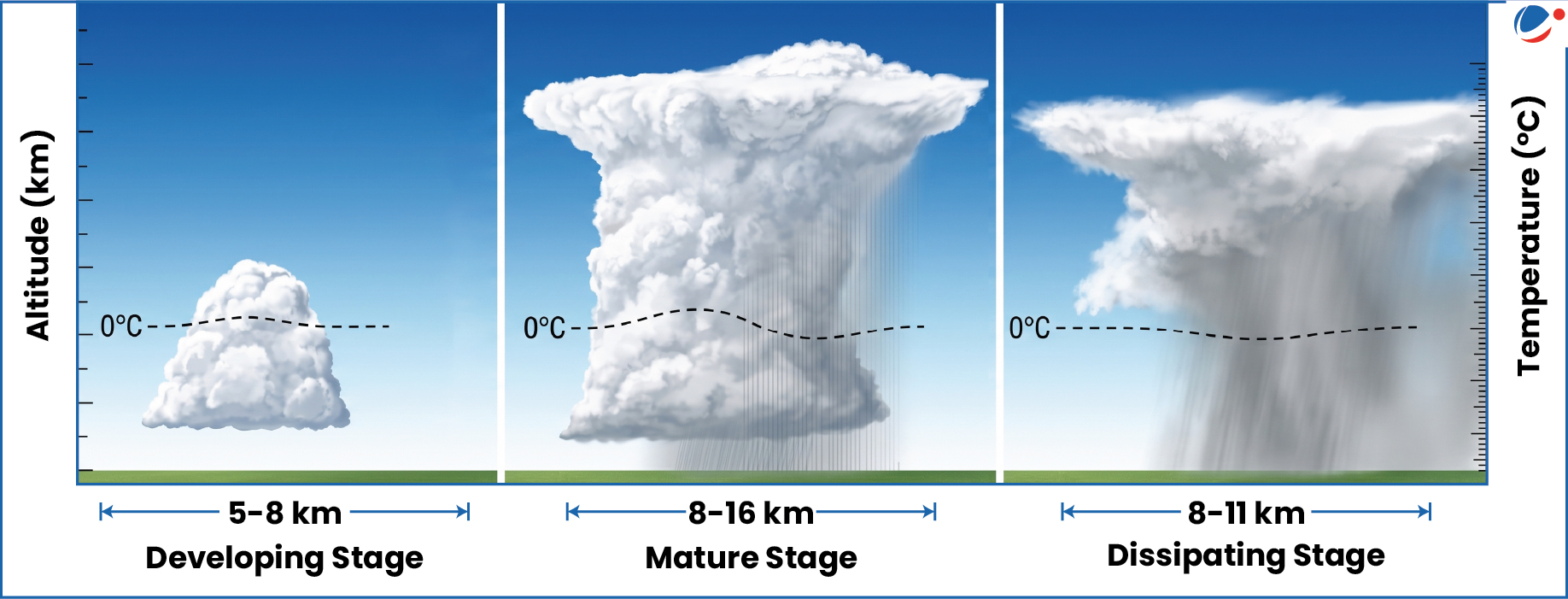
Life Cycle of Thunderstorms

  • Developing Stage: Marked by cumulus cloud being pushed upward by a rising column of air (updraft); that soon looks like a tower. 
    • This stage has little to no rain but occasional lightning. 
  • Mature Stage: While Updraft continues to feed the storm, precipitation begins to fall out of the storm, creating a downdraft (column of air pushing downward). 
    • Causes hail, heavy rain, frequent lightning, strong winds, and tornadoes.
  • Dissipating Stage: Eventually, large amount of precipitation is produced and the updraft is overcome by the downdraft beginning the dissipating stage. 
NDMA through its Guidelines for Prevention and Management of Thunderstorms, 2018 provide comprehensive measures to tackle it by way of Hazard mapping, structural mitigation measures, etc. 

Watch Video News Today

Explore Related Content

Discover more articles, videos, and terms related to this topic

RELATED TERMS

3

NDMA

राष्ट्रीय आपदा प्रबंधन प्राधिकरण (National Disaster Management Authority)। यह भारत में आपदा प्रबंधन के लिए एक शीर्ष निकाय है, जो नीति, योजना और समन्वय के लिए जिम्मेदार है।

Downdraft

A current of air that descends rapidly from a cloud, often triggered by falling precipitation, and can lead to strong surface winds.

Updraft

A current of air that rises rapidly within a cloud, contributing to the development and intensification of thunderstorms.

Title is required. Maximum 500 characters.

Search Notes

Filter Notes

Loading your notes...
Searching your notes...
Loading more notes...
You've reached the end of your notes

No notes yet

Create your first note to get started.

No notes found

Try adjusting your search criteria or clear the search.

Saving...
Saved

Please select a subject.

Referenced Articles

linked

No references added yet