


Government approved an increase in MSP for 14 Kharif Crops for Marketing Season 2026-27.
About MSP
- Definition: Mechanism through which government supports farmers by purchasing their crops at a pre-determined price.
- Recommendation: The Commission for Agricultural Costs & Prices (CACP), Ministry of Agriculture
- Final approval: Cabinet Committee on Economic Affairs, chaired by PM.
- Legal Status: MSP does not have any statutory (legal) backing.
- Crops Covered: 22 crops. In addition, MSP for Toria and De-Husked coconut is also fixed on the basis of MSPs of Rapeseed & Mustard and Copra.
- 14 Kharif Crops (e.g., Paddy, Jowar, Bajra, Maize, Ragi, Arhar, Moong, Urad, Groundnut, Soybean, Sunflower, Sesamum, Nigerseed, Cotton).
- 6 Rabi Crops (e.g., Wheat, Barley, Gram, Masur/Lentil, Rapeseed/Mustard, Safflower).
- 2 Commercial Crops (Raw Jute, Copra).
Wholesale inflation jumps to 3.5-year high of 8.3% in April 2026 due to war in West Asia.
About WPI:
- Meaning: It is a measure of the average change of prices of a fixed set of goods at the first point of bulk sale in a commercial transaction in the domestic market over a given period of time.
- Released by: Office of the Economic Adviser, Department for Promotion of Industry and Internal Trade, Union Ministry of Commerce & Industry.
- Base Year: 2022-23
- Composition of Basket: Categorized into three major groups:
- Primary Articles (Weight 22.62%): Consists of 4 sub-groups: Food Articles; Non-Food Articles; Minerals; and Crude petroleum and natural gas
- Fuel & Power (Weight 13.15%): Consists of 3 sub-groups: Coal; Mineral Oils; Electricity.
- Manufactured Products (Weight 64.23%): Consists of 22 sub-groups.
Article Sources
1 sourceA study suggests Neanderthals carried out dental procedure around 59,000 years ago based on a molar found in Chagyrskaya Cave in Siberia, Russia.
About Neanderthals (Homo neanderthalensis)
- Period: from about 400,000 to 40,000 years ago.
- Location: Evolved in Europe and southwest and central Asia whereas our species, Homo sapiens - were evolving in Africa.
- Appearance: Long and low skull, large nose and brain, strong double-arched brow ridge, relatively short and stocky bodies and didn't have much of a chin.
- Diet: largely carnivore but also ate plants
- Features: skilled tool makers, proficient hunters, able to communicate, made fire and jewellery.
- However no clear examples of them creating representational art copied from real sources such as animals.
The Chinese President raised the “Thucydides Trap”and Peloponnesian War in talks with the US president in Beijing.
About Thucydides Trap:
- Origin: The term was coined by Harvard political scientist Graham Allison.
- He named it after the ancient Greek historian Thucydides who chronicled the Peloponnesian War.
- Peloponnesian War was long war between Athens and Sparta started in 431BC.
- He named it after the ancient Greek historian Thucydides who chronicled the Peloponnesian War.
- Meaning: It describes the danger that emerges when a rising power threatens to displace a dominant one, leading to conflict.
- Modern Relevance: it is used to analyze the complex and tense geopolitical relationship such as between the United States (established power) and China (rising global power).
Technology Development Board entered into an agreement is under the Indo-Singapore collaborative framework to develop treatment for Multiple Myeloma (incurable blood cancer) using CAR- T cell therapy.
About CAR-T cell therapy
- CAR-T cell therapy is called a "living drug" because it uses the patient's own living immune cells (T-cells).
- It is a type of immunotherapy which modifies immune cells, specifically T-cells, by turning them into potent cancer fighters known as CAR-T cells.
- T-cells are special cells (types of white blood cells) whose primary function is cytotoxic, meaning killing other cells.
- T cells are taken from patient blood and are changed in the lab by adding a gene for a man-made receptor (called CAR) then returned to patient.
- CARs are proteins that assist the T-cells to recognise and attach to a specific protein present on cancer cells.
Article Sources
1 sourceIndia nominated as Chair of CCDB from April 2026 to April 2028, during 1st Quarter Meeting of Common Criteria Recognition Arrangement (CCRA) in Japan.
About CCDB
- Serves as technical core of CCRA, managing international work program for Common Criteria (CC) and Common Methodology for Information Technology Security Evaluation (CEM).
- CCRA is foundational international treaty enabling mutual recognition of IT security certificates across borders comprising 20 certificate-authorizing and 18 certificate-consuming nations.
- India and CCDB: India has been active member of CCRA since 2013 as Certificate Authorizing Nation.
- Through Ministry of Electronics and Information Technology (MEITY) and STQC Directorate, as the official Certification Body for IT security evaluations in India.
Article Sources
1 source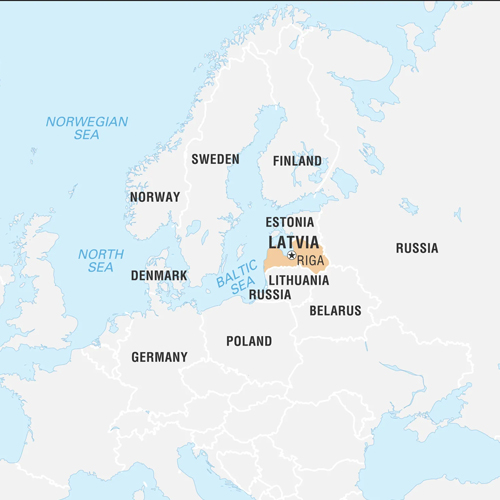
Latvia (Capital: Riga)
Latvian Prime Minister announced resignation over government’s handling of multiple incidents involving stray drones suspected from Ukraine.
Political Features
- Location: Northeastern Europe and middle of the three Baltic states.
- Baltic States comprises of Estonia, Latvia, and Lithuania.
- Land Boundaries: Estonia (North), Russia (East), Belarus (Southeast), and Lithuania (South).
- Maritime Boundaries: Baltic Sea and Gulf of Riga.
Geographical Features
- Highest point: Gaizinkalns
- Major rivers: Daugava, Gauja, Venta.
National Investigation Agency (NIA) highlights the use of rare explosive mixture TATP in the 2025 Red Fort blast.
About TATP (C9H18O6)
- Also known as “Mother of Satan” and acetone peroxide, it is a semi-stable crystalline solid, attractive as a terror weapon as it is relatively easy to prepare.
- Key Characteristics: belongs to a class of organic peroxide explosives.
- extremely sensitive to impact, friction, static electricity, and heat.
- extremely dangerous, and even small quantities (1gram) can cause injury and damage.
- Terror Linkages: Used in major terror attacks like Paris (2015), Brussels (2016), Manchester Arena (2017), etc.
International panel has renamed polycystic ovary syndrome (PCOS) as PMOS.
- PCOS is a common hormonal condition affecting women of reproductive age.
- In this, ovaries produce excess androgens (hormones regulating masculine characteristics), causing irregular menstruation, ovarian cysts, acne, weight gain and fertility difficulties.
- “PCOS” was considered misleading because many women diagnosed with it do not have polycystic ovaries; narrowing down both diagnosis and treatment.
About PMOS
- PMOS highlights multiple hormonal pathways, central metabolic dysfunction and broader systemic risks.
- Polyendocrine: involvement of multiple hormone-producing systems.
- Metabolic: connection with metabolic dysfunction, insulin resistance and cardio-metabolic dysfunctions as central features.
- Ovarian: irregular menstruation, infertility and ovulation problems
- Syndrome: complex multisystem disorder and not single-organ complication.




