
Cabinet approves SARTHAK-PDS Scheme to Modernise Public Distribution System (PDS) | Current Affairs | Vision IAS

Upgrade to Premium Today

Start Now
MENU
Home
Quick Links

High-quality MCQs and Mains Answer Writing to sharpen skills and reinforce learning every day.

Watch explainer and thematic concept-building videos under initiatives like Deep Dive, Master Classes, etc., on important UPSC topics.

A short, intensive, and exam-focused programme, insights from the Economic Survey, Union Budget, and UPSC current affairs.

ESC

In Summary

  • SARTHAK-PDS integrates two schemes, running until March 2031 with a ₹25,530 crore outlay for 81.35 crore NFSA beneficiaries.
  • Key features include unified national databases, AI analytics, automated grievance redressal, and standardized digital processes for real-time monitoring and transparency.
  • The scheme aims to improve last-mile delivery and reduce leakages by supporting intra-state transport, handling, and FPS margins within a citizen-centric PDS.

In Summary

The Scheme for Assistance in Ration Transport and Handling-Income with Automation in PDS (SARTHAK-PDS) integrates two schemes:

  • Assistance to State Agencies for intra-State movement of foodgrains and FPS dealers’ margin under NFSA” 
  • Scheme for Modernization and Reforms through Technology in PDS (SMART PDS).

About SARTHAK-PDS
  • Duration: Up to 31 March 2031 (16th Finance Commission cycle).
  • Outlay: ₹25,530 crore over five years.
  • Coverage: Around 81.35 crore NFSA beneficiaries.
  • Key Features:
    • Unified national databases, AI-enabled analytics dashboards, automated grievance redressal systems, etc to monitor distribution networks in real time. 
    • Standardised digital processes and ISO-certified protocols to improve transparency.
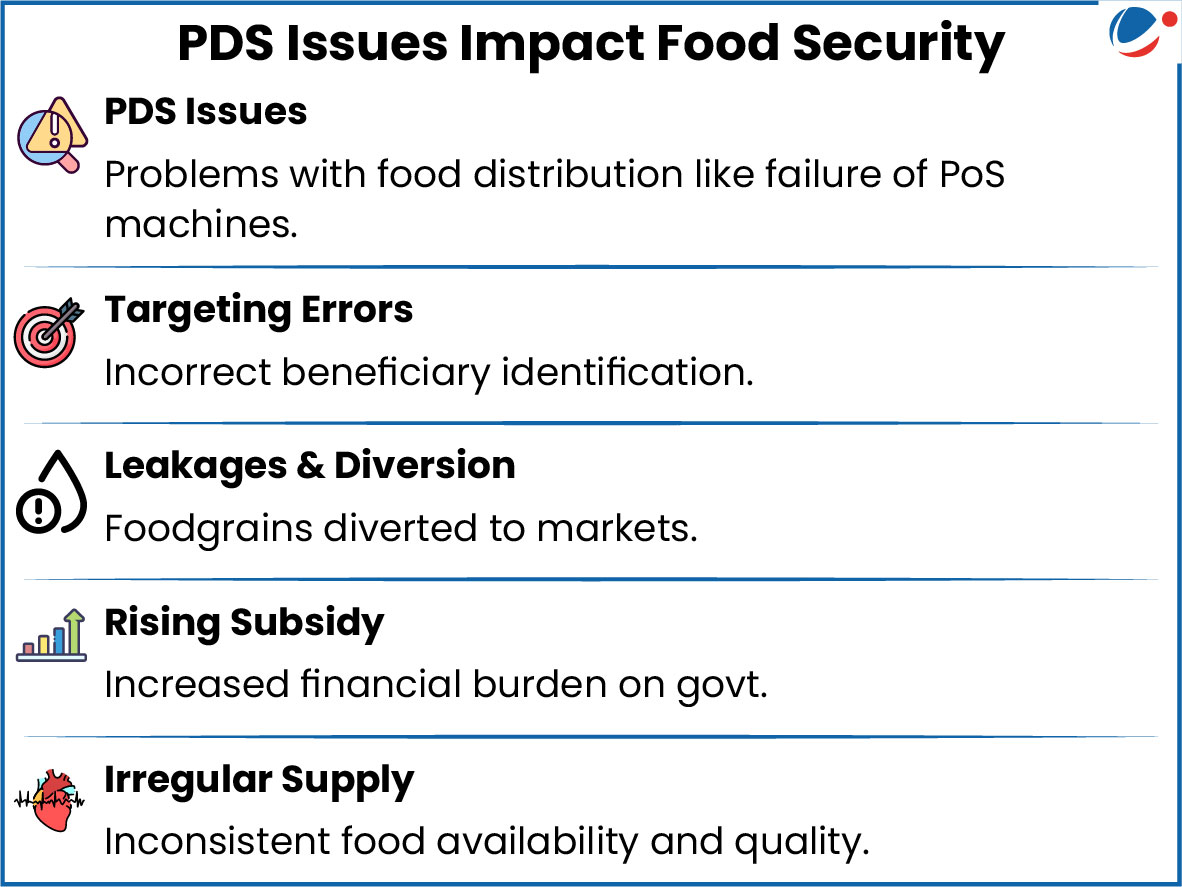
  • Aim: Provides financial support for intra-state transport, handling, and FPS margins, while creating a unified, citizen-centric and interoperable PDS to improve last-mile delivery and reduce leakages. 

About Public Distribution System (PDS)

  • Eligibility under National Food Security Act, 2013 (NFSA): Antyodaya Anna Yojana (AAY) households are eligible to receive 35 kg of foodgrains per family per month, whereas the Priority Households (PHH) beneficiaries are eligible to receive 5 kg of foodgrains per person per month.
  • Ministry: Ministry of Consumer Affairs, Food and Public Distribution.
  • Operated Jointly
    • Centre (through Food Corporation of India): Procurement, storage, transportation and bulk allocation of food grains.
    • States: Operational  responsibility including allocation within State, identification  of eligible families, issuing of Ration Cards and supervision of Fair Price Shops. 
Watch Video News Today

Explore Related Content

Discover more articles, videos, and terms related to this topic

RELATED TERMS

3

Food Corporation of India (FCI)

A government-owned corporation established under the Food Corporations Act, 1964, it is a nodal agency responsible for the procurement, storage, movement, and distribution of food grains to ensure food security in India.

FPS

Fair Price Shop. Retail outlets where foodgrains and other essential commodities are distributed to the beneficiaries of the Public Distribution System at subsidized prices.

PHH

Priority Households. Beneficiary households identified by the State Government under NFSA, entitled to receive 5 kg of foodgrains per person per month at subsidized prices.

Title is required. Maximum 500 characters.

Search Notes

Filter Notes

Loading your notes...
Searching your notes...
Loading more notes...
You've reached the end of your notes

No notes yet

Create your first note to get started.

No notes found

Try adjusting your search criteria or clear the search.

Saving...
Saved

Please select a subject.

Referenced Articles

linked

No references added yet
