
MAHA Water Mission Launched Towards Water-Secure Future | Current Affairs | Vision IAS

Upgrade to Premium Today

Start Now
MENU
Home
Quick Links

High-quality MCQs and Mains Answer Writing to sharpen skills and reinforce learning every day.

Watch explainer and thematic concept-building videos under initiatives like Deep Dive, Master Classes, etc., on important UPSC topics.

A short, intensive, and exam-focused programme, insights from the Economic Survey, Union Budget, and UPSC current affairs.

ESC

In Summary

  • MAHA (Mission for Advancement in High-Impact Areas) Water Mission, a Rs 200 crore program, funds multidisciplinary consortia for scalable water solutions.
  • Focus areas include water resource management, drinking water, quality, efficiency, and climate resilience.
  • Modern tech like GIS, remote sensing, and real-time monitoring is used for water conservation and management.

In Summary

It is a Rs 200 crore programme launched by Anusandhan National Research Foundation and Ministry of Jal Shakti

Key Highlights of MAHA (Mission for Advancement in High-Impact Areas) Water Mission

  • Purpose: Provide up to Rs 20 crore to selected multidisciplinary consortia (universities, Startups, MSMEs, industries, etc.) for technology development, field assessment, validation and deployment of high‑impact innovative and scalable water solutions.
  • Five priority themes: Water resource assessment and sustainable management; drinking water; water quality and ecological health; water use efficiency and circular economy; climate resilience and adaptation.
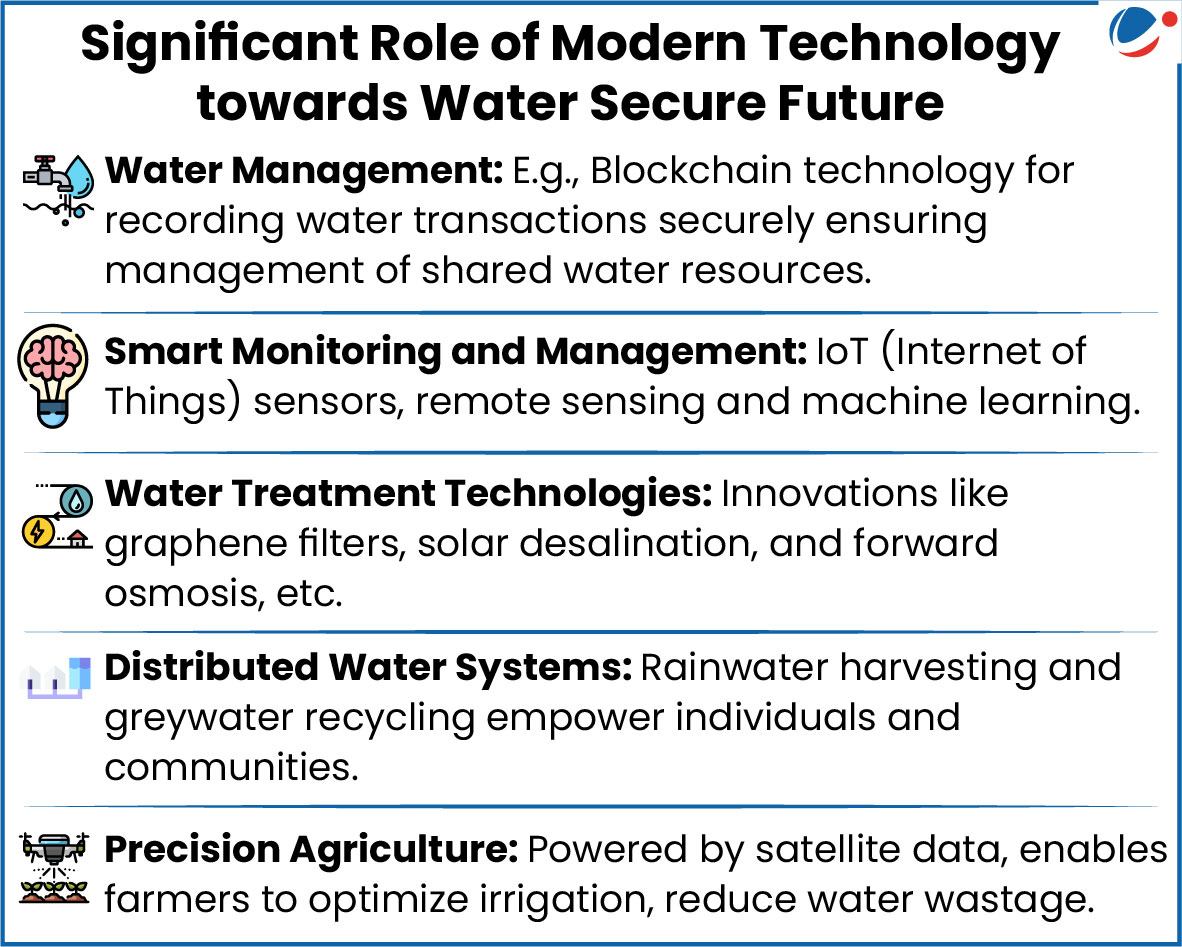
Key Initiatives incorporating Modern Technology in Water Management

  • Scientific Data-Driven Conservation: Enumeration, geo-tagging and incentivization of water bodies under Jal Shakti Abhiyan: Catch the Rain (JSA: CTR) Campaign
    • Use of remote sensing data from National Remote Sensing Agency (NRSA) and Geographic Information System (GIS), etc. 
  • Real-time groundwater level monitoring: Nationwide network of Digital Water Level Recorders (DWLRs) equipped with telemetry systems conducted by Central Ground Water Board (CGWB).
  • Use of Satellite: From platforms like GRACE (Gravity Recovery and Climate Experiment) for large-scale groundwater storage assessment, NISAR (NASA-ISRO Synthetic Aperture Radar) mission for detection of groundwater changes at macro level.
  • Smart elements in sustainable Urban development: AMRUT guidelines provides for smart elements like Supervisory Control and Data Acquisition (SCADA) as part of water supply and sewerage projects.

Watch Video News Today

Explore Related Content

Discover more articles, videos, and terms related to this topic

RELATED VIDEOS

1
News Today (Sep 11, 2024)

News Today (Sep 11, 2024)

YouTube HD

RELATED TERMS

3

Supervisory Control and Data Acquisition (SCADA)

A system that enables the monitoring and control of industrial processes, often used in water supply and sewerage projects to oversee operations, collect data in real-time, and manage system performance efficiently.

AMRUT guidelines

Guidelines for the Atal Mission for Rejuvenation and Urban Transformation (AMRUT), a government scheme aimed at improving urban infrastructure in India, including water supply, sewerage, and drainage systems, with an emphasis on smart solutions.

NISAR (NASA-ISRO Synthetic Aperture Radar)

A joint NASA-ISRO mission that will use advanced radar technology to observe Earth's land surfaces at high resolution, capable of detecting changes in groundwater at a macro level, soil moisture, and surface deformation.

Title is required. Maximum 500 characters.

Search Notes

Filter Notes

Loading your notes...
Searching your notes...
Loading more notes...
You've reached the end of your notes

No notes yet

Create your first note to get started.

No notes found

Try adjusting your search criteria or clear the search.

Saving...
Saved

Please select a subject.

Referenced Articles

linked

No references added yet