
Chief Economic Advisor (CEA) Highlighted Chronic Underinvestment in India’s R&D | Current Affairs | Vision IAS

Upgrade to Premium Today

Start Now
MENU
Home
Quick Links

High-quality MCQs and Mains Answer Writing to sharpen skills and reinforce learning every day.

Watch explainer and thematic concept-building videos under initiatives like Deep Dive, Master Classes, etc., on important UPSC topics.

A short, intensive, and exam-focused programme, insights from the Economic Survey, Union Budget, and UPSC current affairs.

ESC

In Summary

  • India's R&D expenditure is low (0.6-0.7% of GDP) compared to nations like South Korea and Israel, with the government funding most of it.
  • Factors contributing to low R&D include a large captive domestic market, historical de-industrialization, premature financialization, and systemic uncertainties.
  • To boost R&D, Indian corporates need long-term focus, aligning shareholder interests with national goals, and learning from global models like Germany, Japan, and South Korea.

In Summary

CEA warned that such underinvestment could lead to 

  • Existential threat to India’s future corporate profits (due to technology dependence).
  • Loss of geopolitical leverage (due to poor global value chains integration).

Current Status of R&D Expenditure in India
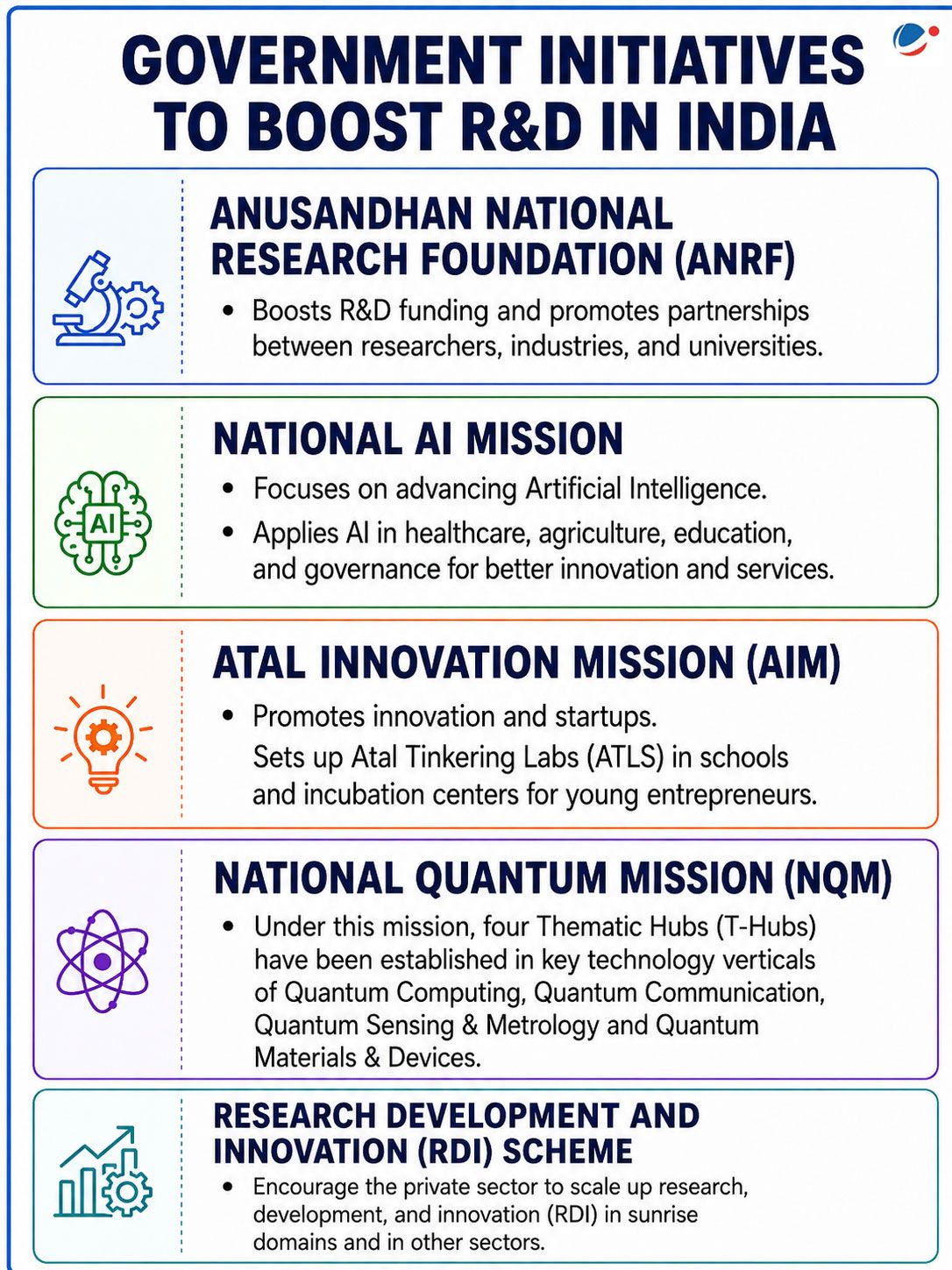
  • Gross Expenditure on Research and Development (GERD): India’s GERD is 0.6-0.7 % of GDP.
    • It is significantly lower than South Korea (4.9%) and Israel (6.3%). 
  • Funding Share: Government (~64%)&private sector (~36%) of total R&D spending,

Why India’s R&D expenditure remains low?

  • Captive Domestic Market: Large domestic demand reduces pressure for export competitiveness and innovation.
  • Colonial De-industrialisation: Colonial rule shifted focus from manufacturing (such as textiles) and innovation to commerce, trading, and arbitrage.
  • Premature Financialisation: Corporate focus on short-term stock prices discourages long-term productive investment. 
  • Generational Shifts: Third-generation family firms often prioritize easier returns of financial markets over capital-intensive manufacturing.
  • Systemic Uncertainty: Operating in a complex democracy with a hostile neighborhood makes long-term planning risky, causing businesses to heavily discount distant R&D payoffs.
  • Others: Geopolitical uncertainty and macroeconomic volatility in last 15 years, such as the 2008 crash, COVID-19, wars, etc. have led firms to defer irreversible, long-term investments.

Way Ahead

  • Long-Term Focus:Indian corporate boardrooms must be willing to absorb short-term costs in pursuit of long-run competitive advantage.
  • Recognize the Convergence of Interests: Private sector must align shareholder interests with long-term national interests and move beyond low-hanging domestic demand. 
  • Learn from global successes: 
  • Germany’s Mittelstand: Deep engineering capabilities through patient capital and a cultural commitment to quality.
  • Japan’s Post-War Miracle: Long-horizon corporate strategies and a willingness to absorb short-term losses.
  • South Korea’s Chaebol: World-class capabilities in semiconductors and shipbuilding by investing at scale.
Watch Video News Today

Explore Related Content

Discover more articles, videos, and terms related to this topic

RELATED VIDEOS

3
The Contribution of Indian Cinema to the Creative Economy

The Contribution of Indian Cinema to the Creative Economy

YouTube HD
Impact Investments

Impact Investments

YouTube HD
Universal and Meaningful Connectivity

Universal and Meaningful Connectivity

YouTube HD

RELATED TERMS

3

Chaebol

Chaebol are large, family-controlled industrial conglomerates found in South Korea. They are known for their diversification across various sectors and significant investments in areas like semiconductors and shipbuilding, often with government support.

Mittelstand

A term used to describe the backbone of the German economy, referring to small and medium-sized enterprises (SMEs) that are often family-owned, highly specialized, export-oriented, and leaders in their niche markets globally. They are known for their innovation, quality, and long-term vision.

Financialisation

Financialisation refers to the increasing role of financial motives, financial markets, financial actors and financial institutions in the operation of domestic and international economies. For UPSC, it's key to understanding economic policy, corporate governance, and the shift towards prioritizing financial returns over industrial investment.

Title is required. Maximum 500 characters.

Search Notes

Filter Notes

Loading your notes...
Searching your notes...
Loading more notes...
You've reached the end of your notes

No notes yet

Create your first note to get started.

No notes found

Try adjusting your search criteria or clear the search.

Saving...
Saved

Please select a subject.

Referenced Articles

linked

No references added yet
