
Government pushes for setting up a root server in India | Current Affairs | Vision IAS

Upgrade to Premium Today

Start Now
MENU
Home
Quick Links

High-quality MCQs and Mains Answer Writing to sharpen skills and reinforce learning every day.

Watch explainer and thematic concept-building videos under initiatives like Deep Dive, Master Classes, etc., on important UPSC topics.

A short, intensive, and exam-focused programme, insights from the Economic Survey, Union Budget, and UPSC current affairs.

ESC

In Summary

  • India requested ICANN to establish a root server to enhance Digital Sovereignty, crucial for national security and economic resilience.
  • Digital Sovereignty enables India to control its digital space, data, and infrastructure, reducing reliance on foreign technology.
  • Key aspects include national security, economic resilience, data sovereignty, and strategic autonomy for India's rising power status.

In Summary

Government of India asks Internet Corporation for Assigned Names and Numbers (ICANN) to set up a root server in India to push towards Digital Sovereignty.
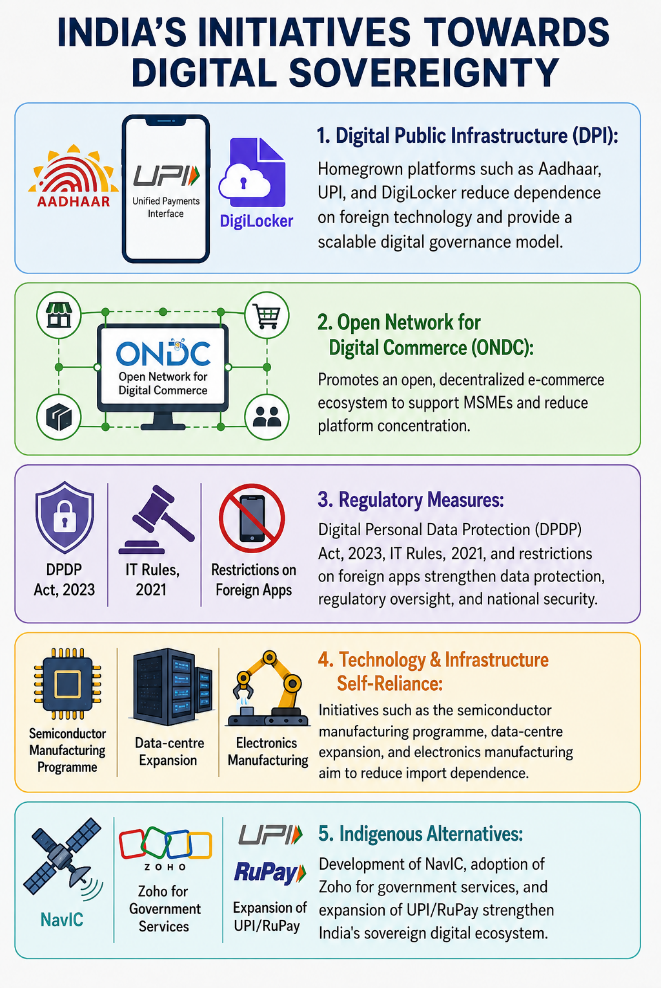
  • ICANN is a global not-for-profit partnership formed in 1998 to keep the Internet secure, stable, and interoperable by coordinating its unique identifiers.
  • Root server is the core part of the internet that connects users to websites.
    • User search on the internet goes to root servers, which, like an exchange, search the location of a website or URL on world wide web and then connect the user with them.

About Digital Sovereignty 

  • It is the ability of a nation to govern its digital space, retaining meaningful control over its data, digital infrastructure, networks, and online narratives, free from external influence.
  • Significance of Digital Sovereignty for India 
    • National Security: Dependence on foreign technology can compromise defence capabilities and strategic autonomy, as seen during the 1999 Kargil conflict when GPS access was restricted.
    • Economic Resilience: Reliance on imported semiconductors, operating systems, cloud services, and security infrastructure creates vulnerabilities that can disrupt business, manufacturing, and trade.
    • Data Sovereignty: Local control over data protects privacy, prevents data exploitation by foreign entities, and retains the economic value of data within the country.
    • Strategic Autonomy: As a rising power, India requires an independent technological ecosystem to reduce external leverage and maintain policy freedom.

Watch Video News Today

Explore Related Content

Discover more articles, videos, and terms related to this topic

RELATED TERMS

3

Strategic Autonomy

The ability of a nation to pursue its own interests and make independent decisions in critical sectors, free from undue influence or dependence on external powers. A strong manufacturing base contributes significantly to strategic autonomy.

Data Sovereignty

The concept that data is subject to the laws and governance structures of the nation where it is collected or processed. Project Suncatcher aims to mitigate this by leveraging outer space, which is not under national jurisdiction.

Digital Sovereignty

The ability of a nation to control its own digital infrastructure, data, and technology. The article highlights the importance of AI development for India's digital sovereignty.

Title is required. Maximum 500 characters.

Search Notes

Filter Notes

Loading your notes...
Searching your notes...
Loading more notes...
You've reached the end of your notes

No notes yet

Create your first note to get started.

No notes found

Try adjusting your search criteria or clear the search.

Saving...
Saved

Please select a subject.

Referenced Articles

linked

No references added yet