
India launches World’s First Nuclear Process Heat-based Hydrogen Production Facility | Current Affairs | Vision IAS

Upgrade to Premium Today

Start Now
MENU
Home
Quick Links

High-quality MCQs and Mains Answer Writing to sharpen skills and reinforce learning every day.

Watch explainer and thematic concept-building videos under initiatives like Deep Dive, Master Classes, etc., on important UPSC topics.

A short, intensive, and exam-focused programme, insights from the Economic Survey, Union Budget, and UPSC current affairs.

ESC

In Summary

  • DAE inaugurated a hydrogen production facility using nuclear energy via the indigenous copper-chlorine thermochemical process.
  • The facility utilizes process heat from the Fast Breeder Test Reactor (FBTR) at IGCAR, Kalpakkam.
  • Other hydrogen production methods include thermochemical processes like Steam Methane Reforming (SMR) and electrolytic processes.

In Summary

Inaugurated by Department of Atomic Energy (DAE),  facility serves as technology demonstrator for production of hydrogen using nuclear energy through copper-chlorine thermochemical process developed indigenously by Bhabha Atomic Research Centre (BARC). 
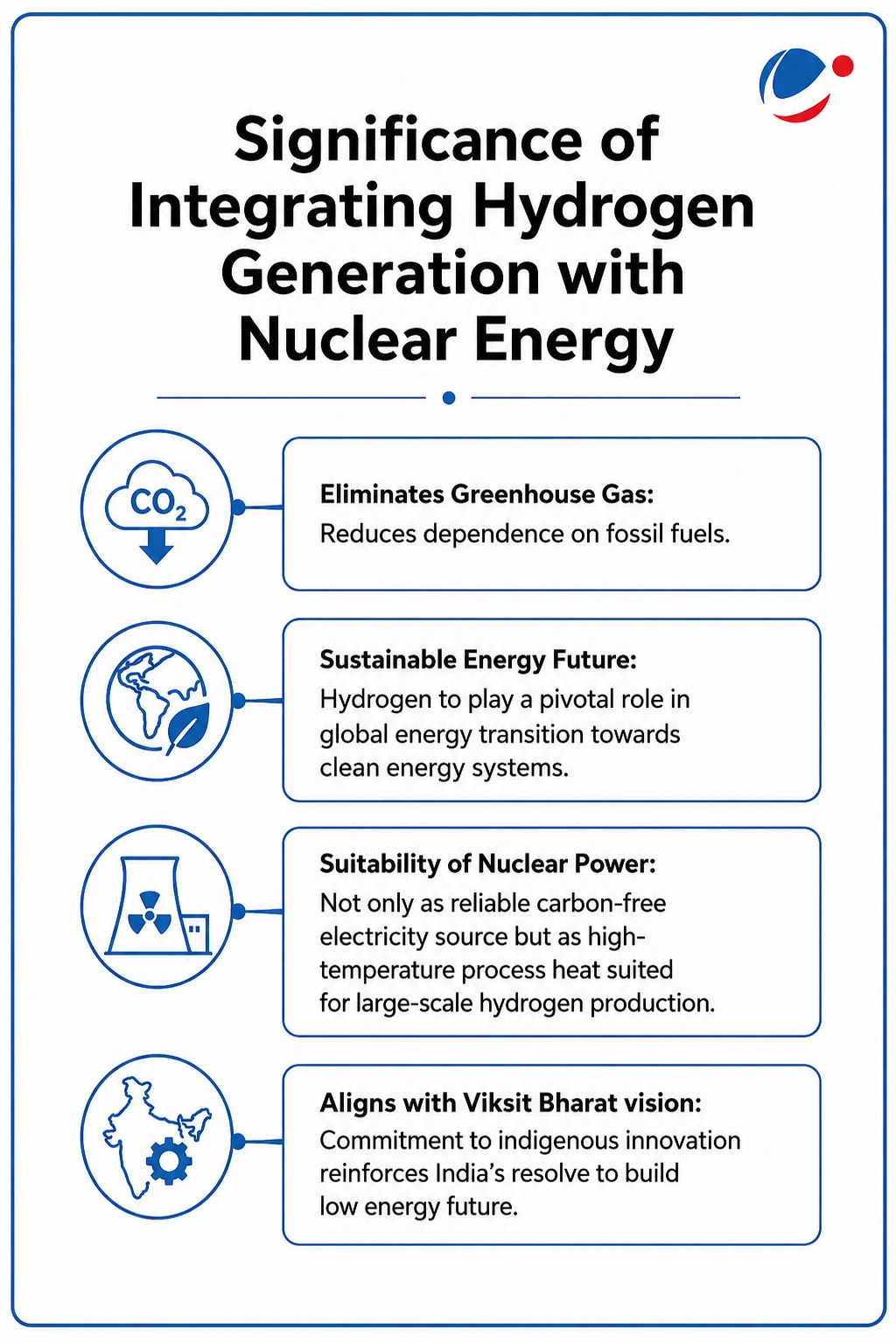
Key Highlights 

  • Use of Fast Breeder Test Reactor (FBTR): It utilizes nuclear process heat generated from FBTR at Indira Gandhi Centre for Atomic Research (IGCAR), Kalpakkam. 
    • Established in 1971, IGCAR, is one of India's premier nuclear research institutions under DAE. 
    • FBTR served as an invaluable platform for development and validation of fuels, materials and sodium technologies. 
      • Also played a pivotal role in development of 500 MWe Prototype Fast Breeder Reactor (PFBR), flagship of second stage of India's three-stage nuclear power programme.
  • Copper-Chlorine (Cu-Cl) thermochemical process: It uses high-temperature heat from nuclear reactor to split water into hydrogen and oxygen. 
    • Cu-Cl cycle operates at lower temperatures while offering relatively high efficiency, considered one of more promising thermochemical routes. 

Other Methods for Hydrogen Production

  • Thermochemical Processes: Use the energy in various resources like natural gas, coal, or biomass, to release hydrogen from their molecular structure. E.g. Steam Methane Reforming (SMR). 
    • In SMR, Natural gas reacts with high-temperature steam (at 700-1000 °C) under 3-25 bar pressure in presence of catalyst to produce carbon monoxide, carbon dioxide and hydrogen. 
  • Electrolytic Processes: Electrolysers use electricity to split water into hydrogen and oxygen. 
  • Photoelectrochemical (PEC) water splitting: Hydrogen is produced from water using sunlight and specialized semiconductors called photoelectrochemical materials. 

Watch Video News Today

Explore Related Content

Discover more articles, videos, and terms related to this topic

RELATED TERMS

3

Photoelectrochemical (PEC) water splitting

A process for producing hydrogen from water using sunlight and specialized semiconductor materials, offering a direct solar-to-hydrogen conversion pathway.

Electrolytic Processes

Methods that use electricity to split water into hydrogen and oxygen, a key technology for producing 'green hydrogen' when renewable energy is used.

Steam Methane Reforming (SMR)

A widely used industrial process for producing hydrogen from natural gas by reacting it with high-temperature steam in the presence of a catalyst.

Title is required. Maximum 500 characters.

Search Notes

Filter Notes

Loading your notes...
Searching your notes...
Loading more notes...
You've reached the end of your notes

No notes yet

Create your first note to get started.

No notes found

Try adjusting your search criteria or clear the search.

Saving...
Saved

Please select a subject.

Referenced Articles

linked

No references added yet