
Indus Waters Treaty to remain suspended: India | Current Affairs | Vision IAS

Upgrade to Premium Today

Start Now
MENU
Home
Quick Links

High-quality MCQs and Mains Answer Writing to sharpen skills and reinforce learning every day.

Watch explainer and thematic concept-building videos under initiatives like Deep Dive, Master Classes, etc., on important UPSC topics.

A short, intensive, and exam-focused programme, insights from the Economic Survey, Union Budget, and UPSC current affairs.

ESC

In Summary

  • India reiterated that the Indus Waters Treaty (IWT) remains suspended until Pakistan ends support for cross-border terrorism.
  • Signed in 1960, the IWT allocates Eastern rivers to India and Western rivers to Pakistan, with provisions for dispute resolution via the Permanent Indus Commission, Neutral Expert, or Court of Arbitration.
  • Suspension impacts Pakistan's food security, economy, and electricity, while for India, it raises concerns about weaponizing water resources and ecological imbalance.

In Summary

India has reiterated that the Indus Waters Treaty will remain suspended until Pakistan credibly and irreversibly ends its support for cross-border terrorism.

  • India had put the Treaty under abeyance post Pahalgam terrorist attack in April 2025.

About Indus Waters Treaty

  • Signed: On 19 September 1960 at Karachi between India and Pakistan, with the World Bank (IBRD) as a signatory/facilitator.
  • Came into force with retrospective effect from 1 April 1960.
  • Rivers Covered:
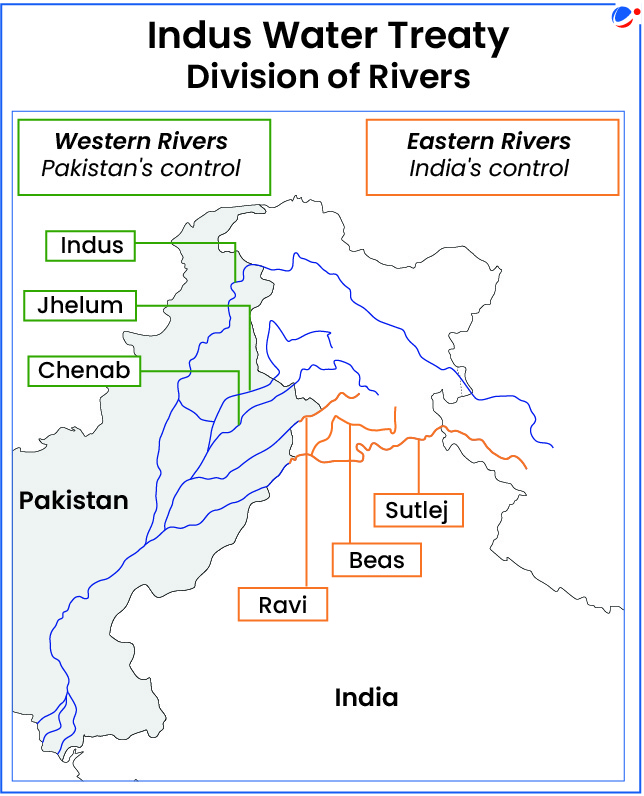
    • Eastern Rivers (Ravi, Beas and Sutlej): Allocated to India for unrestricted use.
    • Western Rivers (Indus, Jhelum and Chenab): Allocated to Pakistan.
      • India is permitted limited use for domestic purposes, non-consumptive uses, irrigation and run-of-the-river hydroelectric projects, in accordance with the Treaty.
  • Dispute Resolution under IWT:
    • Step 1: Permanent Indus Commission (PIC) with a commissioner from each country. (Meets annually alternatively in both countries).
    • Step 2: Neutral Expert (appointed by World Bank) and involves rendering a binding decision.
    • Step 3: Court of Arbitration upon agreement between parties or at the request of either party. 

Implications of the Suspension of the Indus Waters Treaty

For Pakistan:

  • Food insecurity: The Indus system irrigates over 80% of Pakistan's food crops (World Bank).
  • Economy: Wheat, rice and cotton, dependent on the Indus system, earned USD 4.8 billion in exports (2022).
  • Electricity and water stress: Around one-third of Pakistan's electricity comes from hydropower, while the country is already water-stressed.

For India:

  • Weaponisation of water resources: Global focus on Pakistan’ State-terror nexus
    • However, it might set a precedent for upstream countries, particularly China on the Brahmaputra, to adopt similar strategies.
  • Credibility as a responsible international actor: Unilateral suspension may be perceived as undermining treaty commitments.
  • Ecological imbalance: New water infrastructure projects may affect the biodiversity-rich and seismically sensitive Indus basin.
Watch Video News Today

Explore Related Content

Discover more articles, videos, and terms related to this topic

RELATED VIDEOS

1
Role of Indian Diaspora in Making India Self-Reliant

Role of Indian Diaspora in Making India Self-Reliant

YouTube HD

RELATED TERMS

3

State-terror nexus

A concept referring to the alleged involvement or support provided by a state to terrorist activities, often for strategic or political objectives. This term is used in the article to describe India's accusation against Pakistan.

Abeyance

A state of temporary inactivity or suspension. In this context, the Supreme Court has put a temporary hold on a previous judgment, meaning it is not currently in effect.

Court of Arbitration

A seven-member tribunal established under the Indus Water Treaty to legally adjudicate disputes that remain unresolved after the Permanent Indus Commission and Neutral Expert stages.

Title is required. Maximum 500 characters.

Search Notes

Filter Notes

Loading your notes...
Searching your notes...
Loading more notes...
You've reached the end of your notes

No notes yet

Create your first note to get started.

No notes found

Try adjusting your search criteria or clear the search.

Saving...
Saved

Please select a subject.

Referenced Articles

linked

No references added yet
