


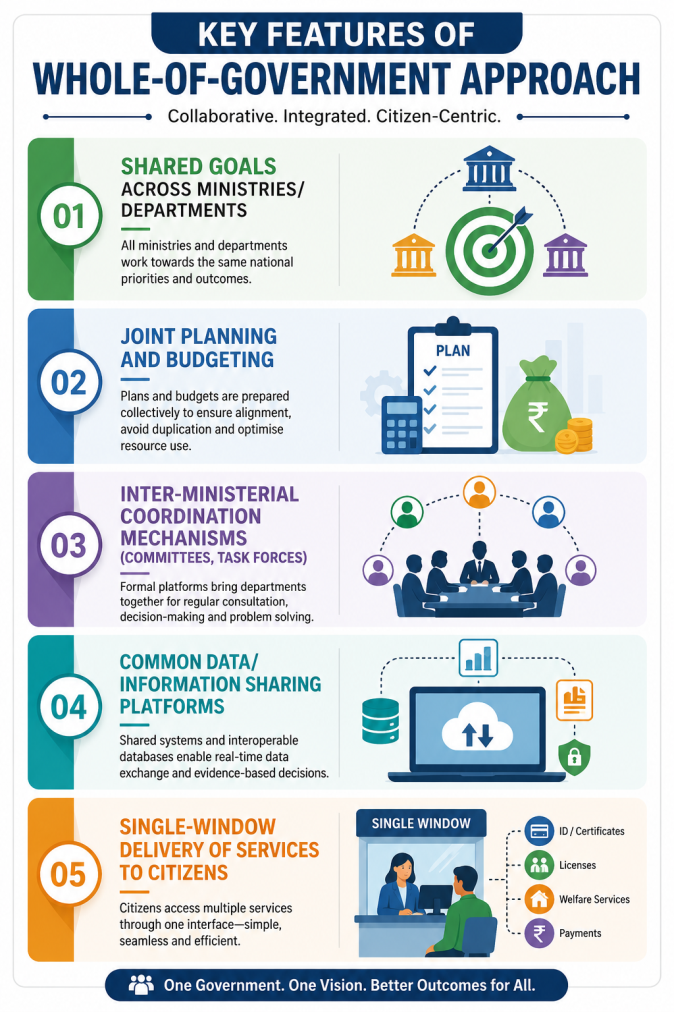
Whole of Government (WoG) approach refers to a mode of governance where different government departments & ministries work together (rather than in silos) to achieve shared goals that no single agency can tackle alone.
- E.g. climate change, poverty etc.
Key Benefits of WoG Approach
- Enhanced Policy Coherence: It ensures that different departments are not working at cross-purposes, leading to more consistent governance.
- E.g. new highways are often dug up soon after construction to lay optical fiber cables.
- Improved Efficiency and Effectiveness: Streamlined processes and integrated service delivery reduce redundancy and optimize resource allocation.
- E.g. POSHAN Abhiyaan brings together > 26 ministries to tackle malnutrition as it cannot be solved by food alone but requires clean water, immunization etc.
- Resource Optimization: Pools financial, human, and technological resources, which reduces delays, cost overruns and allows sharing of knowledge.
- Increased Public Trust: Instead of citizens navigating multiple departments for approvals, integrated platforms provide single-window solutions.
- E.g. Jan Samarth portal integrates 13 credit-linked government schemes from various ministries onto one digital platform.
- Rapid Crisis Response: As demonstrated during the COVID-19 pandemic, a WoG approach allows for a unified and timely response to national emergencies.
- Others: Reduces duplication, enhances transparency and accountability, etc.
Key Initiatives taken in India
|


