


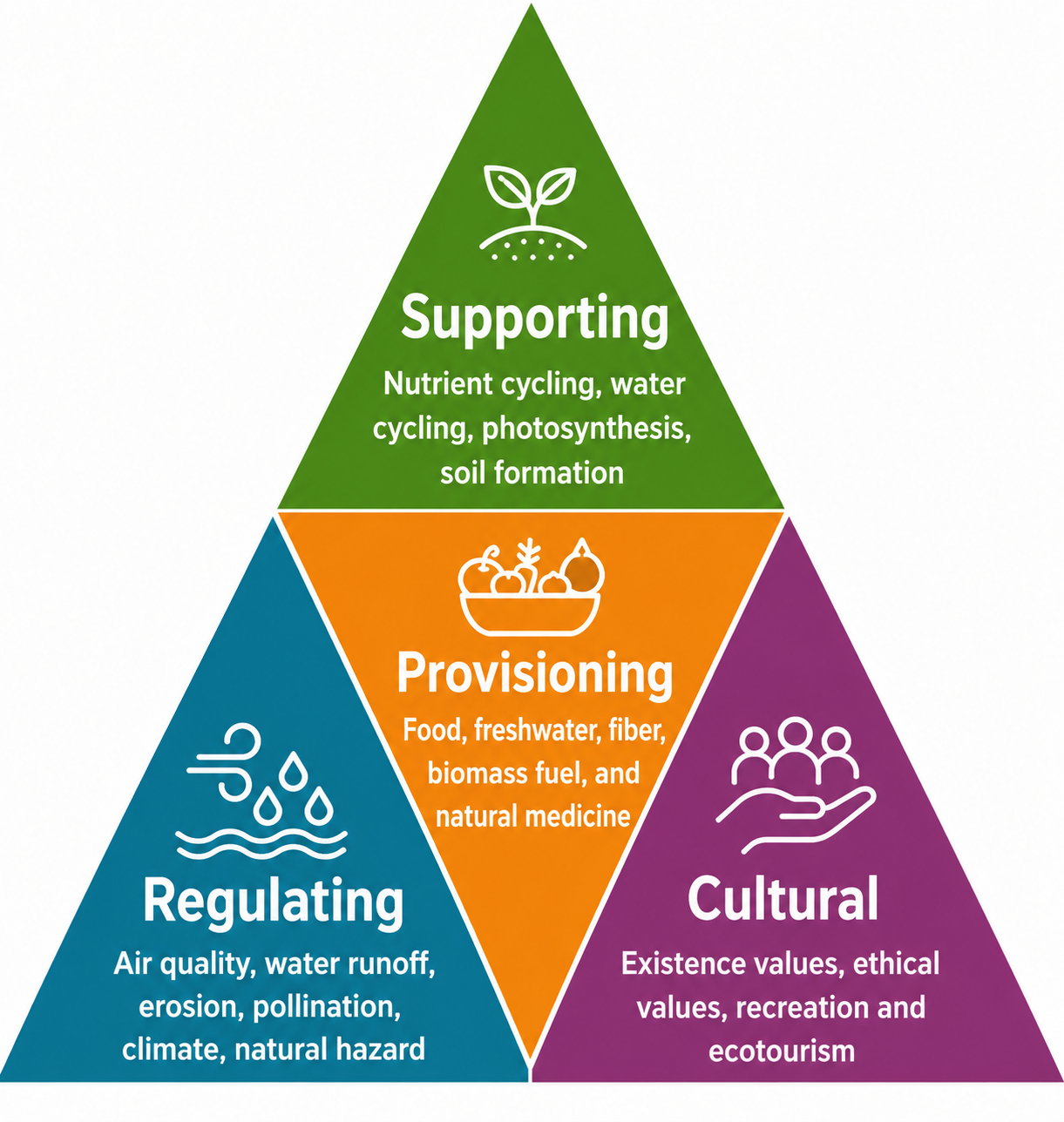
A new study, for the first time, quantified the actual worth of India's forests on a comprehensive national scale.
- The study reveals that Indian forests generate "invisible wealth" that is equivalent to nearly two-thirds of India's formal economy.
Key Findings of Study
- India's forest ecosystem services were worth US$2.5 trillion annually (2023 constant prices).
- Tropical dry deciduous forests contribute the maximum annual value of US$703 billion, followed by Mangrove forests.
- Tropical dry deciduous forests account for the largest proportion of India's forest cover.
- The average value of cultural services is greater than provisioning services and regulating services. (refer infographic for types of ecosystem services).
Challenges Highlighted
- Population Pressure: A 1% increase in population density is associated with a 11.3% decrease in the value of forest ecosystem services.
- Quality Over Quantity: A monoculture plantation counts as forest cover in official statistics but delivers a fraction of the ecosystem services of a natural mixed-species stand.
- Flawed Compensation Models: E.g., Net Present Value (NPV) under-represent the full economic cost of lost regulating and cultural services.
- Accounting Gaps: Failed to integrate forest ecosystem services into India's national income accounts.
The study recommended strengthening Compensatory Afforestation Fund Management and Planning Authority (CAMPA) to prioritize ecologically important forests and expanding Payment for Ecosystem Services (PES) to incentivize biodiversity conservation.


