
Europe's late-June record-breaking heatwave caused over 10,000 excess deaths | Current Affairs | Vision IAS

Upgrade to Premium Today

Start Now
MENU
Home
Quick Links

High-quality MCQs and Mains Answer Writing to sharpen skills and reinforce learning every day.

Watch explainer and thematic concept-building videos under initiatives like Deep Dive, Master Classes, etc., on important UPSC topics.

A short, intensive, and exam-focused programme, insights from the Economic Survey, Union Budget, and UPSC current affairs.

ESC

In Summary

  • June 2026 saw record heat in western Europe and globally, linked to highest-ever sea surface temperatures.
  • Heatwaves caused declining photosynthesis in 57 million hectares of tropical forests, reducing growth and increasing mortality risk.
  • Heatwaves are defined by excess heat over consecutive days, influenced by high-pressure systems, clear skies, climate change, urbanization, and land-use changes.

In Summary

June 2026 was the hottest June recorded for western Europe and the second warmest globally, driven by the highest sea surface temperatures (SSTs) on record.

  • Separately, a study has highlighted that Heatwaves resulted in declining photosynthesis in nearly 57 million hectares of tropical forests, reducing growth and increasing risk of plant mortality. 
    • Photosynthesis is the process by which plants use sunlight, water, and carbon dioxide to create oxygen and energy in the form of sugar.

About Heatwaves
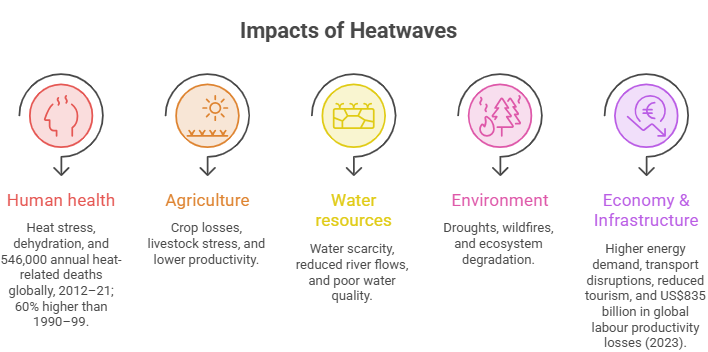
  • A heatwave is a weather phenomenon defined by the ‘local cumulative excess heat over a sequence of unusually hot days and nights.’
  • The World Meteorological Organization defines a heat wave as five or more consecutive days during which the daily maximum temperature exceeds the average maximum temperature by five degrees Celsius.

Factors Causing Heatwaves

  • High-Pressure Systems: Trap hot air, creating a heat dome and preventing heat from escaping.
  • Clear Skies: Reduced cloud cover allows greater solar radiation, increasing surface temperatures.
  • Climate Change: Rising global temperatures increase the frequency, intensity, and duration of heatwaves.
  • Urbanisation: Dense infrastructure and limited green spaces reduce natural cooling and create urban heat island effect.
  • Land-Use Changes: Deforestation and agricultural expansion alter the surface energy balance and local climate.

Watch Video News Today

Explore Related Content

Discover more articles, videos, and terms related to this topic

RELATED TERMS

3

Urban Heat Island Effect

A phenomenon where urban areas experience significantly warmer temperatures than their surrounding rural areas due to human activities and the replacement of natural landscapes with buildings and other infrastructure. This effect intensifies heat waves and impacts cooling needs.

Heat dome

A high-pressure atmospheric system characterized by descending air that compresses and heats up, trapping warm air near the Earth's surface for extended periods. This phenomenon prevents cloud formation and leads to extreme heat conditions, heatwaves, droughts, and wildfires.

Heatwave

A heatwave is declared by the India Meteorological Department (IMD) when the temperature in the plains crosses 40°C, coastal areas reach 37°C, and hills reach 30°C. Additionally, it's defined by temperature departures from normal (4.5°C to 6.4°C for heatwave, >6.4°C for severe heatwave) or actual maximum temperatures (≥45°C for heatwave, ≥47°C for severe heatwave in plains).

Title is required. Maximum 500 characters.

Search Notes

Filter Notes

Loading your notes...
Searching your notes...
Loading more notes...
You've reached the end of your notes

No notes yet

Create your first note to get started.

No notes found

Try adjusting your search criteria or clear the search.

Saving...
Saved

Please select a subject.

Referenced Articles

linked

No references added yet