
Visit to Indonesia, Australia, New Zealand will further strengthen India's Act East Policy | Current Affairs | Vision IAS

Upgrade to Premium Today

Start Now
MENU
Home
Quick Links

High-quality MCQs and Mains Answer Writing to sharpen skills and reinforce learning every day.

Watch explainer and thematic concept-building videos under initiatives like Deep Dive, Master Classes, etc., on important UPSC topics.

A short, intensive, and exam-focused programme, insights from the Economic Survey, Union Budget, and UPSC current affairs.

ESC

In Summary

  • PM's visits to Indonesia, Australia, NZ reinforce India's Act East Policy, MAHASAGAR Vision, and Indo-Pacific commitment.
  • Act East Policy (AEP), launched in 2014, aims to boost economic, strategic, and cultural ties with Indo-Pacific via 4 Cs: Culture, Commerce, Connectivity, Capacity Building.
  • Challenges to AEP include trade deficits, RCEP exit, connectivity gaps, balancing Indo-Pacific partnerships with ASEAN centrality, and waning soft power.

In Summary

India’s Prime Minister highlighted that his visits to Indonesia, Australia and New Zealand will strengthen India’s Act East Policy, MAHASAGAR Vision, and commitment to a free, open and inclusive Indo-Pacific.

About Act East Policy (AEP) 

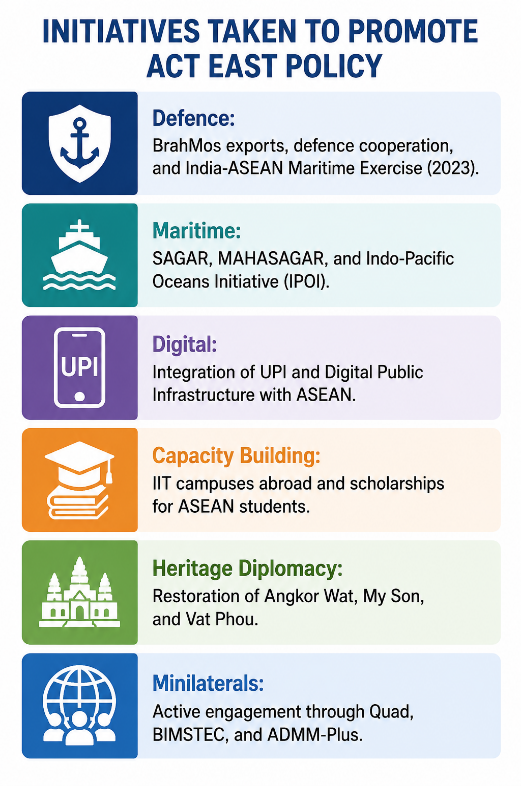
  • Announced in 2014 at the 12th ASEAN-India Summit, upgrading the 1991 Look East Policy.
  • Objective: Strengthen economic, strategic, and cultural ties with the Indo-Pacific through bilateral and multilateral engagement.
  • Approach: Integrates security, economic, and political dimensions.
  • Pillars: 4 Cs—Culture, Commerce, Connectivity & Capacity Building; emerging 5th C: Collaboration.

Significance of AEP

  • Strategic Balancing: It positions India as a potential balancer and net security provider in the region, safeguarding critical sea lines of communication. 
  • Economic: Deepens trade with ASEAN and cooperation in emerging technologies.
    • E.g., ASEAN accounts for around 11% of India's global trade.
  • Diplomatic: Upgraded ties with key ASEAN countries to Comprehensive Strategic Partnerships.
  • Cultural: Strengthens civilizational links through heritage diplomacy (e.g., Buddhist circuits, Ramayana trails), making India a key partner in cultural preservation. 

Challenges

  • Economic: Trade deficit with ASEAN, exit from Regional Comprehensive Economic Partnership (RCEP) talks, and persistent tariff/non-tariff barriers reduces its leverage in regional economic integration. 
  • Implementation & Connectivity Gaps: Delays in projects such as the India–Myanmar–Thailand Trilateral Highway due to inadequate infrastructure, geopolitical instability (Myanmar crisis) and weak inter-ministerial coordination.  
  • Geopolitical: Balancing Indo-Pacific partnerships while respecting ASEAN centrality, e.g., Quad diverges from ASEAN’s preference for non-alignment and strategic autonomy. 
  • Waning Soft Power: Indian cultural presence and cinema are losing ground to competitors like Korean entertainment. 

Watch Video News Today

Explore Related Content

Discover more articles, videos, and terms related to this topic

RELATED VIDEOS

3
Indo-Pacific and Its Relevance for India | Vishal Salsekar Sir

Indo-Pacific and Its Relevance for India | Vishal Salsekar Sir

YouTube HD
News Today (Feb 22, 2025)

News Today (Feb 22, 2025)

YouTube HD
Role of Indian Diaspora in Making India Self-Reliant

Role of Indian Diaspora in Making India Self-Reliant

YouTube HD

RELATED TERMS

3

ASEAN Centrality

The principle that emphasizes the central role of the Association of Southeast Asian Nations (ASEAN) in the regional architecture, particularly in managing security and economic cooperation in Southeast Asia and its surrounding regions.

Quad

The Quadrilateral Security Dialogue (Quad) is an informal strategic forum comprising Australia, India, Japan, and the United States. It aims to promote a free, open, and inclusive Indo-Pacific region and serves as a platform for cooperation on various issues, including security and maritime domain awareness.

Regional Comprehensive Economic Partnership (RCEP)

A proposed free trade agreement between the 10 ASEAN member states and their five dialogue partners: Australia, China, Japan, South Korea, and New Zealand. It aims to reduce tariffs and non-tariff barriers to trade among its member countries.

Title is required. Maximum 500 characters.

Search Notes

Filter Notes

Loading your notes...
Searching your notes...
Loading more notes...
You've reached the end of your notes

No notes yet

Create your first note to get started.

No notes found

Try adjusting your search criteria or clear the search.

Saving...
Saved

Please select a subject.

Referenced Articles

linked

No references added yet