


Since 2023, Japan has been releasing treated Fukushima wastewater containing tritium, a radioactive hydrogen isotope that is difficult to separate from water, into the Pacific Ocean.
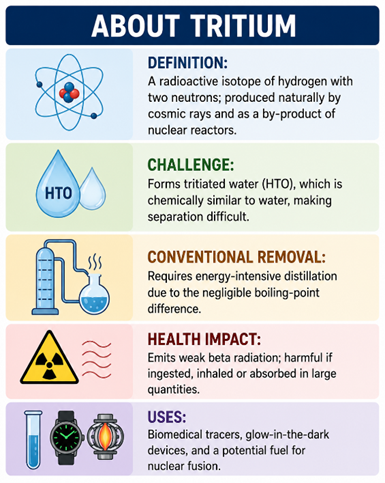
- Chinese researchers developed an MOF-based material that increases surface area 32 times and efficiently removes tritium by exchanging it with regular hydrogen.
- MOFs are materials in which metal ions are linked together by organic molecules in a regular repeating pattern to create a 3D network.
- MOFs are more absorbent and have large internal area, making them useful in storage applications like gas storage, filtration, or carbon capture.
About Radioactive Waste
- Definition: Radioactive by-product of nuclear power, medical, industrial and defence activities.
- Types: Low & Intermediate-Level Waste (LILW) and High-Level Waste (HLW).
- Disposal & Management
- Cooling & Storage: Spent fuel is cooled in spent fuel pools and later stored in dry casks.
- Recycling: Recover usable uranium/plutonium to reduce waste volume and radioactivity.
- Near-Surface Disposal: Used for LILW in engineered trenches, caverns or vaults.
- Deep Geological Disposal (GDF): Preferred permanent solution for HLW using multi-barrier systems in stable rock formations.
- Vitrification: Immobilizes HLW in borosilicate glass; India operates plants at Trombay, Tarapur and Kalpakkam.
- India’s Strategy (BARC): Follows Delay & Decay, Dilute & Disperse, Concentrate & Contain, Recycle & Reuse.
- Joint Convention on the Safety of Spent Fuel Management and on the Safety of Radioactive Waste Management (under the IAEA) is the primary international legal instrument ensuring safe waste management globally.
