


About LDES
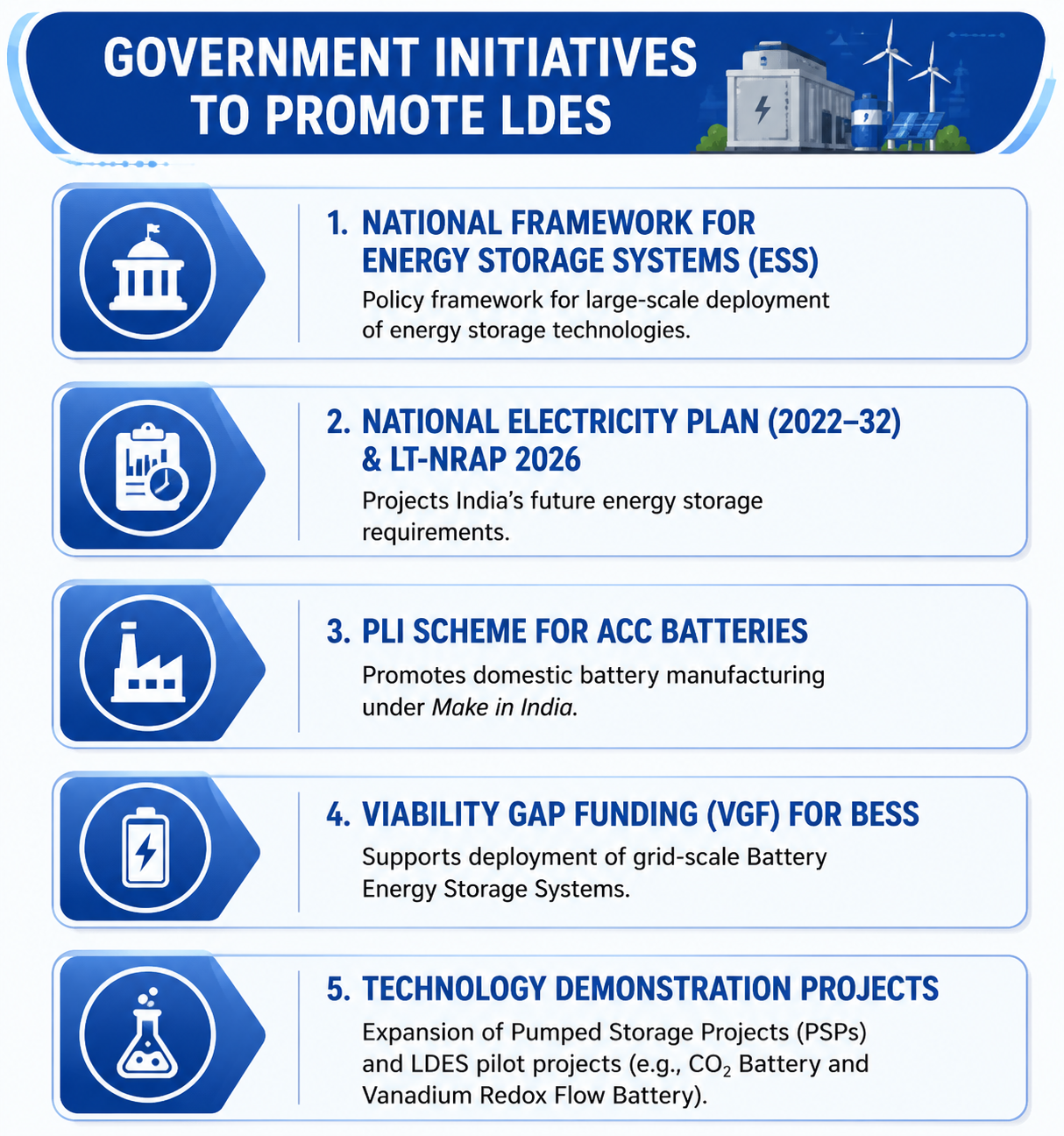
- LDES refers to technologies that store energy and discharge it as power or thermal energy for 8 hours or longer (up to days or seasons), unlike short-duration storage (<8 hours).
- It includes Pumped Hydroelectric Energy Storage, Compressed Air Energy Storage, hydrogen-based storage, flow batteries etc.
- LDES ensures grid remains reliable during prolonged periods of low solar and wind generation
- India will require 170–260 GW of LDES to achieve net-zero by 2070.
Challenges to LDES Deployment in India
- Renewable intermittency: Variable solar and wind generation creates supply-demand mismatch, and gird stability issues with rising renewable penetration.
- Policy gaps: Lack of a dedicated LDES policy, deployment targets, and market mechanisms to incentivise investment.
- High upfront costs and uncertain revenue streams hinder commercial viability.
Way Forward
- Dedicated Policy: Formulate National LDES Policy with clear regulatory and implementation framework, along with national LDES targets.
- Market mechanisms: Introduce Capacity Markets, Long-Term Energy Service Agreements, Cap-and-Floor framework, etc. to ensure commercial viability.
- Ease of deployment: Enable efficient grid pricing, streamline approvals, and single-window clearances.
- Innovation: Promote R&D, pilot projects, and integration of LDES with renewable energy, data centres, and green hydrogen.
- Adopt global best practices: Draw on successful LDES policy frameworks like UK's Cap-and-Floor mechanism and California's dedicated LDES deployment targets to accelerate investments and deployment in India.
