
Medium Range Ballistic Missile Agni-4 was successfully test fired | Current Affairs | Vision IAS

Upgrade to Premium Today

Start Now
MENU
Home
Quick Links

High-quality MCQs and Mains Answer Writing to sharpen skills and reinforce learning every day.

Watch explainer and thematic concept-building videos under initiatives like Deep Dive, Master Classes, etc., on important UPSC topics.

A short, intensive, and exam-focused programme, insights from the Economic Survey, Union Budget, and UPSC current affairs.

ESC

In Summary

  • Agni missile program evolved from a re-entry vehicle demonstrator into a family of ballistic missiles under India’s IGMDP.
  • The Agni family includes Agni-I (liquid-solid), Agni-II (2,500 km, solid), Agni-III (3,500 km), Agni-4 (4,000 km MRBM), and Agni-5 (ICBM with MIRV capability).
  • Ballistic missiles are rocket-powered initially, then follow a free-falling trajectory; classified by range: SRBM (<1,000 km), MRBM (1,000–3,000 km), IRBM (3,000–5,500 km), ICBM (>5,500 km).

In Summary

Test demonstrated the missile’s operational readiness and confirmed that all critical systems performed in line with expected parameters.

Agni Missiles 
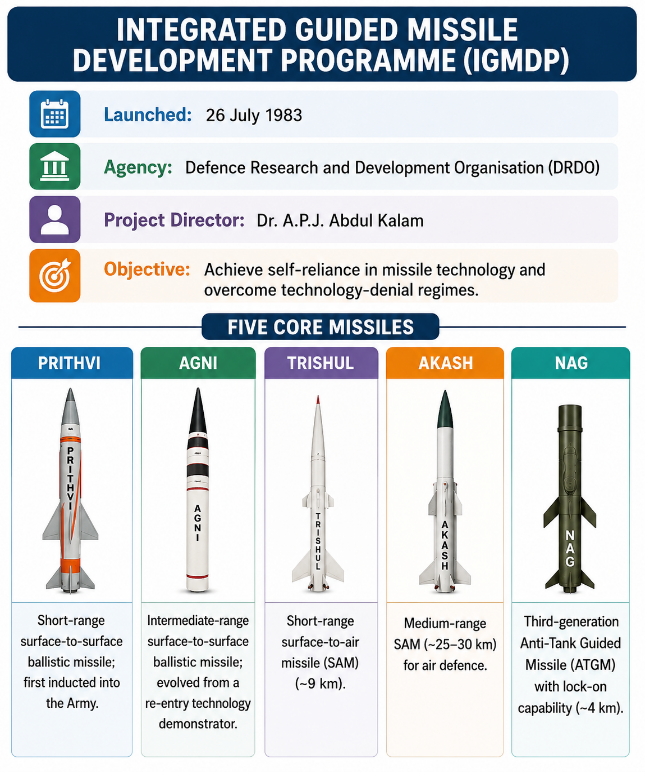
  • Agni Programme: Evolved from a re-entry vehicle technology demonstrator into a family of ballistic missiles with varying ranges under India’s Integrated Guided Missile Development Programme (IGMDP).
  • Agni-I:Two-stage liquid-solid propulsion missile; operationally limited by long deployment time and mobility constraints.
  • Agni-II: Two-stage, solid-propellant design with range of approximately 2,500 km.
  • Agni-III:3,500 km range, designed to strengthen India's strategic deterrence, especially against China.
  • Agni-4:Medium-Range Ballistic Missile (MRBM) under the Strategic Forces Command (SFC), enhancing India's credible minimum deterrence.
    • Range of approx. 4,000 km, can carry a 1,000 kg payload.
  • Agni-5: ICBM with solid fuel three stage propulsion design and equipped with MIRV (Multiple Independently Targetable Re-entry Vehicle) capability.

About Ballistic Missiles

  • Ballistic missiles are powered by rockets initially but then they follow an unpowered, free-falling trajectory toward their targets. 
  • Classification:
    • Short-Range Ballistic Missile (SRBM): Range below 1,000 km
    • Medium-Range Ballistic Missile (MRBM): Range 1,000–3,000 km
    • Intermediate-Range Ballistic Missile (IRBM): Range 3,000–5,500 km

Intercontinental Ballistic Missile (ICBM): Range above 5,500 km 

Watch Video News Today

Explore Related Content

Discover more articles, videos, and terms related to this topic

RELATED VIDEOS

1
News Today (Apr 05, 2024)

News Today (Apr 05, 2024)

YouTube HD

RELATED TERMS

3

Medium-Range Ballistic Missile (MRBM)

A classification of ballistic missiles with a range between 1,000 and 3,000 kilometers. Agni-4 is an example of an Indian MRBM.

Ballistic Missiles

Missiles that follow a ballistic trajectory to deliver warheads, typically involving a powered ascent phase followed by an unpowered ballistic flight path. Their trajectory is influenced by gravity and atmospheric resistance, making them distinct from cruise missiles.

MIRV (Multiple Independently Targetable Re-entry Vehicle)

A payload technology on ballistic missiles that allows a single missile to carry multiple nuclear warheads, each capable of being independently targeted at different locations. This enhances the missile's effectiveness and survivability.

Title is required. Maximum 500 characters.

Search Notes

Filter Notes

Loading your notes...
Searching your notes...
Loading more notes...
You've reached the end of your notes

No notes yet

Create your first note to get started.

No notes found

Try adjusting your search criteria or clear the search.

Saving...
Saved

Please select a subject.

Referenced Articles

linked

No references added yet
