


Released by Union Minister of Health & Family Welfare, it highlights India's potential to emerge as a global leader in responsible AI-enabled MedTech by leveraging its clinical diversity and manufacturing base.
About India’s MedTech Industry
- MedTech refers to clinical tools and digital health solutions, including medical devices, diagnostics, and AI-enabled software, used for patient care.
- Recognized as sunrise industry, and expected to grow to US$50 billion by 2030.
- Fourth largest medical devices market in Asia after Japan, China, and South Korea.
Role of AI in MedTech
- Decentralized Healthcare: AI-enabled diagnostic tools enable frontline workers (ASHA/ANM) to screen diseases like TB in rural areas.
- In India, there are 9.6 physicians per 10,000 people vs global average of 18.3.
- Reduces diagnostic turnaround from 24–72 hours to minutes.
- Risk Prediction: Uses machine learning for disease prediction and post-market surveillance.
- Improved Efficiency: Enables real-time analysis, automated detection, case prioritization, and clinical decision support, enhancing healthcare productivity.
Barriers for AI adoption in MedTech
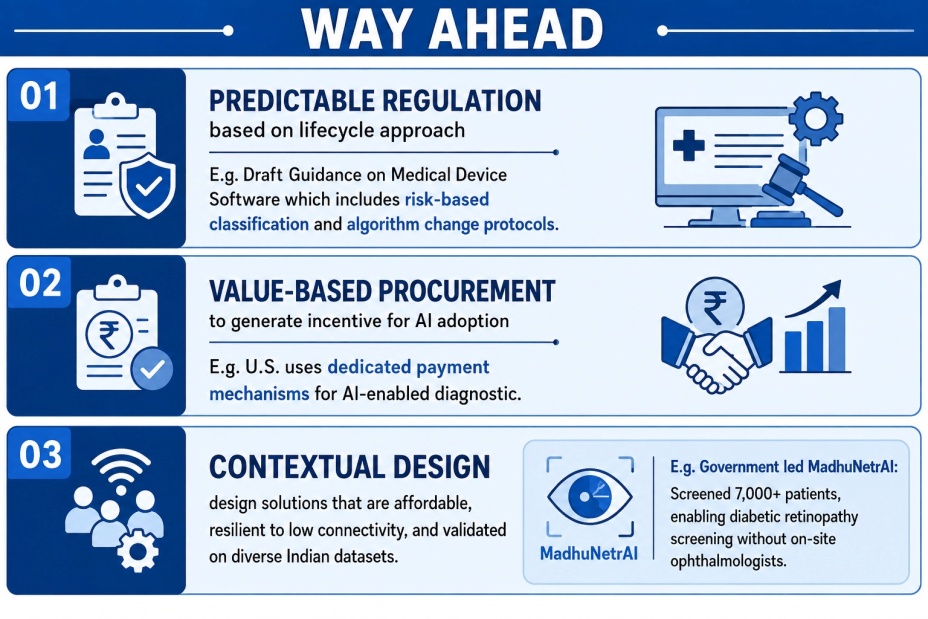
- Fragmented hospital data and lack of real-world evidence on Indian populations make it difficult to validate AI models for local use.
- Regulatory Gap: Rapid AI software updates outpace lengthy regulatory approvals, delaying deployment of improved algorithms.
Lack of incentives for AI adoption due to its high cost. E.g. Ayushman Bharat PM-JAY does not provide dedicated reimbursement for AI-enabled diagnostics


