
Landmark 300 GW Non-Fossil Fuel Power Capacity achieved by India | Current Affairs | Vision IAS

Upgrade to Premium Today

Start Now
MENU
Home
Quick Links

High-quality MCQs and Mains Answer Writing to sharpen skills and reinforce learning every day.

Watch explainer and thematic concept-building videos under initiatives like Deep Dive, Master Classes, etc., on important UPSC topics.

A short, intensive, and exam-focused programme, insights from the Economic Survey, Union Budget, and UPSC current affairs.

ESC

In Summary

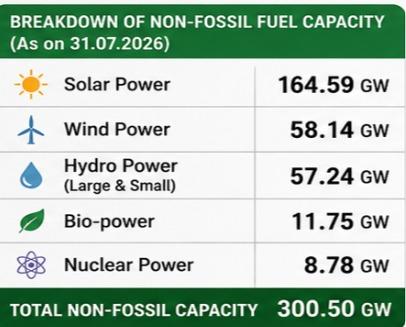
  • India's non-fossil energy capacity exceeded 300.50 GW by July 2026, surpassing 54% of total installed capacity.
  • Significant challenges include import dependency (90% solar cells, 98% polysilicon) and a storage deficit (less than 5 GW vs. 60 GW needed by 2030).
  • Government initiatives like PLI, PM-KUSUM, OWEP, and the National Green Hydrogen Mission aim to boost non-fossil energy adoption.

In Summary

Union Ministry of Power uses term “non-fossil energy”, which includes nuclear power along with renewable energy.

  • In March 2019, the Union government included large hydropower projects as renewable energy source. 
Key Achievements

  • Non-Fossil Capacity: Crossed 300.50 GW by 31 July 2026, constituting over 54% of total installed capacity.
  • 2025–26 Addition: Record 55.29 GW non-fossil capacity added, including 44.6 GW solar and 6 GW wind.
  • Wind Growth: Reached 58.14 GW (2026), up from 21 GW (2014).
  • Progress toward 2030 Goal: The country has already secured over 60% of its target to install 500 GW of non-fossil power capacity by 2030 (Nationally Determined Contributions (NDCs) under the Paris Agreement).

Persisting Challenges

  • Technological & Supply Chain Vulnerabilities: India remains heavily dependent imports (nearly 90% cells, 98% polysilicon/wafers) particularly from China.
  • Grid Integration & Storage Deficit: Intermittent solar/wind require storage for grid stability; India needs over 60 GW storage by 2030 but India currently has less than 5 GW.
  • Just Transition & Social Barriers: Coal-dependent states like Jharkhand and Chhattisgarh face major livelihood risks.

Government Initiatives

  • Solar Energy Schemes: PLI promotes domestic solar PV manufacturing, Solar Parks targets more than 50 parks more than 500 MW each), PM-KUSUM for the agricultural pumps, PM Surya Ghar promotes rooftop solar.
  • Wind Energy Initiatives: Offshore Wind Energy Policy (OWEP), Wind Bidding Scheme enables competitive e-bidding/inter-state transfer.
  • Green Hydrogen & Bioenergy: National Green Hydrogen Mission targets 5 MMT/year by 2030, GOBAR-Dhan convert organic waste into energy.


Watch Video News Today

Explore Related Content

Discover more articles, videos, and terms related to this topic

RELATED VIDEOS

2
Carbon Markets

Carbon Markets

YouTube HD
What is Artificial Rain? | Deep Dive With VisionIAS

What is Artificial Rain? | Deep Dive With VisionIAS

YouTube HD

RELATED TERMS

3

GOBAR-Dhan

An acronym for Galvanizing Organic Bio-Agro Resources Dhan, a scheme that promotes the conversion of organic waste into valuable resources like biogas and manure, contributing to rural sanitation and energy security.

National Green Hydrogen Mission

A flagship initiative by the Indian government to promote the production, use, and export of green hydrogen. It aims to make India a global hub for green hydrogen and reduce dependence on fossil fuel imports.

Offshore Wind Energy Policy (OWEP)

A policy framework designed to facilitate the development and deployment of wind turbines in offshore locations, harnessing the higher and more consistent wind speeds available at sea.

Title is required. Maximum 500 characters.

Search Notes

Filter Notes

Loading your notes...
Searching your notes...
Loading more notes...
You've reached the end of your notes

No notes yet

Create your first note to get started.

No notes found

Try adjusting your search criteria or clear the search.

Saving...
Saved

Please select a subject.

Referenced Articles

linked

No references added yet
