
India’s first Fast-Breeder Nuclear Reactor (500 MWe) set for commissioning by 2026 | Current Affairs | Vision IAS
MENU
Home

Periodically curated articles and updates on national and international developments relevant for UPSC Civil Services Examination.

Quick Links

High-quality MCQs and Mains Answer Writing to sharpen skills and reinforce learning every day.

Watch explainer and thematic concept-building videos under initiatives like Deep Dive, Master Classes, etc., on important UPSC topics.

ESC

Located at Kalpakkam in Tamil Nadu, this will mark the beginning of the second stage of India’s three-stage nuclear power programme.

About Fast Breeder Reactor

  • Genesis: In 2003, government established Bharatiya Nabhikiya Vidyut Nigam Limited (BHAVINI) to construct and operate Prototype Fast Breeder Reactor (PFBR)
    • Earlier first stage was implemented by Nuclear Power Corporation of India Limited (NPCIL).
  • Functioning: 
    • It uses indigenously produced Uranium-Plutonium Mixed Oxide (MOX) fuel and utilizes liquid sodium as a coolant.
    • Uranium-238 “blanket” surrounding fuel core will undergo nuclear transmutation to produce more fuel, thus earning the name ‘Breeder’.

Significance of FBR

  • Paves way for third stage: It also marks use of Thorium-232 (a non fissile material), which creates fissile Uranium-233 to be used as fuel in third stage.
  • Technological Advancement: India becomes second country after Russia with a commercial FBR.
  • Reduced Nuclear Waste: Uses spent fuel from Stage-I
  • Utilization of Thorium Reserve: Paves the way for the full utilization of India’s abundant thorium reserves.

India’s 3 stage Nuclear Power Programme:

  • Dr Homi J Bhabha (Father of India’s nuclear programme) devised a three-stage nuclear power programme in the 1950s to make the most of India's limited uranium reserves and abundant thorium reserves.
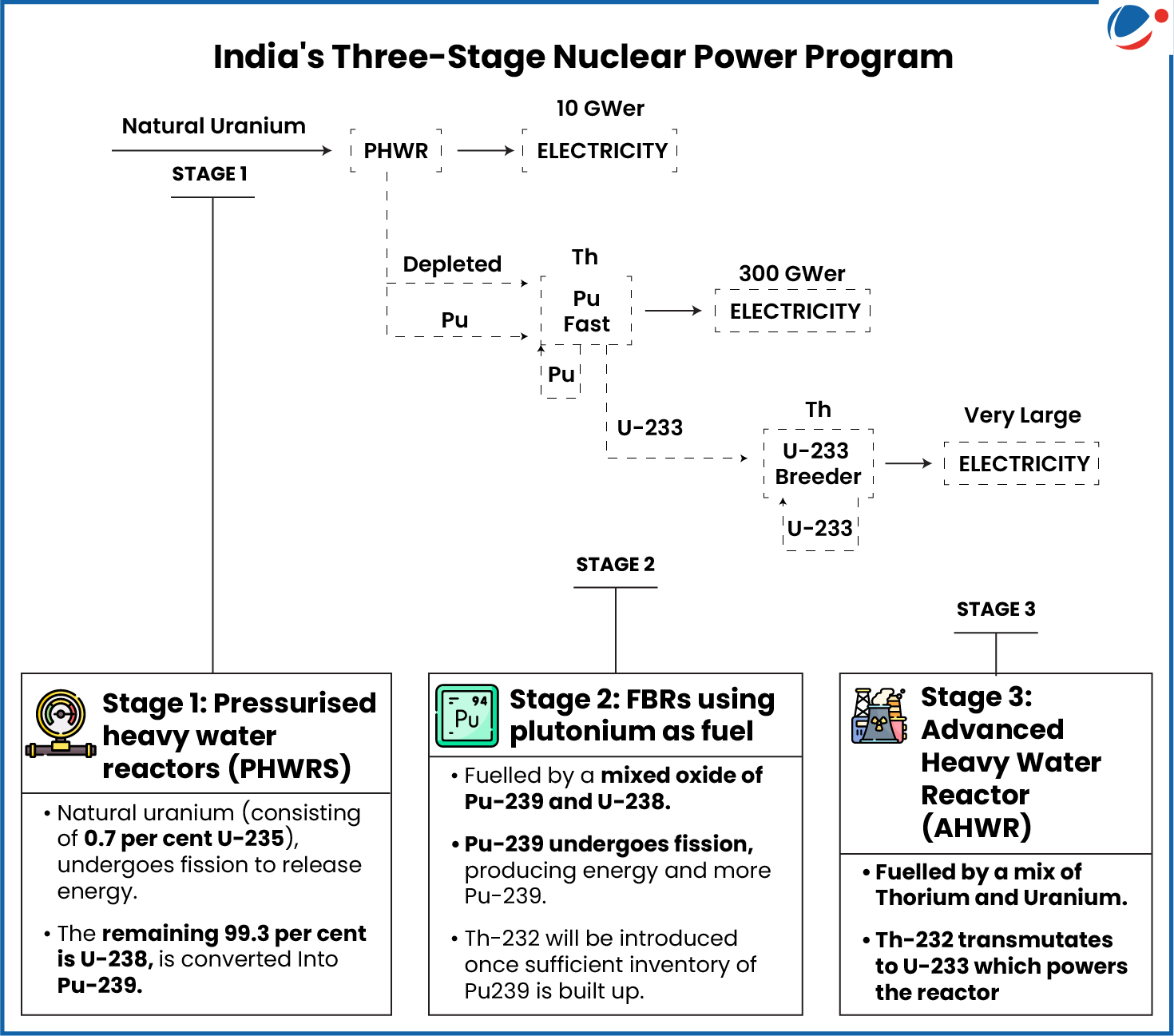
A flowchart titled "India's Three-Stage Nuclear Power Program" outlines the three stages of the nuclear energy cycle using natural uranium and thorium.  Stage 1: Pressurised Heavy Water Reactors (PHWRs)  Uses natural uranium (0.7% U-235 and 99.3% U-238).  U-235 undergoes fission to release energy.  U-238 is converted into plutonium-239 (Pu-239).  Generates 10 GWe of electricity.  Stage 2: Fast Breeder Reactors (FBRs) using plutonium as fuel  Uses a mixed oxide of Pu-239 and U-238.  Pu-239 undergoes fission, generating more Pu-239.  Thorium-232 (Th-232) is introduced once Pu-239 inventory is sufficient.  Produces uranium-233 (U-233).  Generates 300 GWe of electricity.  Stage 3: Advanced Heavy Water Reactor (AHWR)  Fuelled by a mix of thorium and uranium.  Th-232 transmutes into U-233.  U-233 powers the reactor.  Generates a very large amount of electricity.
Watch Video News Today

Explore Related Content

Discover more articles, videos, and terms related to this topic

RELATED VIDEOS

3
News Today (Mar 05, 2024)

News Today (Mar 05, 2024)

YouTube HD
News Today (Jul 31, 2024)

News Today (Jul 31, 2024)

YouTube HD
News Today (Apr 20-21, 2025)

News Today (Apr 20-21, 2025)

YouTube HD
Title is required. Maximum 500 characters.

Search Notes

Filter Notes

Loading your notes...
Searching your notes...
Loading more notes...
You've reached the end of your notes

No notes yet

Create your first note to get started.

No notes found

Try adjusting your search criteria or clear the search.

Saving...
Saved

Please select a subject.

Referenced Articles

linked

No references added yet
