Executive Committee (EC) of NMCG placed a strong emphasis on research-led river rejuvenation, approving major research projects aimed at strengthening scientific understanding and data-driven planning across the Ganga basin.
- Approved Scientific River Management Projects span critical areas—from Monitoring of Key Himalayan Ganga Headstream glaciers, Digital Twin development for the Ganga, and high-resolution SONAR-based riverbed surveys, to managed aquifer recharge via paleochannels and the creation of a historic geospatial river database.
River Basin Management
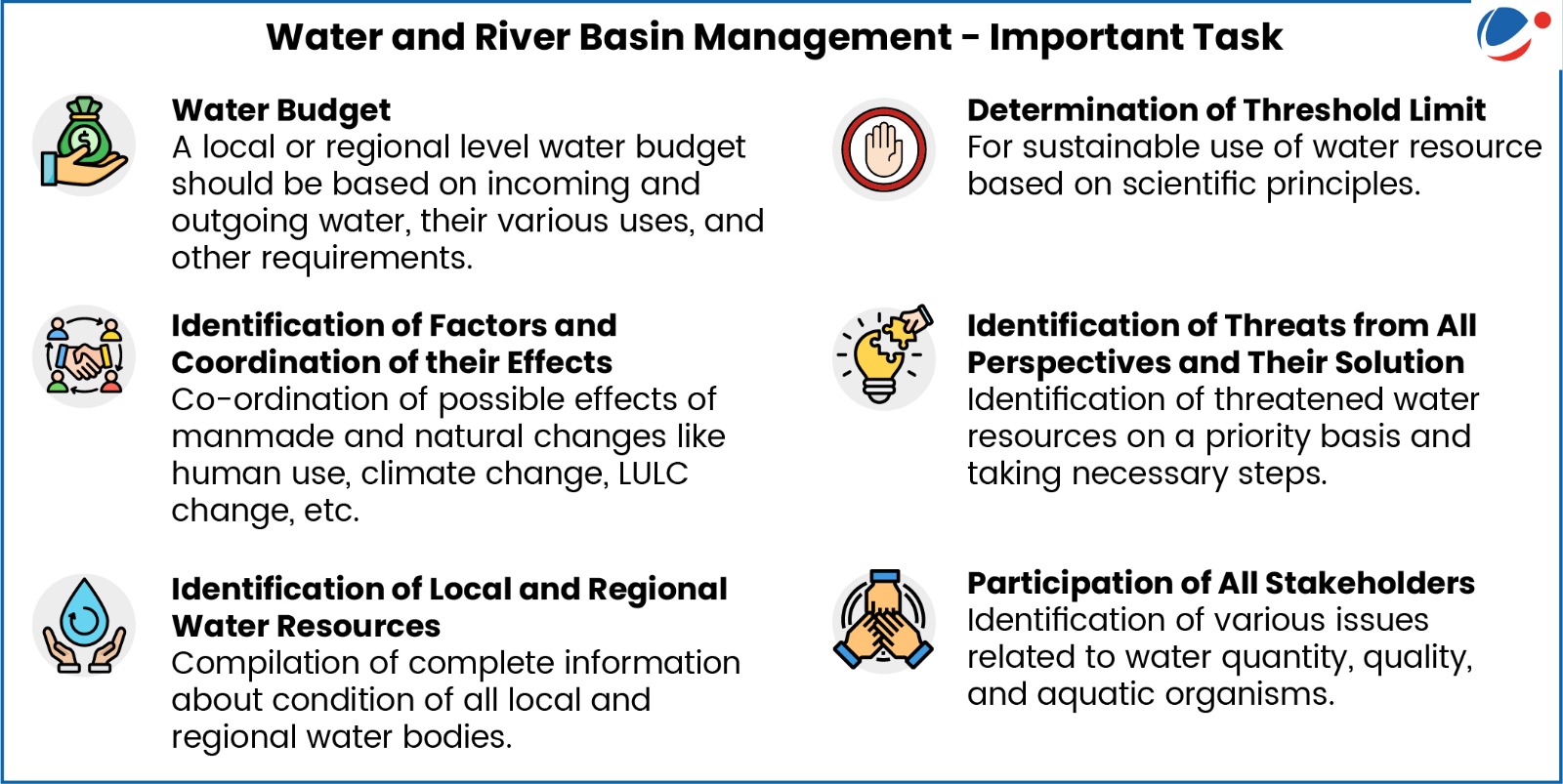
River Basin Management (RBM) refers to management of all natural and artificial structures and processes that are directly or indirectly connected to all water resources of the river basin. Key components include:
- Institutional Arrangement: Creation of necessary governance bodies such as National Ganga Council, NMCG, State Ganga Committees etc.
- Information System: Building a geospatial river database utilizing historical maps, high-resolution riverbed surveys, remote sensing satellite data etc.
- For instance, NMCG has approved creation of Geospatial River Database for Ganga River.
- Basin-wide Policies: Identification of protected areas, assessment of future water supply and demand, and implementing appropriate water conservation and recharge measures.
- Stakeholders: Mobilise all primary, secondary and tertiary stakeholders, including national agencies and local governments, civil society organisations and the rest of the private sector.
- Performance Indicators: Establish monitoring network analysing water quality, pollution levels, mapping ecological hazards, financial sustainability and institutional capacity etc.
- For instance, Digital Twin model for Ganga Basin will model the river management in real time.