
INSV Kaundinya begins journey to Oman | Current Affairs | Vision IAS
MENU
Home

Periodically curated articles and updates on national and international developments relevant for UPSC Civil Services Examination.

Quick Links

High-quality MCQs and Mains Answer Writing to sharpen skills and reinforce learning every day.

Watch explainer and thematic concept-building videos under initiatives like Deep Dive, Master Classes, etc., on important UPSC topics.

ESC

In Summary

  • INSV Kaundinya, a traditional stitched sailing vessel using the Tankai method, completed its maiden voyage to Oman.
  • Modeled on Ajanta cave paintings, it relies solely on wind power and features cultural symbols like Gandabherunda and sun motifs.
  • The Tankai method, dating to the 5th century CE, uses no metal, stitching planks with coir rope and natural resin for flexibility.

In Summary

The Navy’s pioneering stitched sailing vessel built using traditional techniques (Tankai method), believed to date back to the 5th century CE has undertaken her maiden overseas voyage to Oman.

  • The ship is named after Kaundinya, a legendary Indian mariner associated with voyages from India to Southeast Asia.

About INSV Kaundinya

  • It is modeled primarily on ships depicted in the Ajanta cave paintings (cave no 17) as no original blueprints survive for such vessels.
  • It has been built under a tripartite agreement project (2023) between Ministry of Culture, Indian Navy and Hodi Innovations (funded by the Ministry of Culture).
  • Unlike modern naval vessels, Kaundinya has no engine, relying entirely on wind power through sails.
  • Nature and Purpose of the Vessel: Although owned and operated by the Indian Navy, It is not a combat ship. 

Tankai method 

  • It is a traditional Indian shipbuilding technique characterized by: no metal use, stitched wooden planks instead of nails, coir rope, coconut fibre, and natural resin as fastening and sealing material.
    • In this method the hull is stitched first, internal ribs are added later, which gives the ship high structural flexibility, enabling it to absorb powerful ocean waves instead of cracking under pressure.
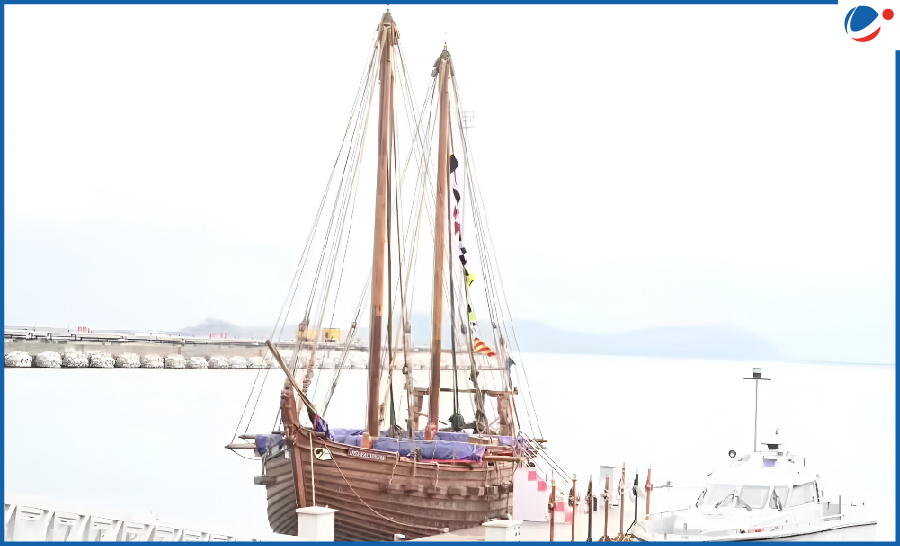
Cultural Symbols on INSV Kaundinya

  • Gandabherunda: A two-headed eagle associated with the Kadamba dynasty, symbolizing power and protection.
  • Sun motifs on sails: Representing vitality, divinity, navigation, and auspicious beginnings.
  • Simha Yali on the bow: A mythical lion-like creature symbolizing strength and guardianship over the ship.
  • Harappan-style stone anchor on deck: A tribute to Indus Valley maritime trade networks and early anchoring technology.
Watch Video News Today

Explore Related Content

Discover more articles, videos, and terms related to this topic

RELATED VIDEOS

1
News Today (Dec 19, 2025)

News Today (Dec 19, 2025)

YouTube HD

RELATED TERMS

3

Harappan-style stone anchor

An anchor made of stone, resembling those used in the Indus Valley Civilization. Its presence on INSV Kaundinya is a tribute to ancient Indian maritime trade and early anchoring technologies.

Simha Yali

A mythical lion-like creature depicted on the bow of INSV Kaundinya. It symbolizes strength and acts as a guardian for the ship, echoing traditional protective motifs in maritime art and culture.

Gandabherunda

A mythical two-headed eagle, a symbol associated with the Kadamba dynasty, prominently featured on INSV Kaundinya. It represents power and protection, reflecting historical maritime symbolism.

Title is required. Maximum 500 characters.

Search Notes

Filter Notes

Loading your notes...
Searching your notes...
Loading more notes...
You've reached the end of your notes

No notes yet

Create your first note to get started.

No notes found

Try adjusting your search criteria or clear the search.

Saving...
Saved

Please select a subject.

Referenced Articles

linked

No references added yet

Subscribe for Premium Features