
CAG releases ‘State Finances 2023-24’ Report | Current Affairs | Vision IAS
MENU
Home

Periodically curated articles and updates on national and international developments relevant for UPSC Civil Services Examination.

Quick Links

High-quality MCQs and Mains Answer Writing to sharpen skills and reinforce learning every day.

Watch explainer and thematic concept-building videos under initiatives like Deep Dive, Master Classes, etc., on important UPSC topics.

ESC

In Summary

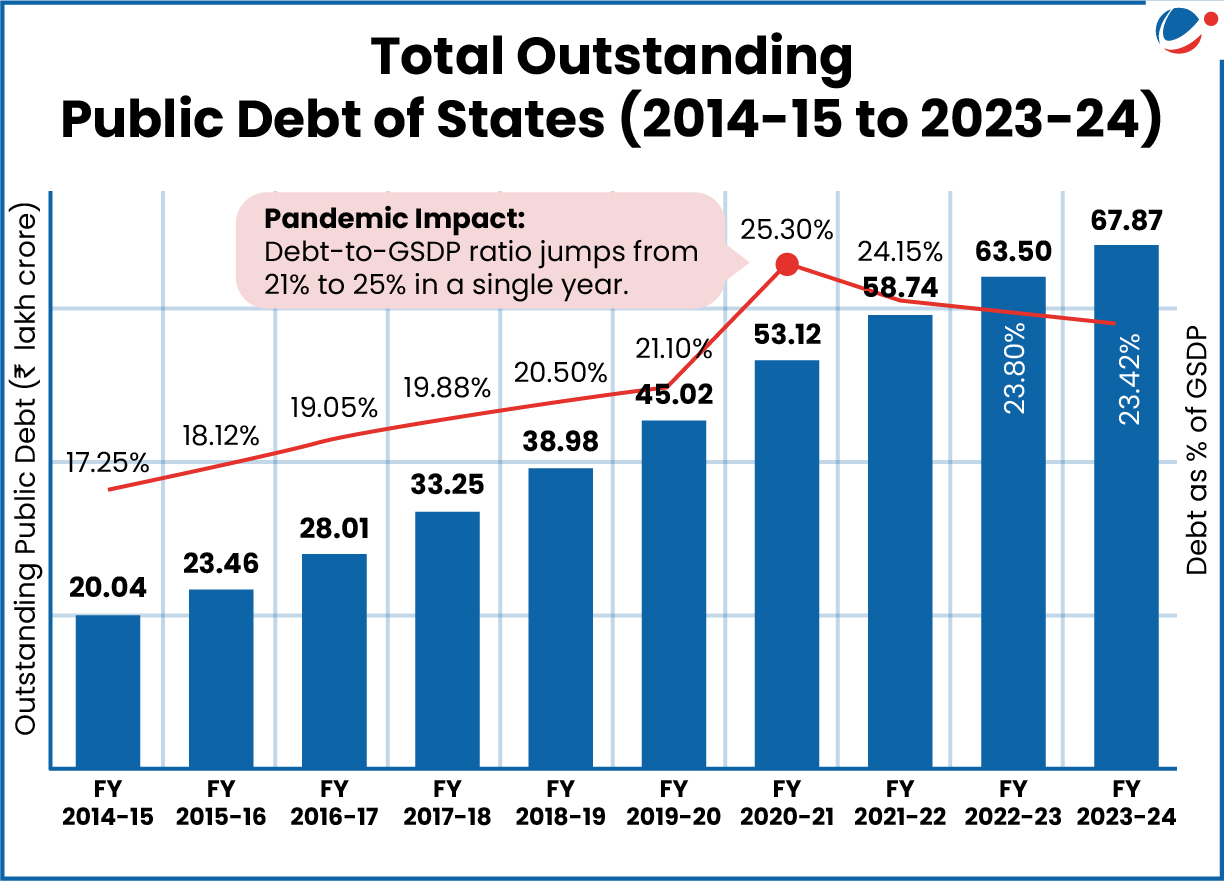
  • States' public debt reached ₹67.87 lakh crore (~23% of GSDP) by March 31, 2024, with 18 states exceeding the 3.0% fiscal deficit benchmark.
  • Extreme fiscal rigidity is evident as committed expenditure consumes ~60% of revenue, and states increasingly rely on Union tax devolution (~30% in FY24).
  • Low capital expenditure (~16%) and transparency gaps like 'shadow budgeting' are highlighted, prompting CAG to mandate harmonized object heads by FY 2027-28.

In Summary

It is the 2nd edition which presents an overview of the finances of all 28 States in FY 2023-24.

  • The first edition of the report, ‘State Finances 2022-23’ was released in September 2025.
Key Highlights of Report

  • Public Debt of States₹67.87 lakh crore (~23% of GSDP) as of March 31, 2024.
  • Fiscal Deficit: 18 states exceeded the 3.0% of GSDP benchmark recommended by the 15th Finance Commission for FY 2023-24.
    • Extreme Fiscal Rigidity: lack of "fiscal space" for new development as committed expenditure (salaries, pensions, interest, etc.) consume ~60% of total revenue expenditure.
  • Reliance on the Union Tax Devolution: rising from ~21% (2014-15) to ~30% (2023-24) for revenue.
    • This makes State budgets highly vulnerable to national economic fluctuations.
  • Low Capital Expenditure: Revenue expenditure (maintenance and salaries) continues to dominate at ~83%, while Capital Expenditure (Capex) is only ~16%, as states are prioritizing immediate consumption over long-term investment
    • In several states, like Punjab and Andhra Pradesh, debt is being used to pay for daily expenses rather than building assets.
  • Transparency Gaps: The "Shadow Budgeting" problem in form of administrative practices, such as misclassification, is obscuring the true state of finances.

CAG’s Recommendation

To address persistent lack of uniformity in how states classify spending, the CAG has mandated the harmonisation of Object Heads across the Union and States to be adopted by FY 2027-28.

Watch Video News Today

Explore Related Content

Discover more articles, videos, and terms related to this topic

RELATED VIDEOS

1
Lateral Entry

Lateral Entry

YouTube HD

RELATED TERMS

3

Object Heads

Specific categories or classifications used to record government expenditures, ensuring uniformity and transparency in financial reporting. Harmonization aims to standardize these across different government levels.

CAG

Comptroller and Auditor General of India is a constitutional authority responsible for auditing the accounts of the Union and State governments. CAG reports highlight financial irregularities, inefficiencies, and policy deviations, making them crucial for governance analysis in UPSC.

Shadow Budgeting

A practice where government finances are obscured or misrepresented through administrative means, such as misclassifying expenses, to hide the true extent of deficits or liabilities.

Title is required. Maximum 500 characters.

Search Notes

Filter Notes

Loading your notes...
Searching your notes...
Loading more notes...
You've reached the end of your notes

No notes yet

Create your first note to get started.

No notes found

Try adjusting your search criteria or clear the search.

Saving...
Saved

Please select a subject.

Referenced Articles

linked

No references added yet
