
NITI Aayog Releases Reports on Green Transition in Cement, Aluminium and MSME Sectors | Current Affairs | Vision IAS
MENU
Home
Quick Links

High-quality MCQs and Mains Answer Writing to sharpen skills and reinforce learning every day.

Watch explainer and thematic concept-building videos under initiatives like Deep Dive, Master Classes, etc., on important UPSC topics.

ESC

In Summary

  • Reports detail decarbonisation roadmaps for cement, aluminum, and MSME sectors, crucial for India's climate goals.
  • India aims to reduce GDP emissions intensity by 45% by 2030 and achieve net-zero by 2070.
  • Decarbonising these sectors mitigates export risks from trade regulations like the EU's CBAM.

In Summary

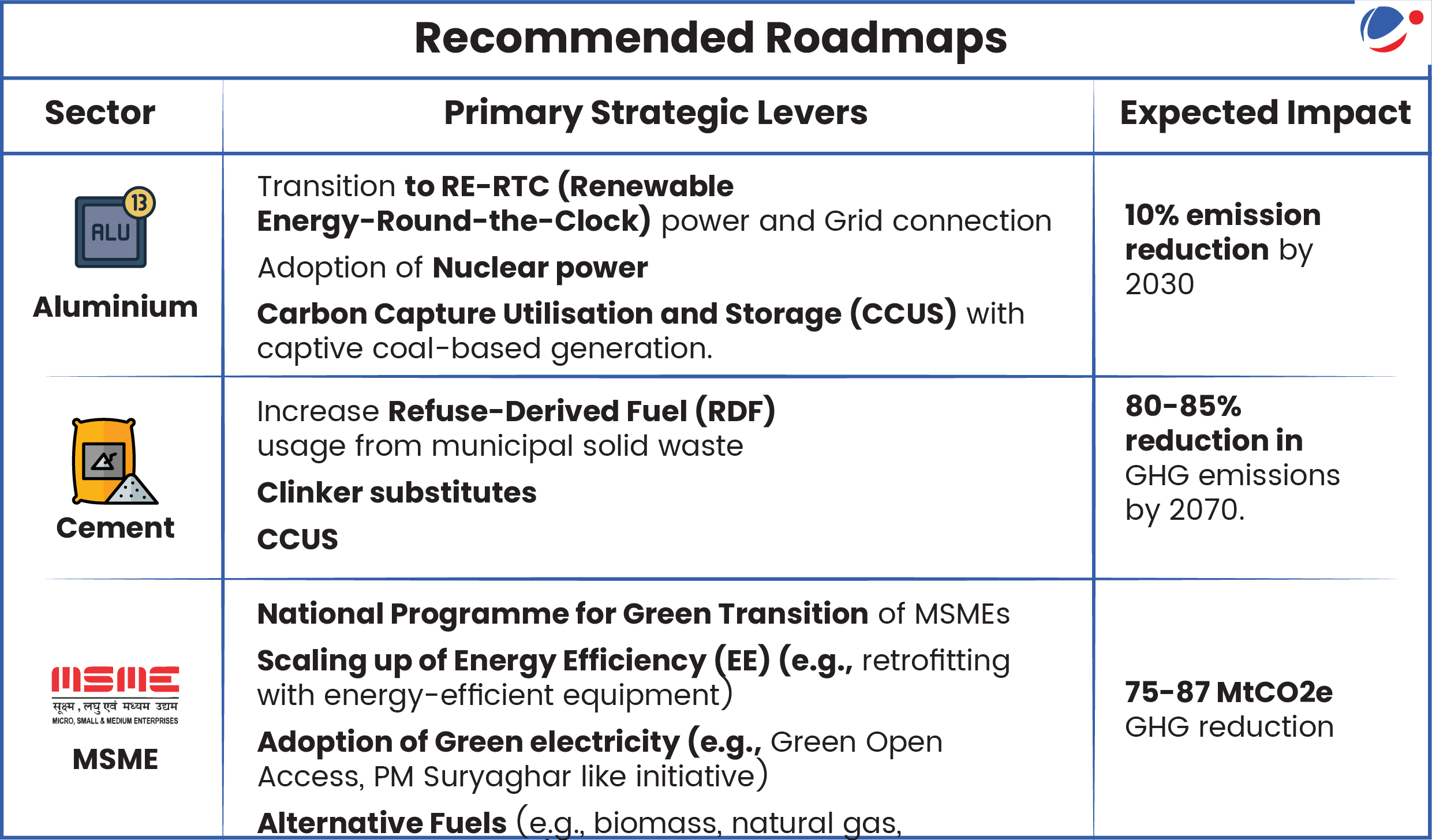
Reports outline decarbonisation roadmaps for the cement, aluminum and MSME sectors.

About Decarbonisation

  • It refers to the process of reducing or eliminating carbon dioxide (CO₂) emissions from an economy or specific sectors.
  • India’s Key Targets
    • Nationally Determined Contributions: Reduce emissions intensity of GDP by 45% by 2030 (from 2005 levels).
    • Panchamrita: Net zero greenhouse gas (GHG) emissions by 2070.

Significance of Decarbonizing these sectors

  • Contribution to India’s total GHG emissions
    • Cement sector: ~6% 
    • Aluminium sector: ~2.8 %
  • MSMEs rely heavily on fossil fuels to meet their energy and process requirements.
    • Contributed ~135 million tonnes of carbon emissions (MtCO2e) in 2022.
  • Mitigate export risks from emerging trade regulations, i.e. the EU’s CBAM.
Watch Video News Today

Explore Related Content

Discover more articles, videos, and terms related to this topic

RELATED VIDEOS

3
The Contribution of Indian Cinema to the Creative Economy

The Contribution of Indian Cinema to the Creative Economy

YouTube HD
Impact Investments

Impact Investments

YouTube HD
Universal and Meaningful Connectivity

Universal and Meaningful Connectivity

YouTube HD

RELATED TERMS

3

MtCO2e

Million tonnes of carbon dioxide equivalent. A unit used to measure greenhouse gas emissions, where different gases are converted into an equivalent amount of CO₂ based on their global warming potential.

CBAM

Carbon Border Adjustment Mechanism. An EU regulation designed to put a carbon price on imports of certain goods into the EU, aiming to prevent carbon leakage and encourage cleaner production globally. It can pose export risks for countries with less stringent climate policies.

MSME

सूक्ष्म, लघु और मध्यम उद्यम (Micro, Small and Medium Enterprises) भारतीय अर्थव्यवस्था का एक महत्वपूर्ण हिस्सा हैं। निर्यात संवर्धन में इनकी भूमिका महत्वपूर्ण है, और उन्हें अंतर्राष्ट्रीय व्यापार में भाग लेने और प्रक्रियाओं को समझने में सहायता की आवश्यकता होती है।

Title is required. Maximum 500 characters.

Search Notes

Filter Notes

Loading your notes...
Searching your notes...
Loading more notes...
You've reached the end of your notes

No notes yet

Create your first note to get started.

No notes found

Try adjusting your search criteria or clear the search.

Saving...
Saved

Please select a subject.

Referenced Articles

linked

No references added yet
