


This second phase, developed by NITI Aayog is based on ‘Asset Monetisation Plan 2025-30’ announced in Union Budget 2025-26.
- Asset monetisation involves leveraging existing or under-utilised infrastructure assets to generate revenue, without additional fiscal pressure on Government.
Key Highlights of NMP 2.0
- Purpose: Offers medium-term roadmap for public asset owners; along with visibility on potential assets to private sector.
- Aggregate Monetisation Potential: Estimated at ₹16.72 lakh crore (including private sector investment of ₹5.8 lakh crore) belonging to 12 sectors, during 5 years (FY26-FY30).
- Sectors: Highways (including MMLPs, ropeways) (26%), power (17%), railways (16%), ports (16%), petroleum and natural gas, civil aviation, warehousing and storage, urban infrastructure, coal, mines, telecom and tourism.
- Proceeds Under NMP 2.0: Largest portion is accrued to Consolidated Fund of India, followed by direct investment (private), PSU or Port Authority allocation and State Consolidated Fund.
- Guiding Principles for Considering Assets for Monetisation:
- Core Vs non-core assets: In line with NMP 1.0, NMP 2.0 focuses on core assets (central to service objectives of Government) only.
- Monetisation of non-core assets (land, building, pure play real estate assets), has been included where project envisages further development on these assets.
- Investment by private sector in PPP projects: Models like Design-Build-Finance-Operate-Transfer (DBFOT) has been considered.
- Core Vs non-core assets: In line with NMP 1.0, NMP 2.0 focuses on core assets (central to service objectives of Government) only.
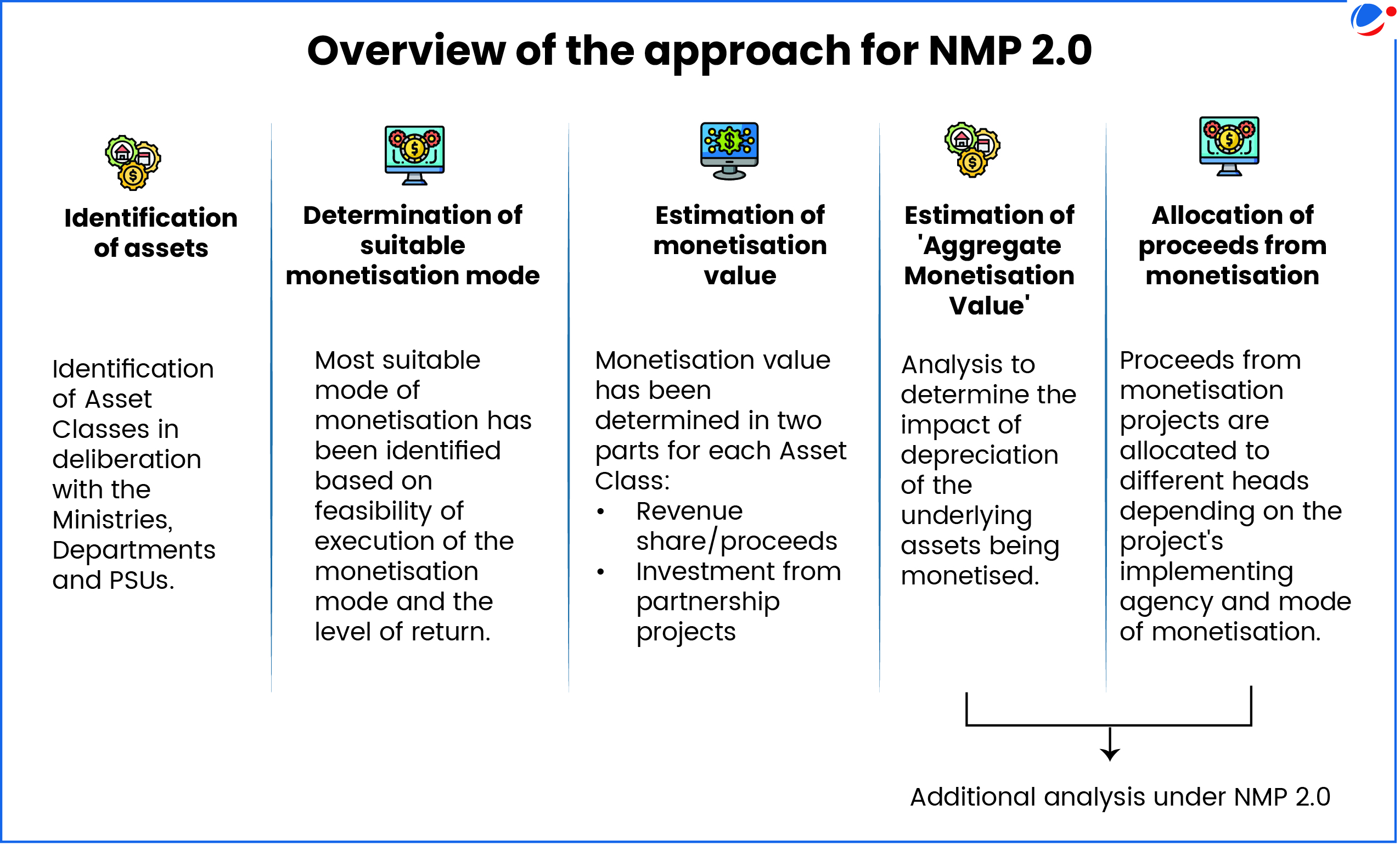
- Stages of Asset Monetisation: Approach towards estimation of monetisation potential is divided into five stages (See infographic):
About NMP 1.0
|



