


A study found that the explosive rise of satellites launched into space since 2019 is causing potent, long-lasting black carbon or soot pollution in the upper atmosphere.
- Black carbon is a component of fine particulate air pollution (PM2.5). It is formed by incomplete combustion of wood, waste and fossil fuels.
Impact on the atmosphere
- Deposition of soot particles is reducing the amount of sunlight (acting like a form of geo-engineering) reaching the Earth’s surface.
- The soot lingers in the upper layers of the atmosphere longer than soot from earthbound sources resulting in a 500-fold greater impact on the climate.
- Satellite launches can also release chemicals such as chlorine into the atmosphere that can degrade ozone by reacting directly with it.
Article Sources
1 sourceIndia’s first satellite-tagged Indian soft-shell turtle has been released in Kaziranga National Park.
About Indian Soft-shell Turtle
- It is also known as the Ganges Softshell turtle.
- Characteristics:
- Found in freshwater habitats
- Distinguished by its prominent, tube-like snout and flattened shell.
- Differentiated from other riverine turtles by its distinct arrowhead-shaped markings on the top of the head.
- Distribution and Range: Found throughout the northern plains of the Indian Subcontinent, in the Indus, Ganga, Narmada, Mahanadi basins and Brahmaputra basin.
- It is also found in countries like Bangladesh, Nepal, and Pakistan
- Conservation Status:
- WPA, 1972: Schedule I
- CITES: Appendix I
- IUCN: Endangered
Article Sources
1 sourceThe Madhya Pradesh High Court recently declared the disputed Bhojshala complex a Hindu temple, quashing a 2003 Archaeological Survey of India order.
About Bhojshala
- Origins: Established by Parmara King Raja Bhoja in 11th-century Dhar, Madhya Pradesh.
- It was turned into the Kamal Maula Mosque by the subsequent Muslim rulers of Dhara.
- Temple of Goddess Vagdevi Saraswati (idol now in the British Museum, London)
- Key Features:
- Served as a premier college and centre of Sanskrit learning.
- Engraved slabs contain two odes to the Kurmavtara or crocodile incarnation of Vishnu written in Prakrit, classical poetry etc.
- Two sarpabandha pillar inscriptions detailing Sanskrit grammar.
Article Sources
1 sourceA canopy bridge was constructed bypassing railway track in Assam's Hollongapar Gibbon Sanctuary for Western Hoolock Gibbon.
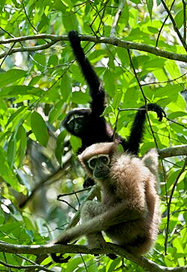
About Western Hoolock Gibbon (Hoolock hoolock)
- It is the only ape species native to India.
- Found in: India (between south of the Brahmaputra river and east of the Dibang river in the northeastern states); Bangladesh and Myanmar.
- Habitat: Tropical evergreen rainforests, semi-evergreen forests, tropical mixed deciduous forests, and subtropical broadleaf hill forests.
- They swing from tree to tree in a mode of locomotion known as Brachiation.
- Threats: Hunting, logging, Mining & quarrying etc.
- Conservation Status: Endangered (IUCN), Schedule 1 of WPA 1972
- Eastern hoolock gibbon is listed as Vulnerable.
In context of worker protests in Noida, Supreme Court highlighted State’s obligation to provide a “living wage” to workers, in accordance with the Constitution’s Directive Principles of State Policy (DPSP).
- Article 43 (DPSP) mandates that the State shall endeavor to secure a "living wage" and a decent standard of life for all workers.
About Living Wages
- A living wage, or living income, is the remuneration received for a standard workweek that is sufficient to afford a decent standard of living for a worker and their family.
- Often, the living wage is higher than the minimum wage.
- Minimum wages are the lowest legally mandated remuneration that employers must pay their workers.
Iran's Foreign Minister highlighted Chabahar Port as a key India-Iran cooperation symbol, calling it a golden gate to Central Asia.
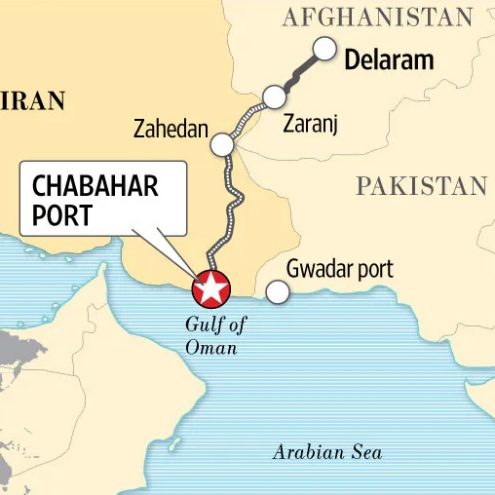
- In 2018, an Indian company, India Ports Global Limited (IPGL) took over the operations of Chabahar Port.
- In 2024, a 10-year contract was signed for operating the Shahid Beheshti Terminal of Chabahar Port.
About Chabahar Port
- Location: Sistan and Baluchestan province on the Makran coast in South-eastern Iran, on the Gulf of Oman.
- Two terminals: Shahid Kalantari and Shahid Beheshti.
- It is the only Iranian port with the direct access to the Indian Ocean.
- It is a key component of the International North-South Transport Corridor (INSTC), enhancing trade between India, Central Asia, and Russia.
Union Minister inaugurated new Manufacturing facilities in Rajasthan.
About the Facilities
- India’s first Small and Medium Enterprise (SME)-led Semiconductor facility at Bhiwadi, Rajasthan.
- ATMP (Assembly, Testing, Marking, and Packaging) and OSAT (Outsourced Semiconductor Assembly and Testing) facility.
- Developed under MeitY’s Scheme for Promotion of Manufacturing of Electronic Components and Semiconductors (SPECS)
- SPECS scheme provides 25% financial incentive on capital expenditure for targeted electronic goods.
- The sunset date for applications under SPECS was 31 March 2024.
- ELCINA Electronics Manufacturing Cluster (EMC) at Salarpur.
- EMC Scheme provides financial assistance for building infrastructure to attract global investments and boost domestic electronics manufacturing.
Article Sources
1 sourceTripura became the first state to complete all priority areas under Deregulation Phase-II of the National Compliance Reduction and Deregulation initiative.
- Deregulation is reduction or elimination of government oversight of an industry.
About National Compliance Reduction and Deregulation initiative
- Genesis:Task Force on Compliance Reduction and Deregulation was constituted in 2025 under the chairmanship of the Cabinet Secretary.
- Objective:Identifying redundant or outdated compliances and recommending their rationalisation; guiding states in amending laws and procedures to align with principles of minimal regulation.
- The Task Force identified 23 Priority Areas across 5 broad sectors.
- Phase II was rolled out in January 2026 to cover priority areas, including land, building and construction, utilities and permissions, environment, education, health, labour, and overarching reform.

